Solar battery prices are quoted per kilowatt-hour, but two quotes for the same nominal capacity routinely differ by a third or more. The gap almost never comes from margin. It comes from four things not being equal: whether the price is per nominal or usable kWh, what is inside the scope of supply, which trade term the price sits on, and which certification set the product carries.
Normalise those four and the quotes become comparable. Skip them and you are comparing numbers that describe different products.
How Solar Battery Prices Are Actually Quoted
Before looking at any number, establish what the number means. Four questions settle it.
- Nominal or usable kWh? A price per nominal kWh on a system with an 80 % usable window is roughly 25 % higher than it looks when restated per usable kWh. Always restate to usable.
- Cell, pack, or system? A cell price, a finished pack price and a system price including the inverter and gateway are three different products. Suppliers are not always explicit about which one they quoted.
- Which trade term? EXW, FOB, CIF and DDP can differ by a wide margin on lithium batteries, because they ship as dangerous goods and freight is not a small line item.
- Which market’s certification? A system certified for several markets carries the cost of those certificates. A cheaper product may simply be certified for fewer places — which is fine until it is the wrong place.
Anyone asking how much is a solar battery should get these four answers before a price, because a price without them is not information.
The Cost Structure of a Home Battery System
The table below gives the structure of an installed residential system. Shares are what matters here: they show which lines are worth negotiating and which are fixed by the site.
| Cost line | Share of installed cost | Negotiable? | What moves it |
|---|---|---|---|
| Battery modules | 40–55% | Yes, with volume | Usable kWh, cell grade and origin, cycle warranty |
| Inverter / PCS | 15–25% | Partly | Continuous kW, surge rating, hybrid vs AC-coupled |
| Enclosure, gateway, DC protection | 8–15% | Partly | Indoor vs outdoor rating, backup scope |
| Installation labour | [待业务填入]% | Locally | Local rates, mounting surface, distance to panel |
| Electrical work and permits | 10–20% | No | Panel age, spare breaker space, jurisdiction |
| Freight and duty | Varies by trade term | Yes, via term | DG classification, volume, destination tariffs |
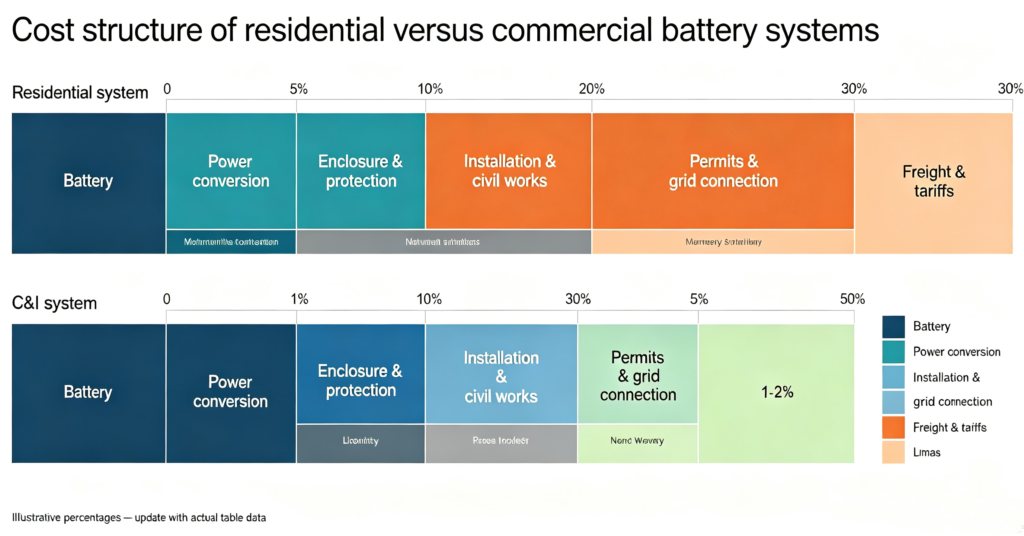
Two observations from this structure. The battery is roughly half the installed cost, which is why a 10 % discount on modules moves the total by only about five points. And the two lines that are genuinely not negotiable — electrical work and permits — are the ones buyers most often leave out of their budget.
The Cost Structure of a Commercial System
At C&I scale the proportions shift, mostly because the power conversion and the site work grow.
| Cost line | Share of installed cost | Notes |
|---|---|---|
| Battery racks / cabinets | 35~45% | Liquid vs air cooling changes this line materially |
| PCS and transformer | 18~25% | Often excluded from equipment quotes — confirm |
| EMS, metering, communications | Low single digits to ~8% | Cheap line, high impact on realised revenue |
| Civil works and foundation | Site-dependent, can be substantial | The line that most often breaks a budget late |
| Interconnection and studies | Utility-dependent | Cost and schedule both set externally |
| Commissioning, O&M, spares | Recurring, not CAPEX | Belongs in lifetime cost, not the purchase price |
For project buyers, comparing equipment price per kWh across C&I quotes is close to meaningless unless the scope is identical. The useful comparison is levelised cost of storage: total lifetime cost divided by total warranted energy throughput. It penalises a cheap system with a short cycle warranty in a way that a purchase price does not. Our C&I buyer’s guide covers how the revenue model changes what you should be willing to pay for.
Six Factors That Move the Price
- Usable capacity and depth of discharge. The single largest driver, and the one most often misstated in comparisons.
- Cell grade, manufacturer and batch consistency. Ask whether one system uses cells from a single production batch. It affects both price and long-term behaviour.
- Cycle warranty and capacity retention. A 6000-cycle warranty and a 3000-cycle warranty are different products at the same nominal capacity.
- Certification set and target market. Each additional market’s certification adds cost and lead time.
- Order quantity and configuration mix. Volume moves the module line; a mixed configuration order does not get the same step as a single SKU. Typical MOQ and price steps: .
- Trade term, freight and duty. Lithium cells ship as dangerous goods; destination tariffs and DG surcharges can exceed the discount being negotiated on the modules.
What a Notably Cheap Quote Usually Means
Low quotes are not automatically suspect. But in this category they usually resolve to one of a small number of explanations, and it is worth knowing which one applies before deciding.
Most often the price is per nominal kWh rather than usable. Sometimes the PCS, gateway or DC protection is outside the scope. Sometimes the cells are B-grade, which is legitimate if disclosed and a problem if not. Sometimes the certification covers a different market than the one the goods are going to. And occasionally the warranty is year-based with no capacity-retention commitment, which means it guarantees the product exists rather than that it still performs.
None of these makes a supplier dishonest. All of them make a quote incomparable until they are surfaced.
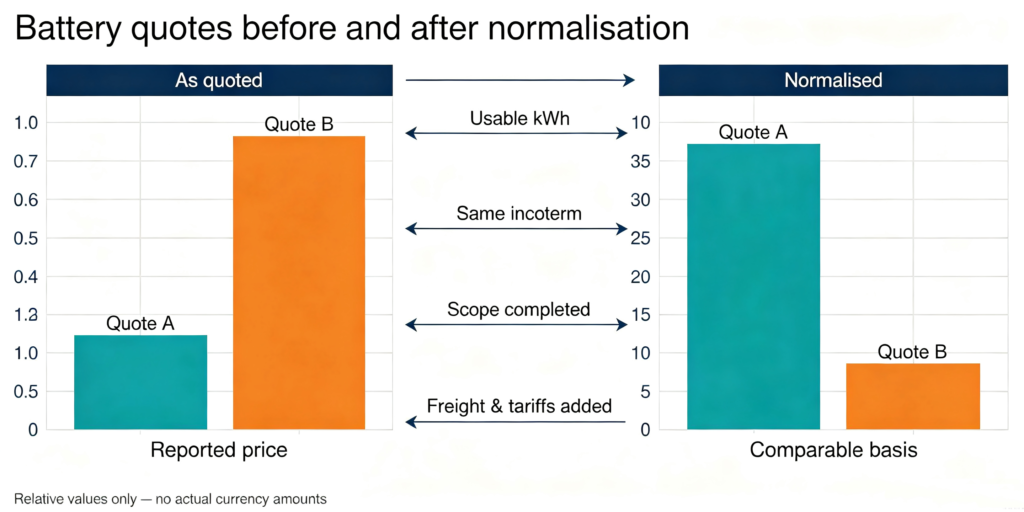
How to Put Two Quotes on the Same Basis
Run this before comparing anything. It takes about twenty minutes per quote and settles most procurement arguments.
- Restate both prices per usable kWh, using each supplier’s stated DOD.
- Restate both to the same trade term — normally the one that lands the goods at your site.
- List the scope of supply line by line and add the missing items to whichever quote excludes them.
- Note the cycle warranty and end-of-term capacity retention for both, and divide the normalised price by warranted throughput.
- Confirm the certification set matches the destination market for both.
- Add freight, DG surcharge and duty for both.
- Compare. The ranking often reverses between step 1 and step 6.
Working Out Payback Yourself
Rather than quoting a payback period that will not apply to your site, here is the calculation to run with your own numbers.
Simple payback (years) = total installed cost ÷ annual benefit
where annual benefit = (energy shifted per year × price spread) + (demand charge reduction × 12) + (avoided outage cost) − annual O&M
Three cautions on using it. Energy shifted per year must account for round-trip efficiency and for realistic cycles, not 365. The price spread is a tariff assumption and tariffs get revised. And avoided outage cost is real but site-specific — see our guide to backup without solar for how to put a defensible number on it.
If the result depends heavily on the tariff spread staying where it is, treat the project as reliability spending with a partial financial return, not as an investment.
FAQ
Q. Why do solar battery quotes vary so much?
Because four variables are usually not held constant: nominal versus usable kWh, scope of supply, trade term, and certification set. Restating all four onto a common basis removes most of the apparent variation.
Q. Is battery price per kWh quoted on nominal or usable capacity?
Both are used, and the difference is significant. A system with an 80 % usable window costs about 25 % more per usable kWh than its nominal figure suggests. Always ask which basis a price uses and restate to usable before comparing.
Q. How long does a solar battery take to pay back?
It depends on which benefit stream applies. Where the benefit is a wide, stable time-of-use spread or a demand charge reduction, payback can be calculated with reasonable confidence from twelve months of meter data. Where the main benefit is outage avoidance, payback is not the right measure, because the value is avoided loss rather than reduced bills.
Q. Does a bigger order reduce the price per kWh?
Yes, mainly on the module line, and in steps rather than continuously. Mixed configurations usually do not receive the same step as a single configuration at the same total volume, because the saving comes from production batching as much as from quantity.
Q. What is usually excluded from a battery quote?
Commonly excluded: the inverter or PCS, the transformer on C&I systems, DC protection, the backup gateway, installation labour, permits, freight and destination duty. Ask for the scope of supply as a written list with exclusions stated explicitly.
Comparing quotes and want them normalised?
Send us the capacity you need, the destination market, the trade term you prefer and the quantity. We will return a quotation stated per usable kWh with the scope of supply listed line by line and exclusions marked, so it can be compared against any other quote on the same basis. If a competing quote looks lower for a structural reason, we will tell you which reason.