A home battery backup without solar is worth installing when one of two conditions holds: outages are frequent or expensive enough that avoiding them has real value, or the local tariff has a wide enough peak-to-off-peak spread to pay for cycling. If neither condition holds, the system will still work — it just will not pay for itself on electricity savings.
That single sentence settles most of these conversations. The harder part is proving which condition applies to a specific house, and doing it before a quote goes out.
What a Home Battery Does When There Are No Panels
Definition. A home battery without solar is a grid-charged battery energy storage system. It charges from the utility supply — usually during off-peak hours or whenever the grid is stable — stores the energy, and discharges it during an outage or during high-price hours. The hardware is the same as in a solar-plus-storage system. What changes is the charging source, and therefore the economics.
Three components make the difference between a battery that sits on a wall and a battery that actually backs up a house. The battery itself stores energy. A battery inverter or hybrid inverter converts between DC and AC and controls charge and discharge. A transfer switch or backup gateway disconnects the house from the grid within milliseconds when the grid fails, so the battery can supply the load without exporting into a dead line.
Skip the third one and you have a battery that reduces bills but does nothing during a blackout. That distinction matters, because a large share of buyers searching for solar battery backup for power outages are asking about the transfer function, not the battery capacity.
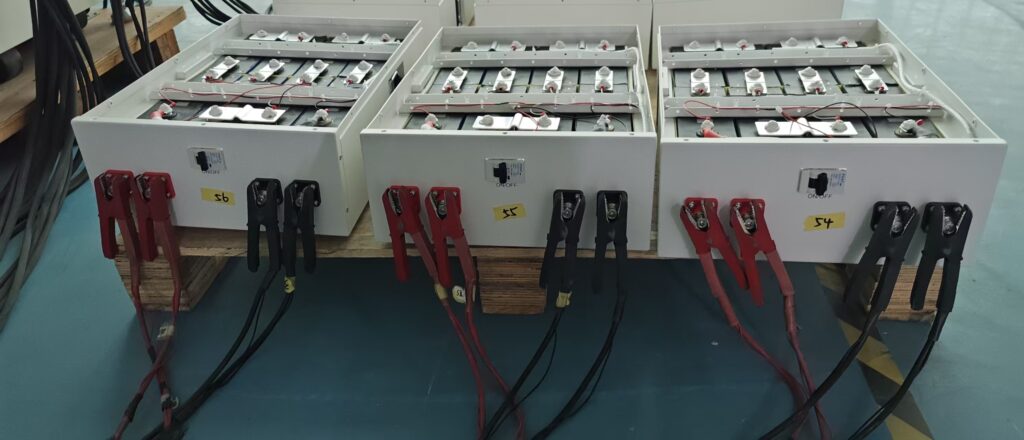
Where the Value Comes From Without Solar
Without panels there are three plausible value paths, and only two of them produce measurable cash flow.
- Outage avoidance. This is the reason most no-solar buyers move forward. The value equals what an outage actually costs the household — spoiled food, lost remote-work hours, a failed sump pump, medical equipment, a frozen pipe in winter. It is real, it is site-specific, and it does not appear on any utility bill.
- Time-of-use arbitrage. Charge off-peak, discharge on-peak, pocket the spread minus round-trip losses. This only works where the tariff has a genuine time differential and the meter supports it.
- Solar readiness. Sizing the inverter and the electrical work for a future PV array avoids paying twice for the same conduit, breaker space and commissioning. It is not cash flow, but it is avoided cost.
In practice, projects that rely on arbitrage alone are the ones that disappoint. Tariff spreads move, and a spread that justifies a battery this year may not survive the next rate revision.
What It Costs: Where the Money Actually Goes
Installed cost splits into hardware, electrical work and soft costs. The proportions below are the structure worth quoting against; absolute prices depend on the market, the electrician and the scope of the panel work.
| Cost item | Typical share of installed cost | What drives it |
|---|---|---|
| Battery module(s) | 40–55% | Usable kWh, chemistry, cycle warranty, enclosure rating |
| Battery or hybrid inverter | 15–25% | Continuous kW, surge rating, whether PV inputs are included |
| Transfer switch / backup gateway | 5–12% | Whole-home vs critical-loads, service amperage |
| Electrical work (subpanel, conduit, re-wiring) | 10–20% | Distance to the panel, panel age, whether a subpanel is needed |
| Labour and commissioning | 8–15% | Local rates, mounting surface, crew size |
| Permits and inspection | 2–6% | Jurisdiction, utility interconnection process |
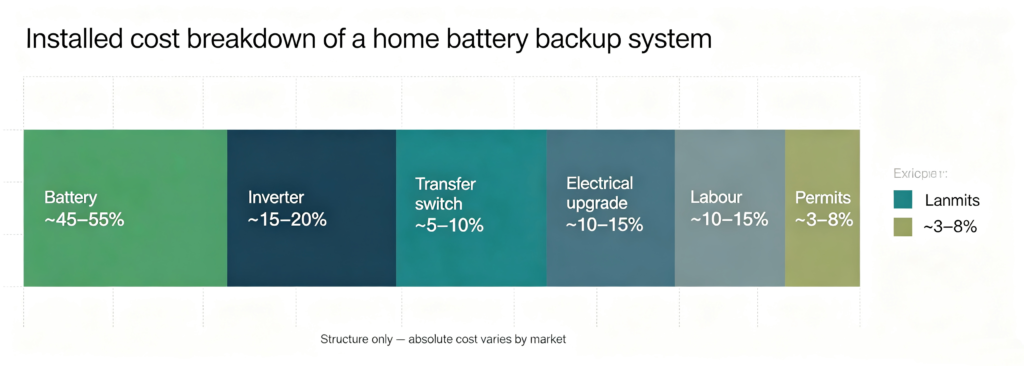
Two of these lines surprise buyers regularly. The first is the electrical work: a house with an old main panel and no spare breaker space can push that line to the top of the range before anyone touches a battery. The second is the transfer switch, which is where the whole-home-versus-critical-loads decision quietly changes the budget.
How to Decide, in Five Steps
Run these in order. Reversing steps 1 and 4 is the most common reason a quote gets revised twice.
Step 1 — Put a number on the outages
Pull the actual outage history for the address: how many events per year, average duration, worst event in the last three years. Then list what fails during an outage and what that costs. A household with two four-hour outages a year and no critical loads has a weak case. A household with well water, a sump pump and a home office has a strong one.
Confirm with the supplier: ask for the guaranteed transfer time in milliseconds and whether the system supports black start after a full discharge.
Step 2 — Check the tariff spread
Find the peak and off-peak rates, the peak window, and whether the utility allows grid charging of a battery at all. Some tariffs and some incentive programmes restrict grid-charged discharge. Multiply the spread by usable kWh and by realistic cycles per year, then subtract round-trip losses.
Confirm with the supplier: request the round-trip efficiency figure with its test conditions — C-rate, temperature and whether inverter losses are included. Efficiency quoted without conditions is not comparable between vendors.
Step 3 — Decide the backup scope
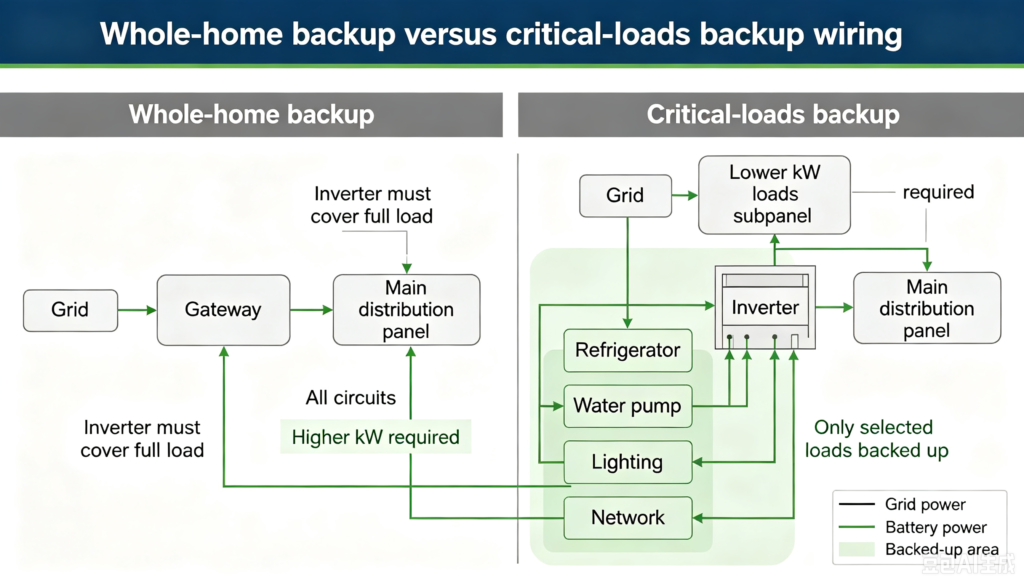
Whole-home backup is what buyers ask for. Critical-loads backup is what most projects end up installing, because it sizes the inverter to the loads that matter instead of to the service rating. Whole home battery backup without solar is technically achievable, but it requires the inverter continuous rating and surge capability to cover simultaneous motor starts — air conditioning, well pump, workshop tools.
Confirm with the supplier: continuous kW, surge kW, surge duration in seconds, and the largest motor the inverter is rated to start.
Step 4 — Check the physical and electrical constraints
Wall type and load-bearing capacity, ambient temperature range at the mounting location, clearance requirements, distance to the main panel, spare breaker space, and whether the enclosure rating suits a garage, a basement or an outdoor wall. Temperature is the constraint most often ignored — an unconditioned garage in a hot climate will affect both available power and cycle life.
Confirm with the supplier: operating temperature range for charge and discharge separately, IP rating, and the minimum clearances used in the installation manual.
Step 5 — Decide whether solar comes later
If PV is likely within a few years, specify a hybrid inverter with PV inputs now and size the conduit and breaker space for the future array. If PV is genuinely off the table, an AC-coupled battery inverter is usually simpler and cheaper. Choosing wrong here is the one mistake that costs money twice.
When the Payback Works — and When It Doesn’t
Use these criteria instead of a single payback number, because the two value paths behave differently.
- Proceed when: outages exceed roughly a dozen hours a year and there are loads whose failure carries real cost; or the tariff spread is wide, stable and permits grid charging; or an incentive programme covers a meaningful share of installed cost.
- Reconsider when: the case rests only on a narrow tariff spread; the main panel needs replacing before the battery can be connected; the mounting location runs hot; or the household plans to move within a few years and the system is not transferable.
The honest framing for a homeowner is this: a grid-charged battery is bought mostly as reliability, and partly as a hedge. Selling it purely as a savings device is how installers end up with a dissatisfied customer holding a spreadsheet.
What to Confirm Before You Quote
For installers and distributors, these are the specification items that change the price or the feasibility of the job. Ask for all of them in writing before issuing a quote.
- Usable kWh at the stated depth of discharge, not nominal kWh
- Continuous kW, surge kW and surge duration
- Guaranteed transfer time and whether the gateway is included or separate
- Whether grid charging is enabled in firmware and configurable by schedule
- Operating temperature range for charge and for discharge
- Cycle life with its test conditions, plus the capacity-retention figure in the warranty
- Cell traceability — whether the cells in one system come from a single production batch
- Certification list for the target market, with certificate numbers and issuing body
- Lead time by configuration, and whether the gateway ships with the battery
- Firmware update path and who is responsible for it after commissioning
- Spare-parts availability and freight responsibility for a module replacement in year three
Common Mistakes
Most failed no-solar projects fail for one of a few reasons, and none of them involve the battery being defective.
Sizing to energy instead of power is the most frequent. A 10 kWh battery with a 3 kW inverter cannot start an air conditioner, no matter how much energy it holds. Buyers searching for a 10 kwh home battery are usually thinking about duration when their actual constraint is instantaneous power.
Quoting whole-home backup on a critical-loads inverter is the second. It surfaces during commissioning, which is the worst possible time. The third is assuming the utility permits grid charging without checking the tariff terms — a compliance problem, not a technical one.
FAQ
Can you install a home battery without solar panels?
Yes. A battery charges from the grid through a battery inverter or hybrid inverter and needs no PV array to operate. The only additional requirement is that the utility tariff and interconnection rules permit grid charging, which should be verified before ordering.
How big should a home battery be if there is no solar?
Size it to the loads you intend to back up and the hours you intend to cover, not to household annual consumption. Without solar there is no daytime generation to recharge the battery mid-outage, so the usable capacity has to carry the whole event. Our kWh sizing guide walks through the load-table calculation.
Will a battery lower an electricity bill without solar?
Only where the tariff has a time-of-use differential. The battery charges at the off-peak rate and discharges at the peak rate, and the saving is the spread minus round-trip losses. On a flat-rate tariff, a grid-charged battery slightly increases consumption because of conversion losses.
Can a battery back up an entire house?
It can, if the inverter’s continuous and surge ratings cover the largest simultaneous loads and the gateway is rated for the full service. Whole-home backup costs more than critical-loads backup mainly because of the inverter and gateway sizing, not the battery.
Can solar be added later to a grid-charged battery?
Yes, and it is much cheaper if planned at the start. Specifying a hybrid inverter with PV inputs and leaving conduit and breaker space for the array avoids replacing the inverter when panels are added.
Specifying a no-solar backup system?
Send us the load list, the outage duration you need to cover, the service amperage and the mounting location, and our application team will return a configuration with usable kWh, continuous and surge kW, and the gateway option that matches the backup scope. If a critical-loads design serves the project better than whole-home, we will say so.