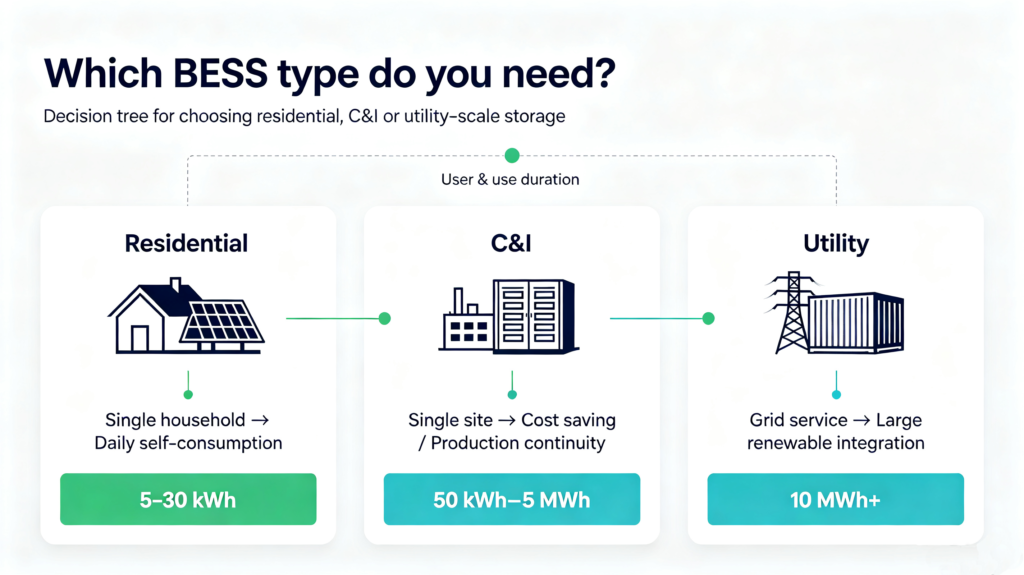
Battery energy storage systems (BESS) fall into three scales: residential (5–80 kWh, one home), commercial & industrial (C&I) (30 kWh–1 MWh+, one site), and utility-scale (MWh–GWh, the grid). The type you need is set by who uses the energy, how long they need it, and how much they can spend — not by chemistry alone.
What an “energy storage system” means here
An energy storage system is batteries plus the parts that make them usable: a Battery Management System (BMS), power conversion (inverter/PCS), enclosure, and control software. “BESS” and “ESS” are the same idea — ESS is the broader term, BESS specifies batteries. This article classifies by scale and user, the split buyers actually search for.
The three types at a glance
| Type | Typical capacity | Discharge duration | Primary user | Common form |
|---|---|---|---|---|
| Residential | 5–80 kWh | 2–24 h backup | Homeowner / installer | Wall-mounted or floor cabinet |
| Commercial & Industrial | 30 kWh–1 MWh+ | Peak shaving / shift | Factory, warehouse, campus | Cabinet or rack system |
| Utility-scale | MWh–GWh | 1–4 h grid service | Utility / IPP | Container (20/40 ft) |
Residential energy storage
The smallest class powers one home. A typical unit pairs with rooftop solar to shift self-generated energy into the evening and ride through outages. Capacity is usually chosen by daily load and backup hours, not by a single “right size” — see the home battery sizing guide. Wall-mounted LiFePO4 dominates because it is safe, long-lived, and light enough for a garage wall.
Commercial & industrial (C&I) storage
C&I systems serve a business site. The same chemistry appears, but the value case changes: cutting peak demand charges, shifting solar self-consumption, or keeping a production line running through a flicker. Sizing here is driven by the tariff and the process, not the roof. Cabinets stack as the site grows, which is why many buyers start at 100 kWh and add later.
Utility-scale storage
At the grid level, storage is measured in MWh and built into containers with their own cooling, fire safety, and PCS. The buyer is a utility or independent power producer, and the goal is grid service — frequency response, arbitrage, or capacity. Seplos covers this as a capability showcase rather than a core product line; a single site can exceed the annual volume of thousands of homes.
How to choose the right type
- Who uses the energy? One meter = residential; one site = C&I; the grid = utility.
- What problem? Outage backup and solar shift favor residential; demand charges and process continuity favor C&I; grid services favor utility.
- How long? Hours of backup (residential) vs. daily peak shaving (C&I) vs. sub-4-hour grid response (utility).
- How will it grow? Modular cabinets (C&I) beat a fixed single block when load is uncertain.
Sizing example at each scale
Concrete numbers make the scale split obvious. Three typical projects a buyer might scope:
- Residential — 10–14 kWh. A home with ~12 kWh of evening load and one backup night picks a wall-mounted unit. Capacity follows daily solar surplus and backup hours, not peak power. See the home battery sizing guide for the load-table method.
- C&I — 100–300 kWh. A small factory with a steep peak demand charge and 200 kW of steady load targets a cabinet that shaves the daily peak for ~1–2 h. Capacity follows the tariff shape, not the roof area.
- Utility-scale — 100 MW / 200 MWh. A grid site delivers 100 MW for 2 h of frequency response or arbitrage. Capacity follows the grid-service product and available land, not any single building.
Why cost per kWh is not cross-comparable
Stored-energy cost per kWh falls as scale rises because containers integrate cells, thermal management, and PCS at volume, while residential pays a premium for a safe, silent, wall-mount form. C&I sits between. Buyers should compare per-kWh price only within a scale class — crossing classes compares integration and enclosure cost, not the underlying cell value. This is also why the right entry page matters: a homeowner should land on a residential guide, an EPC on a utility glossary, and a business on a C&I overview.
Start from the scale, then the page
The single most useful takeaway is to pick the scale first. A homeowner comparing utility-scale numbers is reading the wrong page; an EPC skimming a residential guide will miss the PCS and grid-code detail they need. Once the scale is clear, the rest of the decision — capacity, duration, chemistry, supplier — follows a known path. If you are unsure which scale fits your project, the three Solution pages (Residential, C&I, Utility) are the fastest way to find out, and each links back to the deeper guide it needs.
Q. What are the three main types of energy storage?
Residential (one home), commercial & industrial (one business site), and utility-scale (the grid). They differ mainly in capacity, user, and discharge duration.
Q. Is residential and C&I storage the same technology?
Often the same LiFePO4 cells, but the enclosure, PCS power, and software differ. C&I needs higher continuous power and stacking; residential prioritizes quiet, safe, wall-mount form.
Q. Which type is cheapest per kWh?
Utility-scale is usually cheapest per kWh because of volume and containerized integration, but it has the highest total project cost. Residential has the highest per-kWh price but the smallest total ticket.
Q. Can a residential system scale to C&I size?
Not practically. Once you pass roughly 100 kWh and need peak-shaving economics, cabinet/rack C&I systems with stronger PCS are the right class.
Q. Does chemistry differ by type?
LiFePO4 leads residential and most C&I for safety and cycle life. Utility-scale is also mostly LFP now, with some NMC where energy density is prioritized over cost.
Need a storage solution by scale?
Pick the right entry point by scale:Residential · Commercial & Industrial · Utility-scale。or start with What Is Battery Storage (BESS)? to build the foundation.