A custom battery pack moves through five stages: requirement → design → prototype → validation → mass production. The fastest quotes come from buyers who arrive with a clear spec, not a vague “make me a battery.” Prepare the electrical, mechanical, and certification inputs before you contact a factory, and the timeline and price both improve.
Stage 1 — Requirement
Write down what the pack must do: nominal and max voltage, capacity (Ah or kWh), continuous and peak current, target temperature range, and form factor. These are the “spec” a factory prices against — vague requirements produce vague quotes.
Stage 2 — Design
The factory returns a cell selection, series/parallel layout, BMS choice, and mechanical drawing. Confirm the BMS communication protocol (CAN/RS485) and protection settings here, because they are hard to change after tooling.
Stage 3 — Prototype
A small batch (often 5–20 units) is built to test fit, thermal behavior, and protection logic. This is where surprises show up cheaply. Do not skip it to save time — a bad production run costs far more.
Stage 4 — Validation
Safety and performance tests (cycle, abuse, certificate pre-test) gate production. Align on which certifications you need for your market — UN 38.3 for transport, IEC 62133 / IEC 62619 for product safety — before this stage so there is no late rework.
Stage 5 — Mass production
With validated design and agreed QC, volume builds start. Lock the QC plan (IPQC/OQC, traceability) and a sample-acceptance rule in the contract, not just in email.
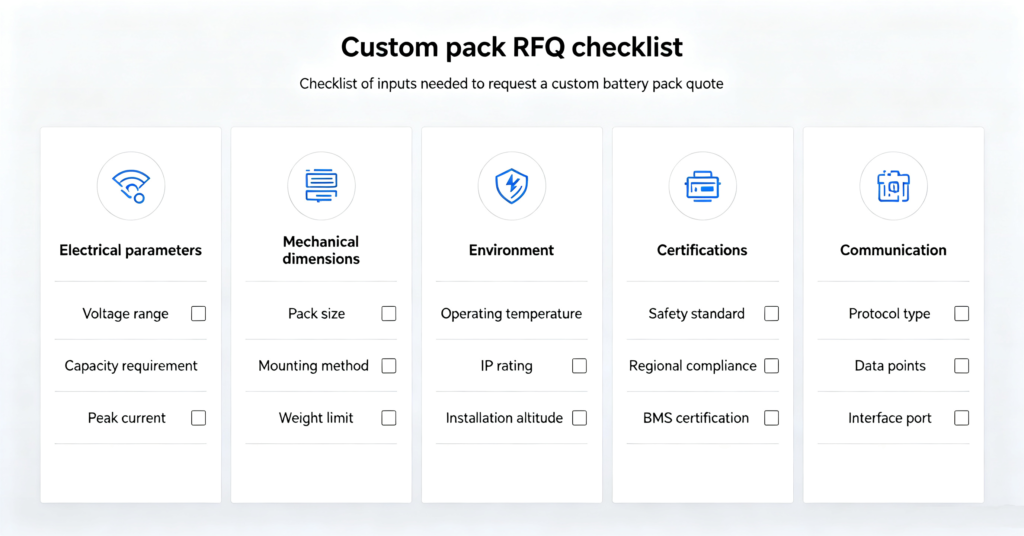
RFQ checklist (send this to the factory)
- Electrical: nominal/max voltage, capacity, continuous & peak current.
- Mechanical: dimensions, weight limit, mounting, connectors.
- Environment: operating and storage temperature, ingress rating.
- Communication: BMS protocol (CAN/RS485) and data needs.
- Certification: target markets and required standards.
- Volume: prototype quantity and expected annual volume (affects price and MOQ).
What to prepare at each stage
1. Requirements
Write down application, voltage, capacity, form factor, environment, and target certifications. A vague “I need a battery” produces a vague quote; a spec produces a comparable one. Include the connector type and any mechanical constraints.
2. Design & DFM
The supplier returns a cell layout, BMS choice, and thermal plan. Review for serviceability and safety margin, not just cost. Design for manufacture (DFM) feedback now saves tooling changes later.
3. Prototyping
A small batch proves the design under real load. Test capacity, thermal behavior, and communication before committing to volume. Treat the prototype as the contract sample for mass production.
4. Validation & certification
Run the certifications your market requires (UN38.3 for transport; IEC 62619 / UL 1973 for stationary). Schedule these early — they are often the longest lead item and block shipment.
5. Mass production & QC
Lock the bill of materials, agree on incoming inspection, and sample-test from the line. Confirm traceability per batch so a field issue is isolatable to a date and lot.
RFQ template (copy and fill)
| Field | What to state |
|---|---|
| Application | Where and how the pack is used |
| Specification | Voltage, capacity, current, form |
| Quantity | Prototype count and annual volume |
| Environment | Temperature, humidity, vibration |
| Customization | BMS, comms, enclosure, branding |
| Target market | Region and required certifications |
| Certification | UN38.3 / IEC 62619 / UL 1973 as needed |
What “OEM” vs “ODM” changes
OEM means you supply the design and the partner builds it; ODM means the partner designs and you brand it. ODM is faster to market but limits differentiation; OEM protects IP but needs your engineering. State which you want — mixed scopes cause the most quotation confusion.
Validating the sample
Run the prototype through the exact duty cycle of your product, not a lab ideal. Record capacity fade, temperature rise, and any communication dropouts. If the sample passes where the brochure claimed, you have a reliable contract unit; if not, fix the design before tooling, not after.
Lead time reality
Custom cells and enclosures — not standard parts — drive lead time. A new enclosure tool can add weeks; certification adds more. Ask for the critical-path date specifically, and build the project plan backward from it rather than from the cheapest quote.
Quality control at volume
Agree on incoming inspection of cells, in-process checks of welds and torque, and outgoing capacity testing. Sample by AQL and keep batch records. The goal is that a field failure maps to a lot, not a mystery.
IP and NDA basics
If the design is yours, sign an NDA and define who owns the tooling and the BOM. Some suppliers reuse a design across clients; confirm yours is exclusive or accept the shared base. Clarity here prevents a competitor shipping your pack.
What drives the quote
Cost follows cell grade, capacity, enclosure complexity, certification scope, and volume. A small change in grade or enclosure can move price more than the cell count. Request a breakdown so you can trade features against budget.
Custom vs off-the-shelf
Choose custom when standard packs miss your form, voltage, or certification. Choose standard when speed and cost win. Many buyers start standard, then move to OEM once volume justifies the tooling — a sensible staging that avoids paying for capacity you lack.
Red flags when evaluating a custom partner
- Won’t share cell grade or batch traceability.
- Quotes without your certification named.
- Cannot show a similar built pack, only catalog cells.
- Vague on lead time beyond “fast.”
Typical stage timeline
| Stage | Typical lead | Note |
|---|---|---|
| Requirements | 1–2 weeks | You drive this |
| Design / DFM | 2–4 weeks | Iterative |
| Prototype | 3–6 weeks | Cell + tooling |
| Certification | 4–12 weeks | Often longest |
| Mass production | 4–10 weeks | After sign-off |
Sample acceptance criteria
Define what “good” means before volume: capacity within ±2% of rated at your test rate, internal resistance within the supplier’s spread, no thermal event through a full charge/discharge, and communication stable across the duty cycle. Write these into the prototype contract so the mass-produced unit is judged against the same bar.
Communication spec detail
State the bus (CAN or RS485), the baud and frame, and the register map if you have one. BMS talk is where most integration slips; a precise comms spec turns a vague “compatible” into a testable requirement. If you lack a map, ask the supplier for theirs and confirm it matches your controller.
Common spec omissions that bite later
- Operating temperature range stated but not the derating curve.
- Connector specified but not the torque or gland rating.
- Enclosure IP rated but not the cooling method.
- Capacity at 25°C only, with no high/low temperature number.
What “grade A” should mean to you
Grade A means cells within the maker’s tight capacity and resistance spread, with full traceability — not merely “not recycled.” Ask for the spread numbers, not the label. Two packs with the same nameplate but different grades age very differently; the grade is the hidden variable in your cost per cycle.
Closing the loop with the factory
Once volume runs, keep a monthly batch-record review and a quarterly capacity audit on a sample. Small drift caught early beats a field recall later. Treat the factory as a process partner, not a one-time vendor — the relationship is the real asset on a BOFU timeline.
Pilot-to-production handoff
Treat the prototype as a contract, not a sample. The validated prototype’s test report becomes the acceptance bar for every mass-produced unit, so lock it before signing volume. If the prototype passed at 0.9 kWh per cell and the line drifts to 0.85, that gap is caught at incoming inspection, not in the field. This handoff discipline is what separates a reliable supply from a lucky first batch.
The cost of getting it wrong
A custom pack failure is expensive: freight both ways, line downtime, and a damaged relationship with your own customer. The cheap insurance is the prototype test, the batch records, and the audit right — all minor costs against a field recall. Spend on verification early; it is the smallest line on the project and the highest leverage.
Final word
When you order custom battery packs at volume, treat the engagement as a relationship, not a transaction — manage it like one and the line rewards you with consistency.
Q. What is the OEM/ODM battery pack process?
Five stages: requirement, design, prototype, validation, mass production. Buyers who prepare a clear spec get faster and more accurate quotes.
Q. How long does a custom battery pack take?
Prototype can be weeks; validation and tooling add more. The biggest variable is how ready your spec is and which certifications you need — incomplete inputs stall the line.
Q. What should I send for a custom pack quote?
Use the RFQ checklist above: electrical, mechanical, environmental, communication, certification, and volume. The more complete, the tighter the quote.
Q. OEM or ODM — which do I need?
OEM if you supply the design and the factory builds it; ODM if the factory also designs to your requirements. Pick based on whether you own the engineering.
Q. Which certifications does a custom pack need?
At minimum UN 38.3 for transport; IEC 62133 / IEC 62619 for product safety depending on market. Confirm the exact list with the factory before validation.
Need a custom battery pack?
See OEM/ODM Page and Energy Storage Manufacturer Evaluation Guide,Prepare the RFQ checklist and request a custom quote from leekooenergy.