A 280Ah and a 314Ah LFP cell are the same chemistry (lithium iron phosphate) at two capacity steps. The 314Ah version stores about 12% more energy in nearly the same footprint, so a pack reaches a target kWh with fewer cells. Pick 314Ah when you want higher energy density and fewer connections; keep 280Ah when supply maturity, traceability, and a proven bill of materials matter more than pack size.
What an LFP cell is
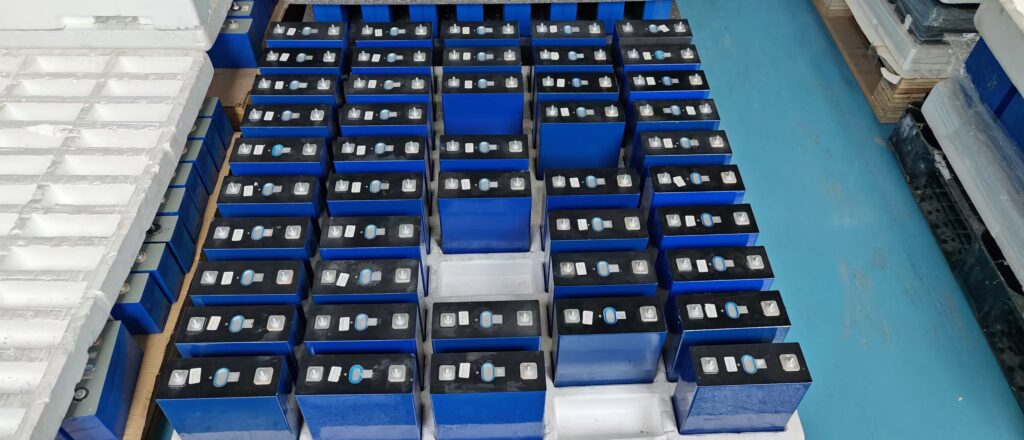
An LFP cell is a single lithium iron phosphate battery, usually shipped as a prismatic (rectangular) can with two terminals. It is the building block of almost every large storage pack: cells are welded into modules, modules into packs or racks, and racks into a system. “LFP” is valued for safety, long cycle life, and thermal stability versus other lithium chemistries.
Why amp-hours (Ah) matter
Capacity in amp-hours tells you how much charge a cell holds; multiply by the nominal voltage (~3.2 V for LFP) to get energy in watt-hours:
- 280Ah cell ≈ 280 × 3.2 = 896 Wh (about 0.9 kWh) per cell.
- 314Ah cell ≈ 314 × 3.2 = 1,005 Wh (about 1.0 kWh) per cell.
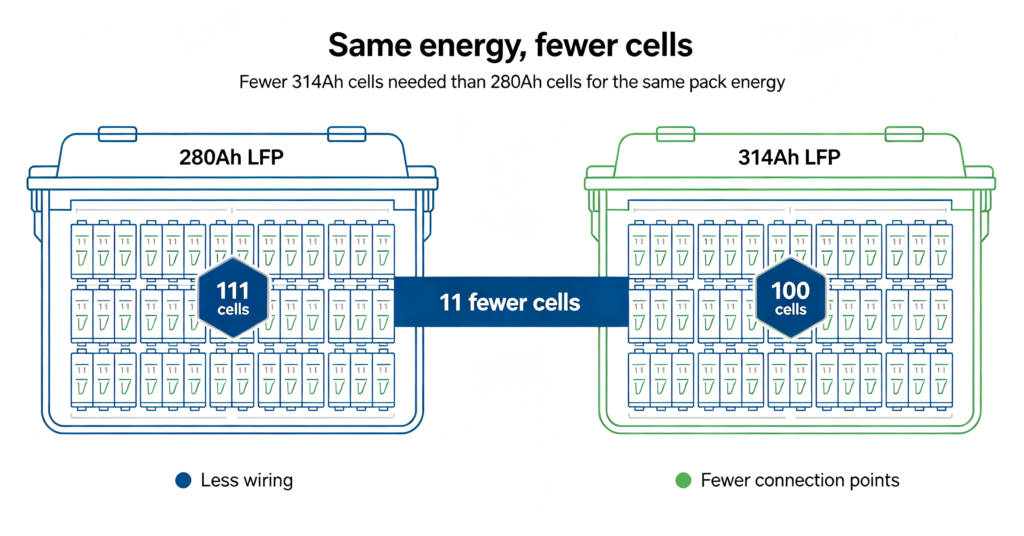
For a fixed system size, fewer 314Ah cells are needed. That means fewer welds, busbars, and monitoring points — but also newer tooling and supply chains to validate.
280Ah vs 314Ah at a glance
| Attribute | 280Ah LFP | 314Ah LFP |
|---|---|---|
| Nominal capacity | 280 Ah | 314 Ah |
| Energy per cell (~3.2 V) | ~0.90 kWh | ~1.00 kWh |
| Relative energy density | Baseline | ~12% higher |
| Cells needed per 100 kWh | ~111 | ~100 |
| Form factor | Prismatic, mature | Prismatic, newer gen |
| Supply maturity | Very established | Established, newer |
| Typical use | C&I, ESS, base designs | High-density ESS, newer packs |
What changes in pack design at 314Ah
Moving to the larger cell is not a drop-in swap. From a design and procurement view, three things shift:
- Mechanical layout — fewer cells changes module dimensions, compression fixtures, and enclosure size. Existing jigs for 280Ah may not fit.
- Thermal management — a larger cell has more internal volume to cool; verify the same cooling design holds the cell within its operating window.
- BMS channel count — fewer series strings can mean simpler monitoring, but you must re-map voltage-sensing points and re-validate alarms.
What a buyer should confirm before RFQ
For a procurement manager, cell choice is only as good as the data behind it. Before you issue a request for quotation, confirm these points so quotes are comparable and traceable:
- Datasheet vs tested capacity. Ask for third-party or in-house capacity test results at your target temperature and rate, not just the nameplate.
- Cycle life at your DoD. Cells rated for 6,000 cycles at 80% depth of discharge may differ at 90% — request the curve at your operating point.
- Grade and traceability. Specify grade-A cells with batch-level traceability; confirm whether the quote is grade-A, B, or recycled.
- Certifications. Request UN38.3 (transport) and, for your market, CB/IEC 62619 or UL 1973 as applicable.
- MOQ and lead time. 314Ah may carry different minimum order quantities and longer critical-path lead times than the mature 280Ah; confirm both.
- Consistency batch-to-batch. Ask for internal-resistance and capacity spread data; tight spread reduces pack balancing work.
A complete RFQ states cell model, required quantity, target market certifications, operating environment, and whether you need cells only or cells plus BMS/module integration. Suppliers price what you define.
Where these cells are used
- C&I cabinets — 280Ah or 314Ah modules build the 100–500 kWh racks behind a PCS.
- ESS containers — many 314Ah cells pack a 20/40 ft container to MWh scale.
- Telecom & UPS — lower-rate banks where footprint matters less than life.
- Large banks (not single devices) — 280/314Ah suits fixed banks; smaller cells fit a phone or tool.
Application example: a 100 kWh C&I rack
At ~0.9 kWh per 280Ah cell, a 100 kWh rack needs about 111 cells; at ~1.0 kWh per 314Ah cell, about 100. The 314Ah build saves eleven cells, eleven busbars, and eleven monitoring points — modest per rack, meaningful across a container. The trade is newer tooling and a slightly different BMS mapping, which is why mature 280Ah remains the safe default for proven lines.
Common procurement mistakes
- Buying on nameplate Ah and ignoring tested capacity at temperature.
- Mixing grades (A and B) across a project to cut cost — it breaks balancing.
- Forgetting transport cert (UN38.3) until the container is at the port.
- Assuming 280Ah tooling fits 314Ah without re-checking dimensions.
Building a traceability program
For volume buyers, require batch-level cell IDs and keep them through module assembly. If a field cell drifts, you trace it to a date and lot, not a guess. This is the difference between a one-off replacement and a recall. State the traceability requirement in the RFQ so the supplier prices it in.
Which to choose
Pick 314Ah when pack size, connection count, and energy density lead, and your tooling is ready. Keep 280Ah when supply maturity, proven BOM, and easiest sourcing lead. Both are sound LFP; the right call follows your design and procurement constraints, not a spec-sheet race.
Procurement checklist recap
- State cell model, quantity, and grade (A) in the RFQ.
- Require batch-level traceability through assembly.
- Name transport (UN38.3) and market certs up front.
- Confirm 280Ah tooling fit before assuming a 314Ah swap.
- Ask for tested capacity at your temperature, not nameplate.
Handling transport and arrival
Lithium cells ship as dangerous goods under UN38.3; confirm the supplier’s documentation travels with the container, not sent later. On arrival, verify seal and batch IDs against the records, and visually inspect for swelling or damage before accepting. A five-minute check at the dock prevents a disputed claim weeks later.
One more check: the datasheet vs the batch
Before accepting a shipment, pull the batch’s actual capacity and resistance spread and compare to the datasheet. A small, documented spread is normal; a wide one means mixing risk downstream. This five-minute check at incoming is cheaper than balancing a pack built on inconsistent cells. Keep the comparison on file with the batch ID.
Q. Is 314Ah better than 280Ah for every pack?
Not always. 314Ah gives higher energy density and fewer cells, but 280Ah has a more mature, widely available supply chain. Choose 314Ah when pack size and connection count matter; keep 280Ah when proven sourcing and traceability lead.
Q. How many kWh is one 280Ah LFP cell?
About 0.9 kWh (280 Ah × ~3.2 V nominal). A 314Ah cell is about 1.0 kWh. Exact Wh depends on the cell’s measured nominal voltage from its datasheet.
Q. Can I mix 280Ah and 314Ah cells in one pack?
No. Different capacities, internal resistance, and dimensions must not share a string or module. Each pack design targets one cell model only.
Q. Does a bigger cell mean worse safety?
Chemistry is the same LFP, so baseline safety is similar. The difference is thermal design: a larger cell needs validated cooling and pressure relief. Safety comes from the system design, not the Ah number alone.
Q. What certifications should I require on an RFQ?
UN38.3 for transport is the baseline. For stationary storage, ask for IEC 62619 (or CB scheme) and UL 1973 depending on your market. State the target market so the supplier quotes the right scope.
UN38.3 for transport is the baseline. For stationary storage, ask for IEC 62619 (or CB scheme) and UL 1973 depending on your market. State the target market so the supplier quotes the right scope.
Sourcing 280Ah / 314Ah cells or evaluating suppliers?
start with the fundamentals Lithium Iron Phosphate Batteries Guide to build the chemistry and selection foundation。leekooenergy supplies large-format LFP cells with matching BMS and module solutions,final specs and certifications depend on the cell wholesale / manufacturer page and the project quote。