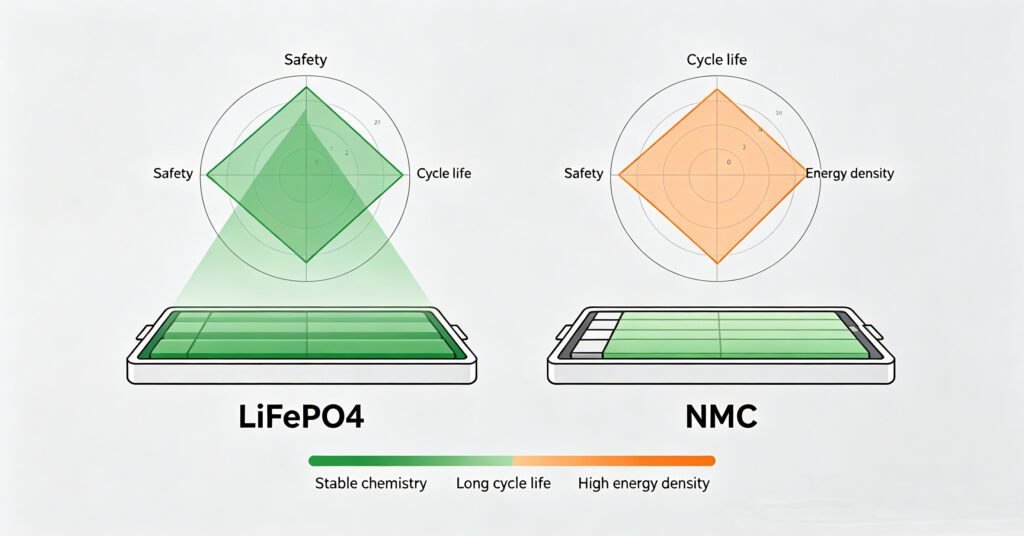
LiFePO4 vs lithium ion is not a fair fight between equals — both are lithium-ion, but LiFePO4 (LFP) trades some energy density for far better safety, longer cycle life, and stable performance in heat and cold. NMC (a common “lithium-ion” in EVs) packs more energy per kilo but ages faster and is more reactive. For stationary storage — home, C&I, utility — LFP is the default; NMC suits weight-critical mobility. Choose by what the application punishes: fire risk and calendar life favor LFP.
“Lithium-ion” is a family, not one chemistry. When buyers compare “lithium-ion vs LiFePO4,” they usually mean NMC versus LFP. Knowing the difference prevents specifying the wrong cell for a fixed installation.
What “lithium-ion” means here
Lithium-ion covers several cathode chemistries. NMC (nickel-manganese-cobalt) dominates EVs because it is energy-dense and light. LFP uses a phosphate cathode that is inherently more thermally stable. Same lithium base, different trade-offs — which is why the comparison is really LFP vs NMC for storage.
Comparison at a glance
| Dimension | LiFePO4 (LFP) | NMC |
|---|---|---|
| Safety / thermal stability | High (low thermal-runaway risk) | Moderate (more reactive) |
| Cycle life | Long (thousands of cycles) | Moderate (fewer cycles) |
| Energy density | Moderate | High (light, compact) |
| Low-temperature behavior | Better | Average |
| Cost per life | Excellent | Moderate |
| Typical use | Stationary storage | EV / portable |
Safety and thermal stability
LFP’s phosphate cathode is far less likely to enter thermal runaway, which is why it dominates stationary storage where the pack sits in a home or plant. NMC’s higher energy density comes with a more reactive cathode that needs tighter thermal management. For a wall in a garage, LFP’s margin matters more than the weight saving.
Cycle life and ownership cost
LFP typically delivers many more full cycles before notable fade, which lowers cost per cycle for daily-cycling storage. NMC fades sooner under the same depth of discharge. The LiFePO4 complete guide details why LFP leads on cycle life for storage buyers.
Energy density vs weight
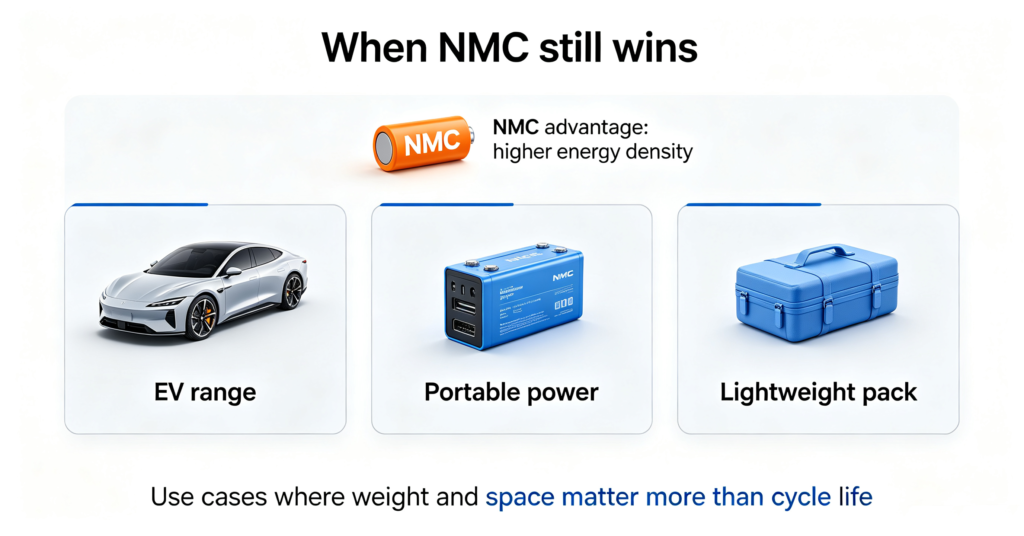
NMC wins where weight and volume are the constraint — vehicles and aircraft. Stationary storage rarely cares about a few kilos; it cares about safe wall-mount form and long life. That is why LFP, not NMC, is the storage default despite lower density.
Low-temperature behavior
Both chemistries lose capacity in cold, but LFP holds up comparatively well and is widely used in off-grid cabins and RVs. Charging below freezing needs management on either chemistry; specify a BMS with low-temp cut-off regardless of choice.
Decision framework
- Fixed installation? Default to LFP for safety and life.
- Weight-critical mobility? NMC may justify the trade-off.
- Daily deep cycling? LFP’s cycle life wins on cost per cycle.
- Space-limited rack? Compare density only if safety margin still fits.
Common mistakes
Buyers read “lithium-ion” and assume one spec fits all, or chase the highest kWh per kilo for a wall-mounted home pack where weight is irrelevant. Match chemistry to what the application punishes — for storage, that is safety and calendar life, which point to LFP.
Cost per cycle: the ownership view
Buyers fixate on price per kWh of cells, but ownership cost is price divided by cycles. LFP lasts far more full cycles in daily use, so its cost per cycle is often lower despite a higher cell price. NMC’s lower upfront can reverse over a long daily-cycled life. The complete LiFePO4 guide shows why cycle life leads; the comparison buyers should run is cost per cycle, not cost per kWh.
Safety standards buyers should know
Stationary lithium storage is built to enclosure and battery safety standards in major markets; the enclosure rating – not just the cell certificate – is what contains a fault. LFP’s stable cathode makes meeting those standards easier, which is why it dominates fixed storage. Ask the supplier which standard the installed system meets, and treat the enclosure rating as the real safety line.
Recycling and supply chain notes
NMC carries cobalt and nickel, with sharper supply and recycling questions; LFP uses iron and phosphate, more abundant and simpler to handle at end of life. Neither is free of footprint, but the material profile differs and matters to some procurement policies. Weight the supply story only after the safety and life case, which already points to LFP for storage.
When NMC still wins
NMC wins where mass and volume are the constraint: EVs, aircraft, portable gear. If the battery must be light or tiny, density beats the safety and life edge. For anything that sits still and cycles daily, that trade reverses. Match chemistry to what the application punishes.
Expanded spec comparison
| If you prioritize | Choose | Why |
|---|---|---|
| Safety / long life | LFP | Thermally stable, more cycles |
| Light weight / small size | NMC | Higher energy density |
| Daily deep-cycle cost | LFP | Cheaper per cycle |
| Vehicle / portable | NMC | Weight-sensitive |
Application examples by setting
In a home wall unit, LFP’s safety and long life win plainly – weight is irrelevant on a wall. In a C&I cabinet that cycles daily, LFP’s cost per cycle beats NMC over the warranty. In an EV or portable power station, NMC’s density wins because every kilo costs range. The chemistry choice follows the setting, not a blanket “lithium is lithium” assumption. The complete LiFePO4 guide frames the storage cases in detail.
How to read a chemistry spec sheet
Look past the cell price to three lines: cycle life at your depth of discharge, operating temperature range, and the safety standard the enclosure meets. A spec that gives only energy density hides the storage-relevant facts. Ask for cycle-life curves, not a single number, and confirm the test condition – a headline figure at light cycling is not your duty.
Environmental and end-of-life
LFP uses iron and phosphate, abundant and simpler to handle; NMC carries cobalt and nickel, with sharper supply and recycling questions. Neither chemistry is footprint-free, but the material profile differs and matters to some procurement policies. Weight the supply story after the safety and life case, which already points to LFP for fixed storage.
Buyer questions answered
- Is LFP safer? Yes for stationary use – stable cathode, long life.
- Does NMC last as long? Usually fewer cycles at the same depth – higher ownership cost per cycle.
- Which for home? LFP, almost always.
- Which for EV? NMC, where weight rules.
Round-trip efficiency and self-discharge
Both chemistries are efficient, but the details matter for a project that cycles daily. LiFePO4 typically shows very low self-discharge (a few percent per month) and a round-trip efficiency that stays high across its life because the chemistry degrades gently. NMC is also efficient, yet its higher energy density comes with tighter thermal margins, so at high C-rate or high ambient the balance-of-system losses (cooling, protection) grow. For a self-consumption or peak-shift system that charges and discharges every day, the small per-cycle efficiency gap compounds over years and shows up in the payback math.
Self-discharge matters for seasonal or standby use – a battery that sits half the year and loses little between charges is cheaper to keep topped. LiFePO4’s low self-discharge is a quiet advantage in backup and remote sites where the pack may sit idle for months.
De-rating in hot climates: a worked view
In a hot, unconditioned room, NMC’s tighter thermal window forces more conservative operation – lower sustained C-rate or active cooling – to stay safe, which can erode the density advantage you bought it for. LiFePO4 tolerates higher cell temperatures before its risk rises, so in the same hot room it often holds rated power with simpler cooling. That is why hot-climate C&I and off-grid projects lean LFP even when footprint is not the main constraint: the chemistry keeps its rated behavior without an expensive thermal system bolted on.
This is a project-level trade, not a spec-sheet one. Ask each vendor for the usable capacity and C-rate at your actual ambient (say 40-45C), not at the lab 25C number, and compare those real figures.
Procurement: requesting chemistry-specific quotes
When you ask suppliers for a quote, name the chemistry and the duty, not just “a 48V 100Ah battery.” Request the cycle-life curve at your depth of discharge, the temperature window at your C-rate, and the cell grade/manufacturer. A vendor who can return chemistry-specific curves is one you can trust on warranty later; one who only quotes a price per kWh on a generic spec is a risk on a long-life asset. The comparison you want is cost per cycle over the project life, with the same test conditions on both sides.
Q. Is LiFePO4 better than lithium-ion for solar storage?
For stationary solar storage, yes in most cases: LFP is safer, lasts far longer in daily cycling, and performs steadily in heat and cold. NMC’s edge is energy density, which matters for EVs, not wall-mounted banks.
Q. Are LiFePO4 and lithium-ion the same?
Both are lithium-ion families, but different cathodes. LFP uses phosphate (stable, long-lived); NMC uses nickel-manganese-cobalt (dense, more reactive). The comparison is really LFP vs NMC.
Q. Which lasts longer, LiFePO4 or NMC?
LFP typically delivers more full cycles before fade, so for daily-cycled storage it wins on lifetime and cost per cycle. Exact figures depend on depth of discharge and temperature — check the datasheet, not the label.
Q. Why is NMC used in cars but LFP in homes?
Cars prize energy density and low weight; homes prize safety and long life with no weight penalty. Each chemistry fits its application’s constraints.
Q. Does LiFePO4 work in cold weather?
It performs comparatively well in cold, but charging below freezing needs a BMS with low-temperature cut-off on either chemistry. Size the pack for the degraded cold capacity, not the lab number.
It performs comparatively well in cold, but charging below freezing needs a BMS with low-temperature cut-off on either chemistry. Size the pack for the degraded cold capacity, not the lab number.
Next step: pick the chemistry by application
If the battery sits still and cycles daily, LFP is the safe default. Confirm the spec against your depth of discharge and temperature range.
- Read #1 LiFePO4 Guide
- See the leekooenergy LiFePO4 product page (48V / 51.2V / Rack / stackable)
- ask the supplier for the cycle-life curve (including DoD)