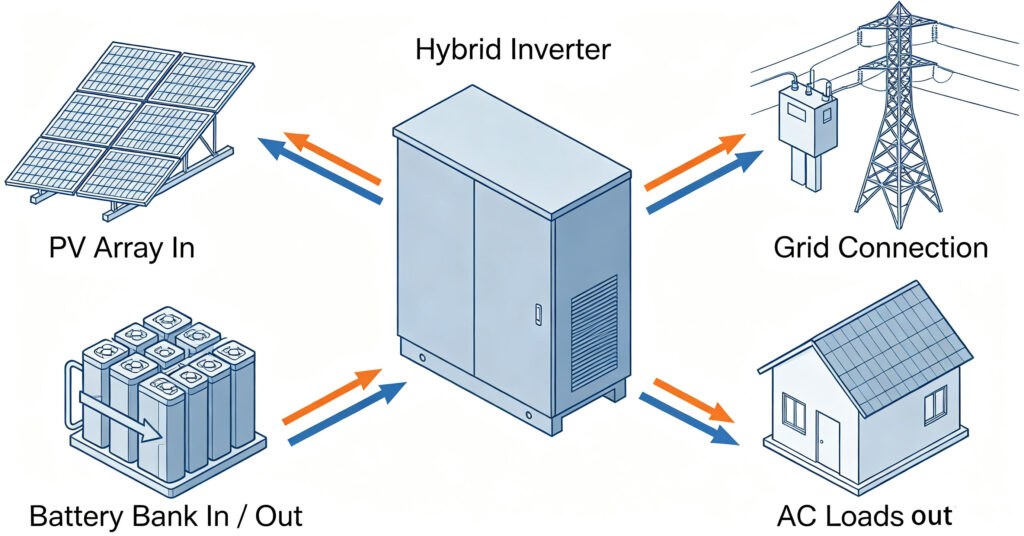
An energy storage inverter (usually a hybrid inverter) is the device that converts DC from your solar array and battery into AC for the loads, while managing when the battery charges and discharges. Choose one by matching six things in order: battery voltage and chemistry, continuous and surge power, PV input and MPPT ranges, the communication protocol between inverter and battery BMS, round-trip efficiency and standby losses, and the grid certification your market requires. Get the battery match and the protocol right first — those are the two things that cannot be fixed after purchase.
Installers and integrators often pick the battery first, then shop for an inverter that “works with it.” That order is correct — but only if the inverter is chosen with the same discipline as the battery. This guide walks through the decision framework a competent supplier will walk you through anyway, so you can verify rather than trust.
What an energy storage inverter does that a plain solar inverter cannot
A grid-tied string inverter has one job: push DC from panels to the AC grid. A storage inverter adds a battery port, a charge controller stage (often built-in MPPT), and the logic to decide where energy goes — loads first, battery second, export last. Off-grid versions go further: they form the grid themselves, creating their own voltage and frequency with no utility reference.
| Inverter type | What it does | Best for | Watch out for |
|---|---|---|---|
| Grid-tied (string) | Panel DC → AC, export only | Pure self-consumption, no backup | No battery port; shuts down in outages |
| Hybrid | PV + battery + grid, manages charging | Most new solar-plus-storage installs | Battery compatibility list must include your pack |
| Off-grid / standalone | Forms its own AC grid from battery | Cabins, farms, telecom, no utility | Needs generator input for long bad weather |
| AC-coupled battery inverter | Adds battery behind existing PV inverter | Retrofitting storage to old solar | Extra conversion step, slightly lower efficiency |
| DC-coupled charge controller + inverter | Separate MPPT charges battery, inverter draws from it | Small 12/24/48 V systems, RVs, boats | More boxes to wire and configure |
The rows overlap in marketing language — many products are sold as “hybrid off-grid inverters.” Read the datasheet for the battery port and the islanding behaviour, not the label.
Step 1 — Match battery voltage and chemistry before anything else
The fastest way to waste a purchase is an inverter whose battery window does not match the pack. A 48 V system is not “roughly 48 V”: a 16S LiFePO4 pack ranges from about 40 V empty to 58.4 V full. The inverter’s battery voltage range must cover the pack’s full charge and discharge window, and its charge profile must suit lithium — absorption, float, and low-temperature cut-off behaviour. Confirm the chemistry support in writing: LiFePO4, NMC, and lead-acid all need different charge curves, and an inverter tuned for lead-acid will undercharge or overcharge a lithium bank.
For packaged rack or wall-mount batteries, the simpler rule applies: the inverter must be on the battery maker’s compatibility list, or the battery must be on the inverter’s. If neither document exists, treat the pairing as untested.
Step 2 — Size continuous and surge power for real loads
Continuous power (kW) must cover the sum of loads that run at the same time; surge power (kVA, typically 2× continuous for a few seconds) must cover motor inrush — well pumps, compressors, power tools. Undersizing surge is the most common cause of nuisance trips in off-grid solar inverter installations. On the other side, a heavily oversized inverter runs inefficiently at low load and wastes standby energy all night. A practical band: size continuous power at 120–150% of your measured simultaneous peak, and verify surge against your single largest motor start.
Step 3 — Check PV input and MPPT windows
Two ranges decide whether your existing or planned array can connect: maximum PV input voltage (must exceed the string’s coldest-condition open-circuit voltage with margin) and MPPT start/operating voltage. Also count MPPT trackers — two trackers let you face panels in two directions, which matters for afternoon-weighted production that better matches evening battery discharge. Undersized PV input on a retrofit is a silent dealbreaker: the inverter may run, but clip production all day.
Step 4 — Get the communication protocol right
Modern lithium batteries refuse to work blind. The inverter and the battery’s BMS must speak the same protocol — CAN bus at 250 or 500 kbps for most home storage, RS485 with a manufacturer-specific register map for many smaller systems. When the handshake works, the inverter sees state of charge, temperature, and charge/discharge limits, and respects them. When it does not, you get forced derating, random shutdowns, or a battery that never reaches 100%.
Ask the battery supplier for three documents: the protocol version list, the exact inverter models tested, and the firmware notes. For a deeper treatment of the BMS side of that conversation, see #34 on BMS-inverter integration and #28 on what a BMS does.
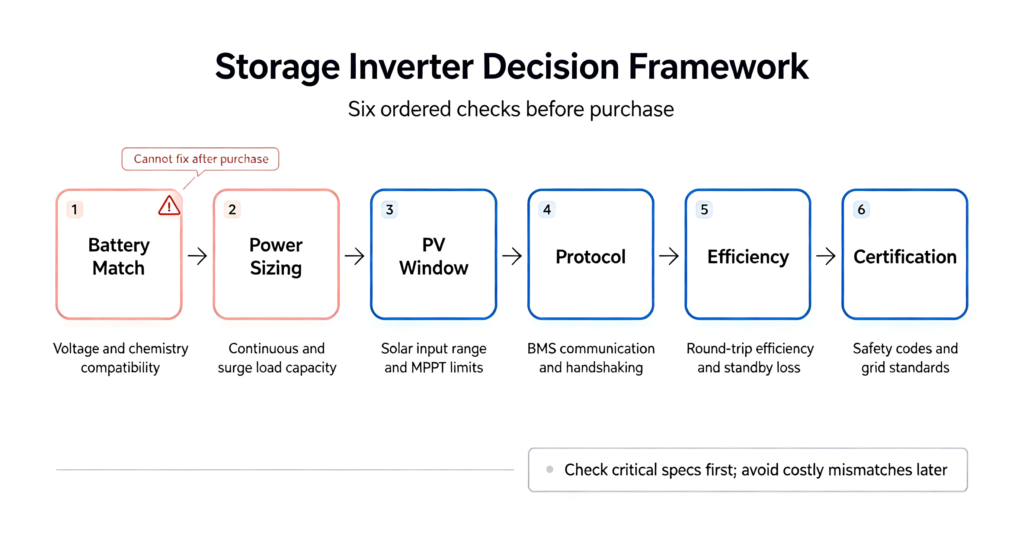
Step 5 — Compare efficiency and standby losses honestly
Peak efficiency (typically 96–98%) flatters every product on the market. What separates good from mediocre is efficiency at 10–20% load — where residential inverters spend most of their day — and night-time standby draw, which can quietly eat 1–2% of a small battery every night. Ask for the efficiency curve, not the headline number. Over a ten-year life, one or two percentage points of part-load efficiency compounds into more energy than the price difference between inverter brands.
Step 6 — Verify grid certification and warranty terms
Each market enforces its own connection rules: EN 50549 and VDE grid codes across much of Europe, IEEE 1547 and UL 1741 SB in North America, AS/NZS 4777.2 in Australia. An inverter without the local listing will fail interconnection approval no matter how good it is. Read the warranty the way you read the datasheet: coverage length (typically 5–10 years), what voids it (unlisted battery pairings often do), and who ships the replacement.
The spec table to demand before you order
Whether you are quoting one system or a hundred, the same parameters decide the deal. Bring this table to the supplier call and refuse blanks:
| Parameter | Why it matters | Typical range (home/C&I) |
|---|---|---|
| Continuous output power | Covers simultaneous loads | 3–10 kW home; 30–100+ kW C&I |
| Surge / peak power | Motor starts without tripping | 2× continuous, 3–10 s |
| Battery voltage window | Must span pack’s empty-to-full range | 40–60 V (16S LFP) as example |
| Max PV input voltage | String must fit under it cold | 450–1000 V |
| MPPT trackers × range | Array orientation flexibility | 1–4 trackers |
| Battery chemistry support | Charge curve correctness | LFP / NMC / lead-acid, in writing |
| Communication protocol | BMS ↔ inverter handshake | CAN 250/500 k; RS485 variants |
| Round-trip efficiency | Lifetime energy losses | 90–96% battery-AC-battery |
| Standby consumption | Night drain on small banks | <20 W target for home units |
| Grid certification | Interconnection approval | EN 50549 / IEEE 1547 / AS 4777.2 |
| IP rating & operating temp | Install location freedom | IP65 outdoor, −25 to 60 °C |
| Warranty & battery-pairing clause | Who pays when it fails | 5–10 yr; check voids |
How battery suppliers make the pairing easier
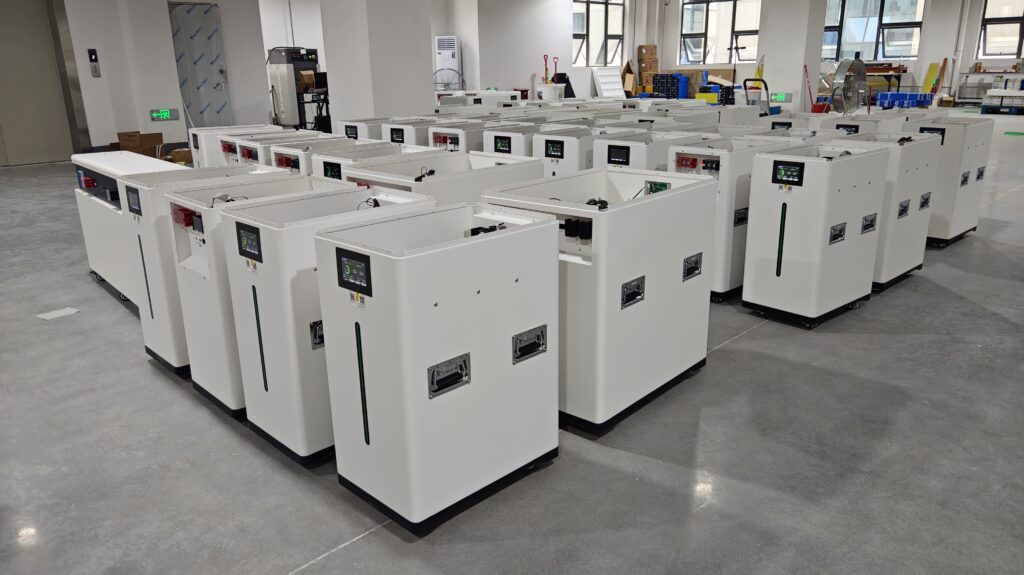
leekooenergy does not build inverters — the focus is lithium packs and the BMS inside them. That division of labour is exactly why battery makers publish compatibility matrices: every leekooenergy pack ships with a matched BMS, documented CAN/RS485 protocol maps, and a growing list of tested hybrid and off-grid inverter partners. When you evaluate a battery, ask for that list and the protocol documents as a package; a supplier who cannot produce them is asking you to do their integration testing for free. For matching a pack to a 48 V architecture, the #35 guide to 48 V lithium systems covers the voltage-side logic.
Installer confirmation checklist
- Battery window and chemistry confirmed against the pack datasheet, in writing
- Simultaneous-peak load measured, surge motor identified by nameplate
- String Voc cold-weather calculation inside the inverter’s PV limit
- Protocol version + tested-inverter list received from the battery supplier
- Part-load efficiency curve and standby draw on file
- Local grid code listing verified on the certifier’s public database
- Warranty battery-pairing clause read before signature, not after
Q. What size hybrid inverter do I need?
Size continuous power to 120–150% of your measured simultaneous peak load, not to the array or battery capacity. Then check that surge rating (usually 2× continuous) covers your largest motor’s start. Oversizing “to be safe” costs efficiency every hour the inverter idles above its comfort zone.
Q. Can I use any inverter with any battery?
No. The inverter’s battery voltage window must span the pack’s full range, its charge profile must suit the chemistry, and the BMS protocol must match. Without a documented pairing on either side’s compatibility list, expect derating, false faults, or a bank that never fully charges.
Q. What is the difference between a hybrid inverter and an off-grid inverter?
A hybrid inverter connects PV, battery, and the utility grid, exporting or importing as policy allows. An off-grid inverter forms its own AC grid from the battery with no utility reference and usually accepts a generator input. Many products do both — the datasheet, not the label, settles it.
Q. Do I need a separate charge controller with a storage inverter?
Usually not. Hybrid and off-grid solar inverters integrate MPPT charge control for the battery port. Separate MPPT controllers remain the norm in small DC systems (12/24/48 V) built from components — RVs, boats, and small cabins.
Q. Which certifications should I check for my market?
EN 50549 / VDE codes for much of Europe, IEEE 1547 and UL 1741 SB for North America, AS/NZS 4777.2 for Australia and New Zealand. Verify the listing on the certifier’s public register — the logo on a datasheet is not proof of approval.
Next step: confirm the pairing in writing before you order
Send your battery model and array details to the inverter supplier, and the inverter model to the battery supplier — then accept the pairing only when both reply with documents. An afternoon of paperwork prevents the two failure modes no commissioning can fix.
- Request the leekooenergy inverter compatibility matrix and protocol documents with your pack quote
- Read #34 on BMS-inverter integration for the protocol workflow
- Cross-check grid listings on the certifier’s public database before signature