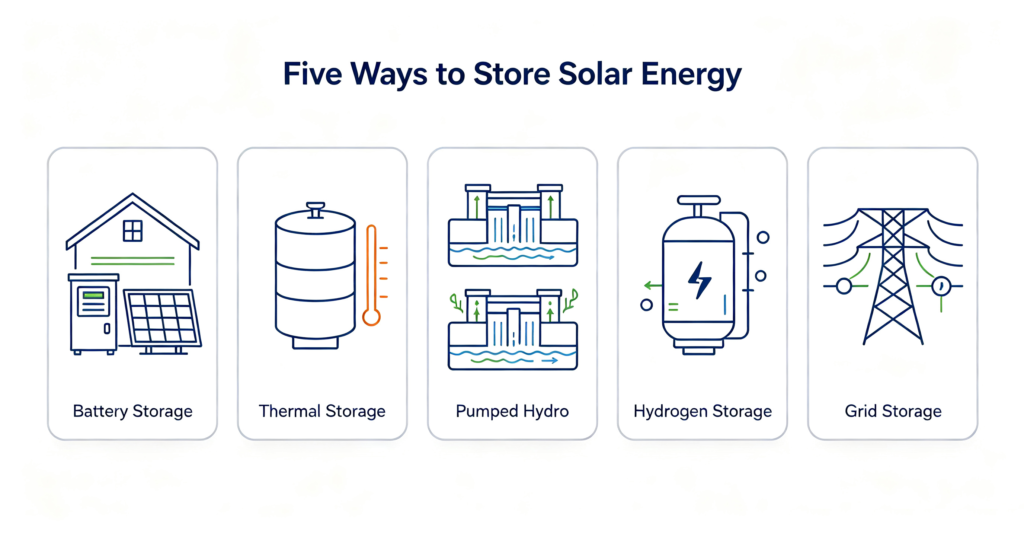
The question of how to store solar energy comes down to converting the electricity (or heat) your panels produce into a form you can hold until you need it. The five practical methods are: electrochemical batteries, thermal storage, pumped hydro, hydrogen, and the utility grid itself via net metering. For homes and most businesses, lithium batteries — with LiFePO4 the mainstream chemistry — are the only method that is efficient, scalable, and installable behind your meter today; the other four either need utility scale, special geography, or a utility policy to make sense.
Solar panels peak at noon; households peak in the evening. Every storage method ever built exists to move energy across that gap. Which one is “best” is really a question of scale — a homeowner, a factory, and a grid operator get very different answers, and the comparison below shows exactly where each method earns its place.
Method 1 — Batteries: storage you can install this month
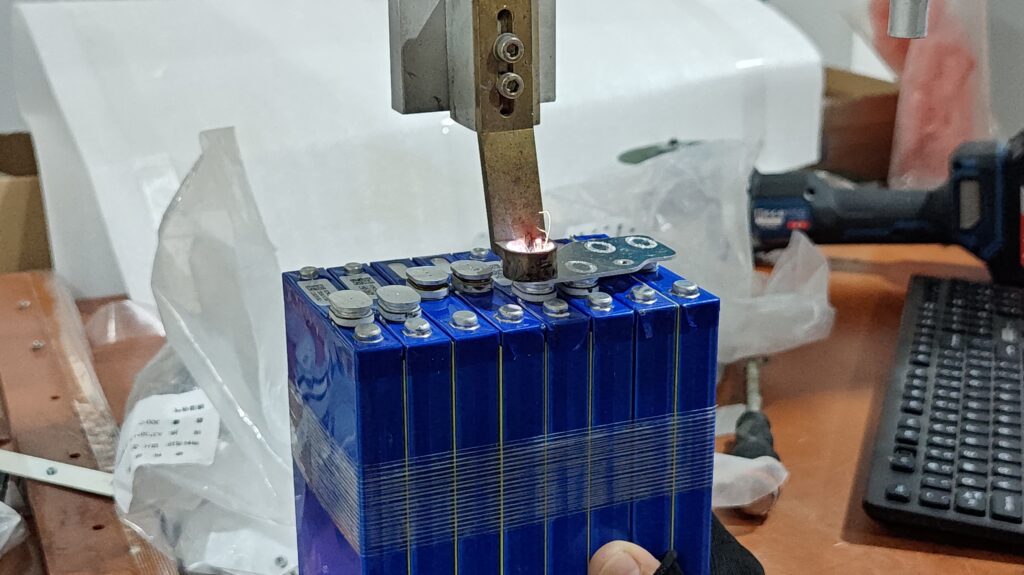
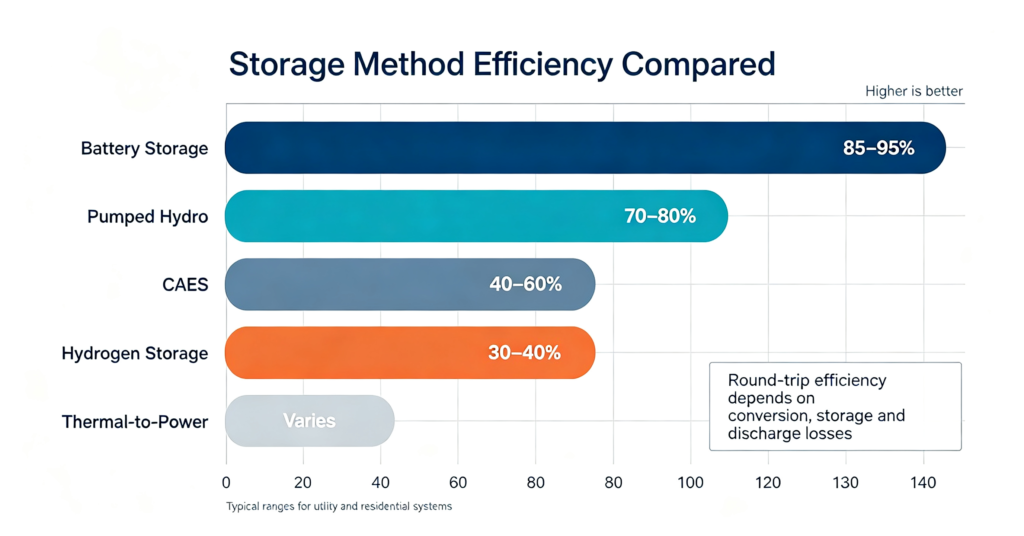
Batteries store solar electricity directly as chemical energy and return it at 85–95% round-trip efficiency. They respond in milliseconds, sit on a wall or in a rack, and scale from a 5 kWh home unit to container-sized commercial banks. Lithium iron phosphate (LiFePO4) has become the default chemistry for stationary storage: it tolerates deep daily cycling (typically 4,000–6,000 cycles to 80% capacity), resists thermal runaway, and needs no maintenance. Lead-acid still appears where upfront cost is the only constraint, at the price of roughly half the usable energy per purchased kWh.
The catch is cost per stored kWh and finite calendar life. A battery is a consumable measured in cycles, which is why daily-cycled systems deserve a chemistry chosen for cycle life, not energy density — the argument made in detail in #33 on LiFePO4 vs NMC.
Method 2 — Thermal storage: cheap heat, clumsy electricity
Solar heat can be parked in water tanks, molten salt, or phase-change materials and released hours later for hot water, space heating, or — in concentrated solar plants — steam turbines. Per unit of energy it is far cheaper than batteries. But converting stored heat back to electricity loses most of it, so thermal makes sense when the demand is heat itself: a solar water heater with a well-insulated tank is the highest-return “storage” a household can buy, even though it stores no electricity at all.
Method 3 — Pumped hydro: the grid’s century-old battery
Pumped storage hydropower moves water uphill when power is surplus and lets it fall through turbines when it is scarce, at 70–80% round-trip efficiency and with 50+ year asset lives. It still stores over 90% of the world’s grid-scale energy. It is also the least installable method on this list: you need elevation and reservoirs, a decade of permitting, and utility-scale capital. Homeowners cannot buy it; grid operators already do, at terawatt-hour scale.
Method 4 — Hydrogen: long-duration storage, at a price
Surplus solar can split water into hydrogen, which stores for months and reconverts to electricity in a fuel cell or turbine. As seasonal storage — bank summer sun for winter — nothing else matches it. The costs are conversion losses (30–40% round trip today), expensive electrolysers, and gas handling. Hydrogen is a serious answer for utilities and industry balancing seasons; for a home it is, for now, a research topic rather than a product.
Method 5 — The grid: net metering as virtual storage
Exporting surplus solar and drawing it back at night uses the grid as a 100%-efficient “virtual battery” with no upfront cost — where policy allows it. The catches: export compensation keeps shrinking in many markets, the credits vanish with the policy, and a net-metered system without batteries still goes dark in an outage. Net metering and batteries are complements, not rivals: the grid absorbs seasonal surplus, the battery covers evenings and blackouts, as #27 on self-consumption works through with numbers.
The comparison at a glance
| Method | Round-trip efficiency | Scale | Energy horizon | Practical for |
|---|---|---|---|---|
| Batteries (LiFePO4 / li-ion) | 85–95% | 3 kWh – 100+ MWh | Hours–days | Homes, C&I, grid services |
| Thermal (water / molten salt) | 40–90% (to heat ~90%; to power much lower) | kWh – GWh | Hours–days | Hot water, CSP plants, industrial heat |
| Pumped hydro | 70–80% | GWh–TWh | Hours–weeks | Utilities with geography |
| Hydrogen | 30–40% | MWh–TWh | Weeks–seasons | Seasonal grid, industry |
| Grid export (net metering) | ~100% (policy-dependent) | Any | Policy-defined | Grid-tied homes, where credited |
Which method fits which buyer
- Homeowner: a right-sized LiFePO4 battery, plus whatever export credit your tariff still pays. Thermal hot water is the cheapest add-on if you heat water electrically.
- Business with day-shift loads: batteries sized to the evening peak and demand charges; solar self-consumption does most of the work, as in #16 on commercial solar plus storage.
- Utility / industrial campus: batteries for hours-scale shifting; pumped hydro and hydrogen for days-to-seasons, decided by geography and capital budget, not by efficiency tables.
For the buyers this site serves — installers, integrators, and the businesses behind them — that logic is why leekooenergy builds its storage line around LiFePO4 packs at 48 V rack and wall-mount formats: the one method on this list that ships in a box, scales by the module, and pays back inside a battery’s service life.
Q. What is the most efficient way to store solar energy?
Lithium batteries, at 85–95% round-trip efficiency. Only grid export via net metering beats it, and only where policy credits exports at full value — the “efficiency” there is a tariff outcome, not a physical one.
Q. Can you store solar energy without batteries?
Yes. Thermal storage (a hot-water tank is the everyday example), pumped hydro, and hydrogen all store solar energy without a battery, and net metering exports it instead of storing it. Each works at a different scale, and none is a drop-in home substitute for a battery today.
Q. How long do solar batteries hold their charge?
Months, at low self-discharge — a lithium pack typically loses only a few percent per month idle. The real constraint is not holding charge but cycle life: a daily-cycled LiFePO4 bank is usually rated for 4,000–6,000 cycles, roughly 10–15 years of daily use.
Q. Is it better to export surplus solar or store it?
It depends on what your tariff pays for export versus what your imported power costs. Where export credits are generous, export first; where they are low or zero, every stored kWh is worth the full retail price. In outage-prone regions, storage buys something no export can: power when the grid is down.
Q. How much solar energy can a home battery store?
Typical residential units hold 5–16 kWh — roughly one evening and morning of essential loads, or a full night of a frugal household. Banks scale in parallel from there; sizing the right capacity is covered in the #9 home battery sizing guide
Next step: size the battery, not the debate
Methods two through five answer questions for utilities and researchers. If your job is a home or a business site, the decision collapses to one number: how many kWh you need after sunset. Start from your evening load list, then pick the chemistry and format that survives daily cycling.
- Compare chemistries in #33 LiFePO4 vs lithium-ion before choosing a pack
- Work the capacity math with #9 home battery sizing
- Review leekooenergy rack and wall-mount LiFePO4 options for your next project