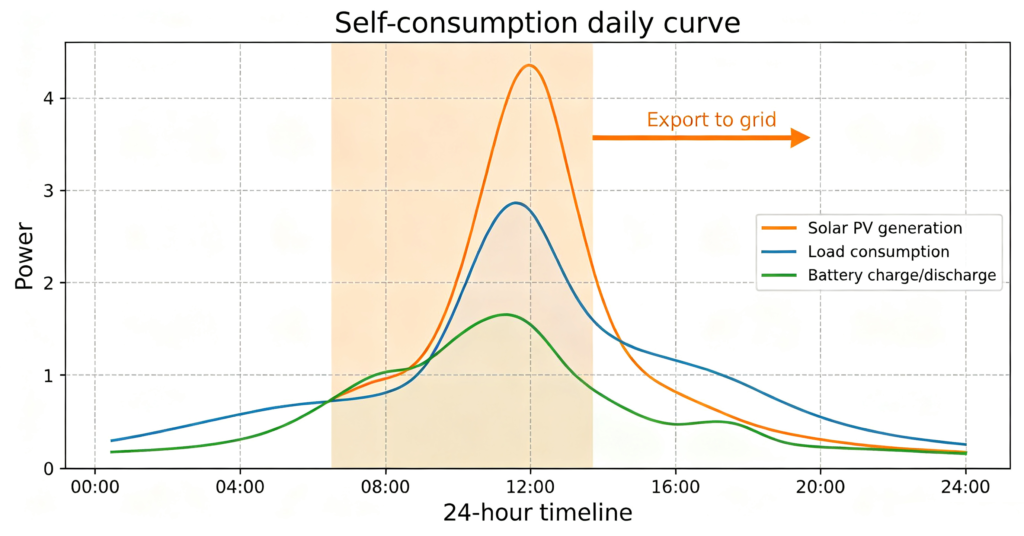
Adding batteries to a commercial solar system lets a business use more of its own PV and export the rest on its terms. Without storage, midday solar often spills to the grid at a low feed-in rate while the business still buys expensive evening power. A battery shifts that midday energy to the evening peak — the core “self-consumption” play.
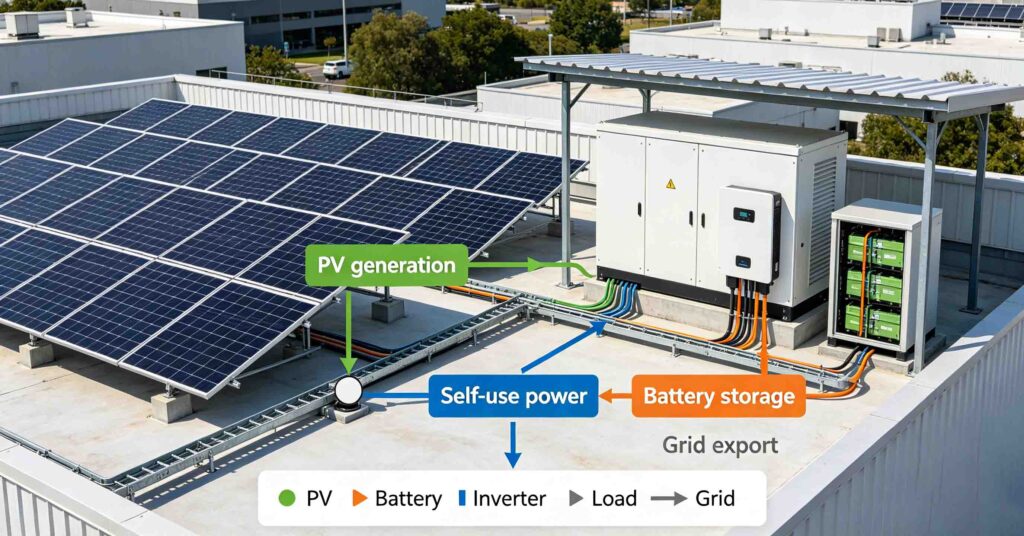
How the system is wired
PV feeds an inverter; the inverter both powers the site and charges the battery through a power conversion system (PCS). Surplus can export to the grid. The battery and PCS are sized so the site can carry its evening load on stored solar rather than buying grid power.
The savings math (in plain terms)
| Lever | What it saves | Depends on |
|---|---|---|
| Self-consumption | Evening grid purchase | PV size vs load shape |
| Peak shaving | Demand charges | Tariff structure |
| Export | Feed-in revenue | Local export rate |
What to size first
- PV size and load shape. A site with high daytime load self-consumes easily; a site empty by day needs export or larger evening storage.
- Eligible incentive. Check local commercial PV/storage incentives before finalizing capacity.
- Battery power vs energy. Evening shift needs kWh; demand control needs kW. Size to the tighter constraint.
- Export limit. Some grids cap export — size the battery to absorb more of the midday surplus instead.
Common mistake: over-sizing PV, under-sizing storage
Many sites add panels but skip storage, then export cheap midday energy and buy expensive evening power — the worst of both. A modest battery often beats a much larger array for self-consumption economics.
How self-consumption actually works
Solar panels often make more at noon than the business uses; without storage that surplus exports at a low feed-in rate. A battery catches the surplus and releases it when the sun drops and the building still draws power, so the business buys less from the grid at peak rates. The gain is the gap between cheap self-made energy and expensive grid energy — wider where feed-in tariffs are low and peak rates are high.
PCS and system topology
The power conversion system (PCS) is the inverter that moves energy between DC batteries and AC loads or grid. In a typical commercial topology, panels feed the PCS, the battery hangs on the DC or AC bus, and the site load draws from the bus. A hybrid PCS can do solar, battery, and grid management in one box; separate inverters split the roles. The choice affects efficiency, redundancy, and cost.
Walking through the revenue
A simple model: if a site self-consumes an extra 100 kWh/day that would otherwise export at $0.05 and import at $0.25, the daily value is the 100 kWh × the $0.20 spread, minus round-trip losses. Over a month that compounds. Exact numbers need your tariff and generation profile; request a simulation from the supplier rather than trusting a generic payback claim.
Four-step sizing
- Pull the tariff. Find peak rate, off-peak rate, and feed-in rate.
- Profile the load. Identify the daily evening draw the battery should cover.
- Size energy. Match battery usable kWh to that draw at your depth of discharge.
- Size power. Set PCS kW to the peak the battery must deliver, not just average.
Self-use vs export: the tradeoff
Where feed-in rates are high, exporting surplus may beat storing it; where they are low, storage wins. The break-even shifts with policy, so revisit it at quote time. A good supplier models both and shows the crossover, not just the sunny-day best case.
What to confirm with the supplier
- Usable capacity at your planned depth of discharge.
- PCS efficiency and whether it handles solar + battery + grid together.
- Communication protocol for your existing inverter or SCADA.
- Enclosure cooling and fire rating for a commercial site.
- Lead time and whether the PCS or the enclosure is the critical path.
Common mistakes
Buyers size energy but forget PCS power, or assume one inverter brand’s battery talks to another’s — it often does not without the right protocol. Confirm closed-loop compatibility in writing, and size power to the real peak, not the average.
Monitoring the result
Track self-consumption ratio and peak import after commissioning. If the ratio stalls, the battery may be undersized for the load or the tariff has shifted; both are fixable with a small expansion rather than a rebuild.
Who benefits most
Businesses with a daytime solar surplus and a high evening peak rate gain first. Sites on flat tariffs or with tiny roofs gain less. The battery is a financial tool here, not just backup — size it to the bill, not the roof.
Reading your tariff in five minutes
Find three lines on your business electricity bill: the peak (or demand) rate, the off-peak rate, and the export (feed-in) rate. The storage case is strong when peak minus off-peak is wide and export is low. If export is high, the battery competes with a generous buyback and the case weakens. This five-minute read tells you whether to size a battery at all before any supplier call. Keep the bill handy during supplier talks; a good vendor will model the actual tariff, not a generic one.
PCS brand and protocol note
Commercial sites often already have an inverter or SCADA. The new battery’s PCS must speak to it — via Modbus, CAN, or the vendor’s API. Confirm this before order; a mismatch means the battery runs blind or not at all. A supplier that asks for your existing equipment list upfront is doing the integration work you are paying for.
From pilot to site-wide
Many businesses start with one cabinet as a pilot, prove the self-consumption gain on real data, then add more. This stages capital and de-risks the model. Design the first cabinet with headroom — PCS and wiring sized for the eventual fleet — so expansion is additive, not a rebuild.
One more check: the export cap
If you enable export, set the limit in commissioning and confirm it matches the utility’s rule. An uncapped export can trip the interconnect or breach terms; a set-and-forgotten cap keeps the site compliant. This five-minute step is the difference between a clean install and a flagged one.
Q. Is commercial solar battery storage worth it?
For sites with a daytime-to-evening load gap and decent evening tariffs, yes — storage captures self-consumption the panels alone cannot. Worth depends on the local tariff, not the panel brand.
Q. What size battery for a commercial solar system?
Start from the evening energy gap after PV: typical daily shift is the battery’s target kWh. Add peak-shaving kW only if demand charges are material. See the C&I guide for the full model.
Q. Can I export surplus to the grid?
Yes, where the grid allows and pays. Export caps vary; a battery can also store more of the midday surplus for later use instead of exporting at a low rate.
Q. Do I need storage if I already have solar?
Only if you want more of your solar’s value. Without storage, excess midday PV exports cheap and you still buy evening grid power. Storage closes that gap.
Q. How long before it pays back?
It tracks your electricity rate and incentives, not a fixed clock. Build the case from your site’s tariff and load shape with a supplier quote.
Adding storage to C&I solar?
See C&I Solution page,review Commercial & Industrial Energy Storage Overview Build the ROI model and send the electricity bill to leekooenergy for a self-consumption sizing.