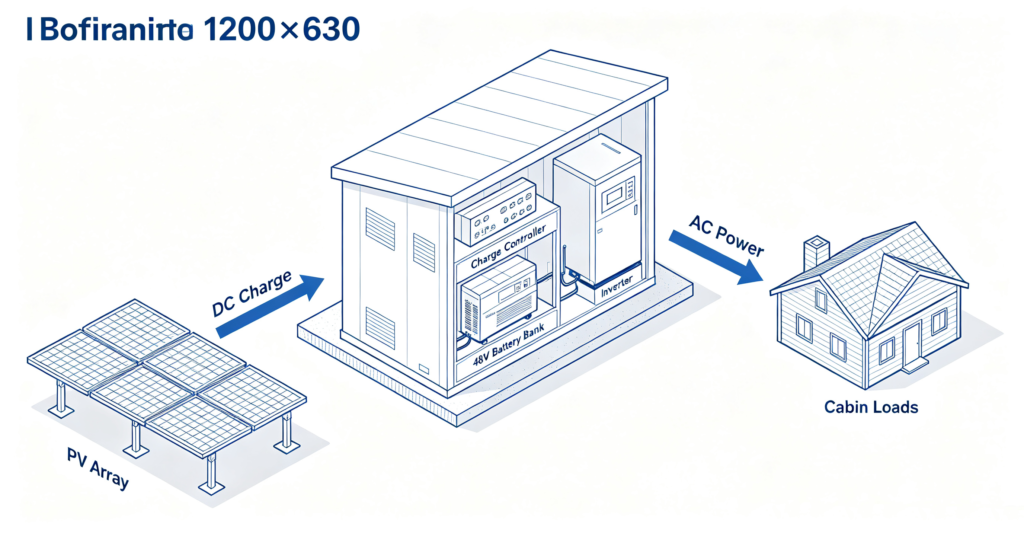
How to go off grid with solar is, in practice, a battery question: the bank comes first — not the panels. Size it backwards from your loads: daily energy (kWh) × days of autonomy ÷ usable depth of discharge ÷ system efficiency. That gives nominal kWh; then choose chemistry (LiFePO4 for daily cycling, lead-acid only when capital is the sole constraint), pick a 48 V architecture for any home-scale system, and match the inverter and charge controller to the bank’s voltage window and surge loads. A worked example: 8 kWh/day with two cloudy-day autonomy needs roughly 20 kWh of nominal LiFePO4 — four 5.12 kWh 51.2 V 100 Ah modules in parallel.
Most off-grid failures are not equipment failures — they are sizing failures. A bank designed for the annual-average day browns out in the worst month; a bank designed for the brochure price dies in year three. This guide follows the sequence professional installers use, with the arithmetic shown at every step, so you can check any quote you receive against the same math.
What an off-grid solar system actually is
An off-grid system has no utility connection at all: PV modules feed a charge controller, the controller charges the battery bank, and an off-grid inverter forms its own AC grid for the loads, with a generator input for long bad weather. That is what separates it from a hybrid system, which still leans on the utility as backup. Off the grid, the battery is not an accessory — it is the grid. Everything else in the system is sized around it, which is why the design sequence below starts with loads and ends with hardware, never the reverse.
Step 1 — Measure the loads before you buy anything
List every load you refuse to live without, with its watts and daily hours, then add them into kWh/day. Use a plug-in power meter for anything uncertain — nameplates overstate real consumption. Typical off-grid figures to sanity-check against:
| Load | Typical daily energy | Notes |
|---|---|---|
| Efficient refrigerator | 1.0–1.5 kWh | Older units can double this |
| LED lighting, whole house | 0.3–0.8 kWh | Cheap to serve, always on the list |
| Laptop / router / phones | 0.3–0.5 kWh | Home-office baseline |
| Well pump (intermittent) | 1–3 kWh | Check surge current for inverter sizing |
| Chest freezer | 0.8–1.2 kWh | Add 0.4 kWh in hot climates |
| Washing machine | 0.5–1.0 kWh per cycle | Run midday on direct solar |
| Air conditioning | 2–8+ kWh | The load that decides system size — minimize first |
Conservation is cheaper than capacity: every kWh/day you cut from the list removes roughly a quarter of a battery module from the bill. Off-grid homes typically land between 5 and 15 kWh/day precisely because of this table.
Step 2 — Plan around your worst month, not your average
Design the bank for the darkest realistic season. Look up peak sun hours for your site in the worst month (a solar atlas or local installer data), and plan the array to recharge the bank fully in that month — with 10–20% margin for panel soiling and ageing. Sizing for the annual average is the classic first mistake: the system is glorious in June and runs the generator every day in December.
Step 3 — Size the battery bank: the core calculation
The bank sizing formula, one line:
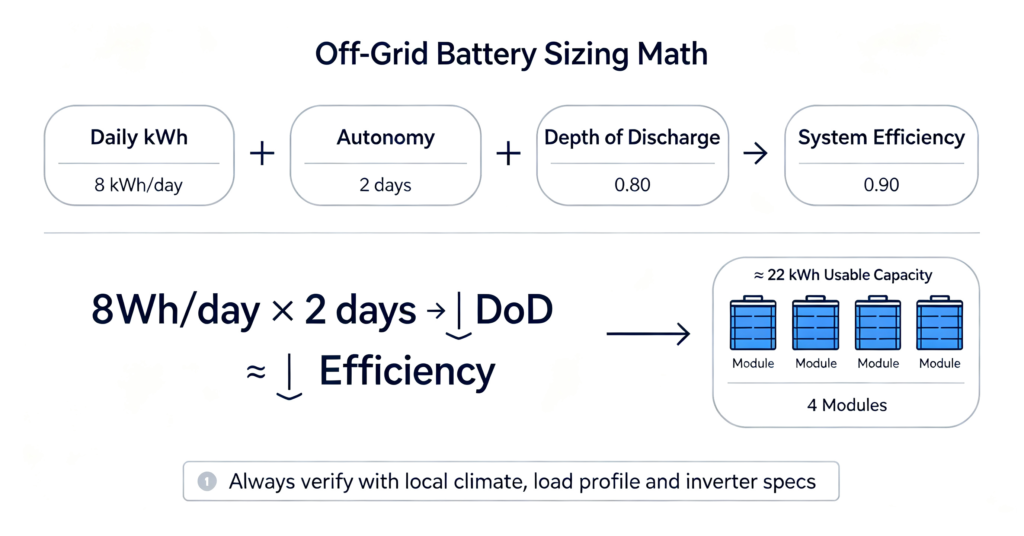
Nominal kWh = (daily kWh × autonomy days) ÷ depth of discharge ÷ round-trip efficiency
Worked example — the one from the opening, made explicit:
- Daily energy: 8 kWh (refrigerator, lights, office, water pump, freezer, one laundry cycle)
- Autonomy: 2 days of no meaningful sun (a common temperate-climate choice; 1 day in reliably sunny regions, 3+ where winters are brutal)
- Depth of discharge: 90% usable (LiFePO4, with BMS limits)
- Round-trip efficiency: 90% (battery + charge controller + wiring)
- Nominal kWh = (8 × 2) ÷ 0.9 ÷ 0.9 ≈ 19.8 kWh
That rounds up to four 51.2 V 100 Ah modules (5.12 kWh each, 20.5 kWh total) — one spare module of headroom for ageing. The same math at 1-day autonomy needs two modules; at 3 days, six. Notice how autonomy, not the loads, drives most of the cost: this is where honest design conversations happen.
Step 4 — Choose the chemistry: LiFePO4 vs lead-acid
| Criterion | LiFePO4 | Lead-acid (flooded/AGM) |
|---|---|---|
| Usable depth of discharge | 80–90% | ~50% (life collapses deeper) |
| Cycle life, daily cycling | 4,000–6,000 cycles | 500–1,200 cycles |
| Energy per purchased kWh | ~2× lead-acid over its life | Cheaper sticker, costlier per usable kWh |
| Maintenance | None (BMS-managed) | Flooded cells need watering, equalizing |
| Low-temperature charging | Needs BMS cut-off or heating | Tolerant but lossy |
| Best fit | Homes, farms, daily cycling, 10+ year plans | Cabins used occasionally, minimum-capital builds |
In an off-grid home the bank cycles every single day, so cycle life dominates the economics — the chemistry comparison in #33 extends this trade-off. Lead-acid survives only where the system is used a few weeks a year; a daily-cycled lead-acid bank is a subscription to replacement batteries.
Step 5 — Pick the voltage: 48 V for anything house-scale
At 12 V, a 5 kW inverter draw is over 400 A — copper that thick is absurd. At 48 V the same power is ~100 A, and standard rack modules (51.2 V nominal, 16S LiFePO4) snap together with busbars. Rules of thumb: 12 V for small cabin/RV loads, 24 V up to ~2 kW continuous, 48 V from there up. If you expect the system to grow, start 48 V immediately — the #35 guide to 48 V lithium systems explains the architecture in depth, and #12 covers the 48 V vs 51.2 V naming confusion.
Step 6 — Match inverter and charge controller to the bank
Close the loop with three checks. First, the inverter’s battery voltage window must span the pack’s full range (about 40–58.4 V for 16S LFP) and its charge profile must suit lithium. Second, surge rating must cover your largest motor start — the well pump, not the fridge. Third, the charge controller’s maximum output current must respect the bank’s charge limit, and the BMS must communicate with the inverter (CAN/RS485) so the system sees state of charge instead of guessing. If any check fails, change the hardware, not the expectation — the #17 inverter selection guide walks through this handshake in detail.
The mistakes that kill off-grid banks
- Sizing to the average day — December disagrees, loudly, via generator runtime
- Forgetting surge loads — the bank survives; the inverter trips on the well pump every morning
- Deep-cycling lead-acid — 80% discharge turns a 1,200-cycle battery into a 200-cycle one
- Charging LFP below freezing — without BMS cut-off or low-temp heating, lithium plating quietly ruins cells
- No monitoring — a bank you cannot see state-of-charge on is a bank you discover failing in year two
Q. How many batteries do I need to go off grid?
Work it from loads, not from a count: (daily kWh × autonomy days) ÷ 0.9 DoD ÷ 0.9 efficiency. A frugal 5 kWh/day home with 1-day autonomy needs about 6–7 kWh nominal (two 5.12 kWh modules); a full 10 kWh/day homestead with 2-day autonomy needs about 25 kWh (five modules). The loads table and formula above do it in five minutes.
Q. Are lithium batteries worth it for off-grid solar?
For a daily-cycled home, yes: LiFePO4’s 4,000–6,000 cycles and 80–90% usable discharge roughly halve the cost per usable kWh over the bank’s life compared with lead-acid, and remove the maintenance visits. For a cabin used a few weeks a year, cheap AGM batteries can still make sense.
Q. What voltage should my off-grid battery bank be?
12 V for RVs and tiny cabins, 24 V up to about 2 kW of continuous load, 48 V for anything house-scale. Higher voltage cuts current (and copper cost) for the same power, and 48 V is where the mainstream rack-battery ecosystem — 51.2 V modules, busbars, compatible inverters — already lives.
Q. Can I go off grid with an off grid solar kit?
Kits bundle matched panels, controller, inverter, and batteries, which removes most compatibility risk — but they still must be sized to your loads first. Measure your kWh/day and worst-month sun hours, then choose (or ask a supplier to assemble) a kit around those two numbers. The general kit-selection framework is in #6 on choosing a solar battery kit.
Q. How many days of battery autonomy should I plan?
One day in reliably sunny climates, two in temperate zones, three or more where winter storms stall recharging for days. Each extra day of autonomy adds roughly a full day of bank capacity — the most expensive line in the budget — so pair the number with a generator or plan load-shedding for the darkest weeks instead of buying a third day of lithium.
Next step: build the load table tonight
Every number in this guide flows from one sheet: your loads, in watts and hours, with the fridge and well pump measured rather than guessed. Build it, apply the formula, and you can price any quote — or any kit — in minutes.
- Apply the capacity math from #9 home battery sizing to your load table
- Review leekooenergy 51.2 V 100 Ah rack modules and low-temperature options for your bank
- Send the load table with your RFQ — a supplier who sizes without it is guessing with your money