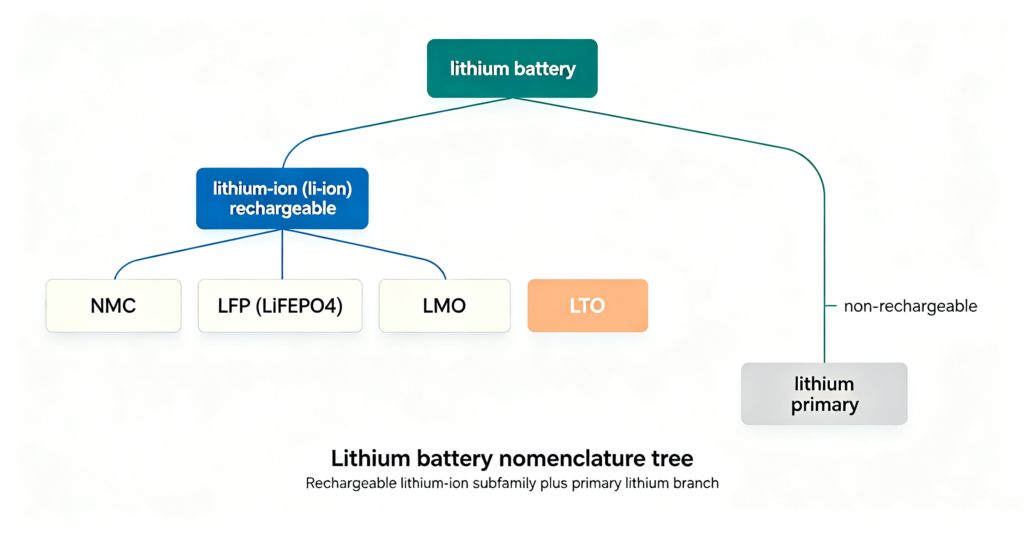
The shortest answer to lithium vs lithium ion (and the related li-ion vs lithium): in everyday speech they usually mean the same thing — a rechargeable lithium battery — but in engineering writing they are not interchangeable. “Lithium battery” is the umbrella term that covers every battery using lithium in any form, including non-rechargeable primary cells; “lithium-ion” (also written “li-ion”) is the specific rechargeable family that uses lithium ions moving between two electrodes. The reverse question — li-ion vs lithium — lands on the same distinction: “li-ion” is a sub-family of “lithium”. So if a product page says “lithium battery” it is almost certainly a lithium-ion rechargeable pack in residential storage; if a spec sheet says “primary lithium” it is a single-use cell that cannot be recharged.
Buyers hit this confusion because the marketing language treats all of these terms as synonyms. The engineering language is stricter, and the stricter version is what matters when a spec sheet claims 6,000 cycles or 80% depth-of-discharge. This guide walks through the eight pairs of terms that show up most often in solar-storage product copy, gives the technically correct answer for each, and flags the cases where the colloquial usage would lead a buyer to the wrong chemistry.
The nomenclature at a glance
| Left term | Right term | Same? | Engineering note |
|---|---|---|---|
| lithium battery | lithium-ion battery | Mostly — but “lithium” is broader | “Lithium” includes non-rechargeable primary cells; “lithium-ion” is rechargeable only |
| li-ion | lithium-ion | Yes — exact synonym | “Li-ion” is the engineering abbreviation; both refer to the same rechargeable family |
| li-ion battery | lithium-ion battery | Yes — exact synonym | Use either; brand copy varies, spec sheets prefer “lithium-ion” |
| lithium battery | regular battery (alkaline) | No — different chemistry | Alkaline is primary zinc-manganese; lithium rechargeable is fundamentally different |
| lithium battery | lithium-ion (NMC) | No — different chemistry | “Lithium-ion” alone most often defaults to NMC in product copy; verify on spec sheet |
| lithium battery | LiFePO4 / LFP | No — different chemistry | LFP is one specific lithium-ion chemistry; not interchangeable with NMC |
| lithium battery | lithium polymer (LiPo) | No — different packaging | LiPo is lithium-ion in a polymer pouch; safer to puncture, lower energy density |
| lithium battery | primary lithium (Li-SOCl2, Li-MnO2) | No — non-rechargeable | Primary lithium cells are single-use; cannot be used in any solar-storage role |
What “lithium” actually means
The word lithium in “lithium battery” refers to the element lithium (Li, atomic number 3) being used as the active material in one or both electrodes. That is the only thing every battery on the list has in common. Beyond that, chemistries diverge sharply. The rechargeable lithium-ion family moves lithium ions between a graphite anode and a metal-oxide cathode through a liquid or polymer electrolyte; the non-rechargeable primary lithium family uses lithium metal or lithium compounds that get consumed irreversibly during discharge. The umbrella term “lithium battery” therefore covers both, and the qualifier “rechargeable” or “primary” is what tells you which one you are holding.
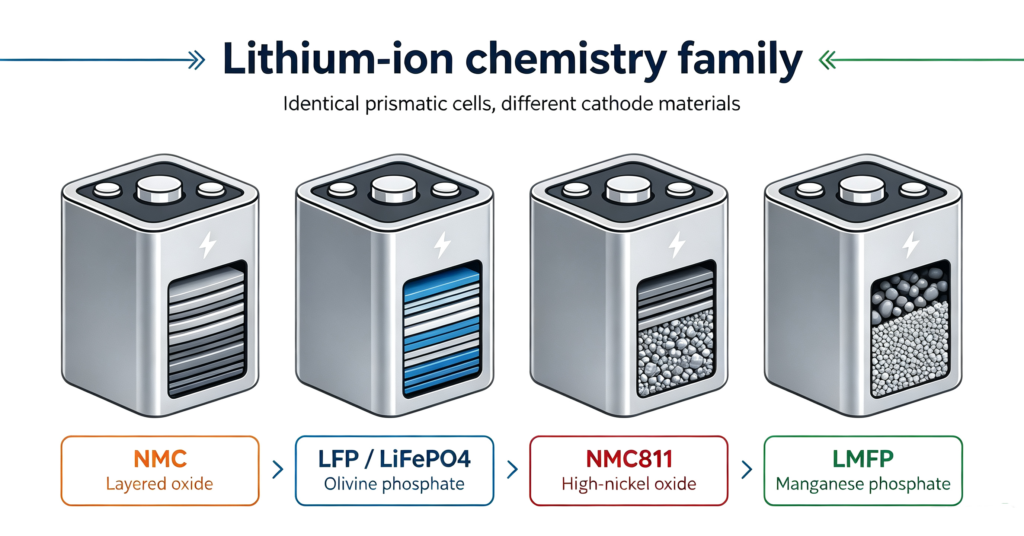
For residential solar storage, every commercially relevant product on the market in 2026 is a rechargeable lithium-ion battery. The variations that matter to a buyer are inside that family: the specific cathode chemistry (NMC, LFP/LiFePO4, NMC811, LMFP), the form factor (cylindrical cell, prismatic cell, pouch), the BMS topology, and the rated cycle life. None of those change the umbrella term — they change which member of the lithium-ion family the pack belongs to.
What “li-ion” adds to the question
The abbreviation li-ion appears in spec sheets, BMS menus, inverter compatibility lists and IEC certification documents. It is not a different battery; it is the engineering shorthand for “lithium-ion”, pronounced exactly the same way. The hyphen and the slash variants (“Li-ion”, “LiIon”, “Li ion”) are all the same family. A spec sheet that says “compatible with li-ion BMS” means “compatible with any lithium-ion battery management system” — not a separate chemistry.
Where confusion creeps in is at the inverter menu level. A hybrid inverter that lists “li-ion” as a battery type almost always defaults to NMC voltage curves unless the menu explicitly offers an LFP option; choosing the wrong one leads to premature low-voltage cutoffs (if NMC curves are loaded on an LFP pack) or dangerous over-charge behaviour (if LFP curves are loaded on an NMC pack). The chemistry selector matters; the umbrella term does not.
The four common confusions, decoded
Confusion 1: “Lithium battery” and “lithium-ion battery” are different products. In residential storage this is false. Every solar-storage pack you can buy in 2026 is lithium-ion. “Lithium battery” on a residential product page is shorthand for lithium-ion; “lithium battery” on a single-use electronics page (a coin cell, a remote-control battery) is shorthand for primary lithium and not rechargeable. The category is determined by the product, not the words.
Confusion 2: “Li-ion” is a cheaper or older version of “lithium-ion”. False. The two terms refer to the same family; “li-ion” is the abbreviation, not a sub-grade.
Confusion 3: A “lithium battery” will fit any “lithium-ion” charger. False at the chemistry level. A charger set for NMC voltage will over-charge an LFP pack; a charger set for LFP voltage will under-charge an NMC pack. Always match the charger’s chemistry mode to the pack’s cathode chemistry, not to the umbrella term.
Confusion 4: Lithium batteries and “regular” (alkaline) batteries are interchangeable. False. Alkaline AA cells are primary zinc-manganese, 1.5 V nominal, single-use. They cannot be recharged, do not deliver the current a solar inverter needs, and will leak if forced into a lithium-ion charger.
Why the precise word matters at the spec sheet
The colloquial umbrella is fine for product copy and customer-facing pages. The strict version matters the moment you compare two products on cycle life, depth-of-discharge or safety. A spec sheet that says “lithium battery, 6,000 cycles” tells you almost nothing — it could be NMC at 80% DoD or LFP at 90% DoD, and the two chemistries degrade very differently. A spec sheet that says “LiFePO4, 6,000 cycles at 80% DoD, 1C charge/discharge” is a contract; the buyer can predict service life, ambient tolerance and thermal-runaway margin from that line. The full chemistry comparison between NMC and LFP, where the engineering precision actually pays off, is in #33 LiFePO4 vs lithium-ion (NMC).
For non-technical buyers — the audience for this page — the practical takeaway is three lines. First, when a product page says “lithium battery” for residential storage, treat it as “lithium-ion rechargeable”. Second, when a spec sheet lists a chemistry (LFP, NMC, LiPo), match the inverter menu to that exact chemistry. Third, when a quote claims cycle life or safety margins, ask for the chemistry before believing the number — the umbrella term does not earn you the warranty.
How the terms travel across a product page
The same battery can show up under three different labels on a single e-commerce site: the page title says “Lithium Battery”, the bullet list says “Li-ion rechargeable”, and the spec sheet says “LiFePO4 prismatic cell, 51.2 V nominal”. All three are correct simultaneously, and all three name the same physical pack. The umbrella term lives in marketing copy because buyers search for “lithium battery” (the high-volume generic term); the abbreviation lives in spec-sheet headers because engineers prefer the short form; the chemistry lives deep in the spec sheet because that is what actually differentiates one pack from another. A reader who learns to expect all three labels on the same product has cracked the nomenclature.
The reverse — a product page that uses only one of the three — is usually a sign of either a non-technical seller (umbrella only) or a technical spec sheet without marketing framing (chemistry only). Neither is wrong; both are incomplete. The complete picture requires reading the umbrella term as the category, the abbreviation as the family, and the chemistry as the specific member of that family. That three-layer reading is what turns a confusing product page into a purchase decision.
Q. Is a lithium battery the same as a lithium-ion battery?
In residential solar storage, yes — every product you can buy is lithium-ion rechargeable. The umbrella term “lithium battery” includes non-rechargeable primary cells (coin cells, single-use electronics batteries), so in the strict sense they are not identical; in solar-storage product copy they are used interchangeably.
Q. Is li-ion the same as lithium-ion?
Yes — “li-ion” is the engineering abbreviation for “lithium-ion”. They refer to the same rechargeable battery family and can be used interchangeably in product copy and spec sheets.
Q. What is the difference between a lithium battery and a LiFePO4 battery?
Lithium battery is the umbrella term; LiFePO4 (also written LFP) is one specific rechargeable lithium-ion chemistry using a lithium iron phosphate cathode. LFP differs from the more common NMC lithium-ion in cycle life (longer), thermal stability (better) and energy density (lower).
Q. Can I charge a lithium battery with a regular charger?
No. A regular (alkaline) charger is for non-rechargeable zinc-manganese cells and will damage any lithium battery. A lithium-ion pack needs a charger or inverter with a lithium-ion mode set to the correct chemistry (LFP, NMC, etc.).
Q. What does “lithium-ion” mean on a product label?
It means the pack is a rechargeable battery from the lithium-ion family. It does not specify which cathode chemistry (LFP, NMC, NMC811, LMFP), which is why two “lithium-ion” packs can have very different cycle life, safety and voltage curves. Read the fine print for the chemistry before comparing.
Next step: drill into the chemistry that fits your use
Once the umbrella term is clear, the decision collapses to which member of the lithium-ion family you actually need. For daily-cycled residential storage the choice usually lands on LFP; for volume-constrained applications it leans NMC.
- Compare the two main chemistries in #33 LiFePO4 vs NMC
- Start from the chemistry in #01 LiFePO4 batteries guide
- Confirm the BESS context in #08 what is battery storage (BESS)
- Browse leekooenergy LiFePO4 packs sized for residential solar