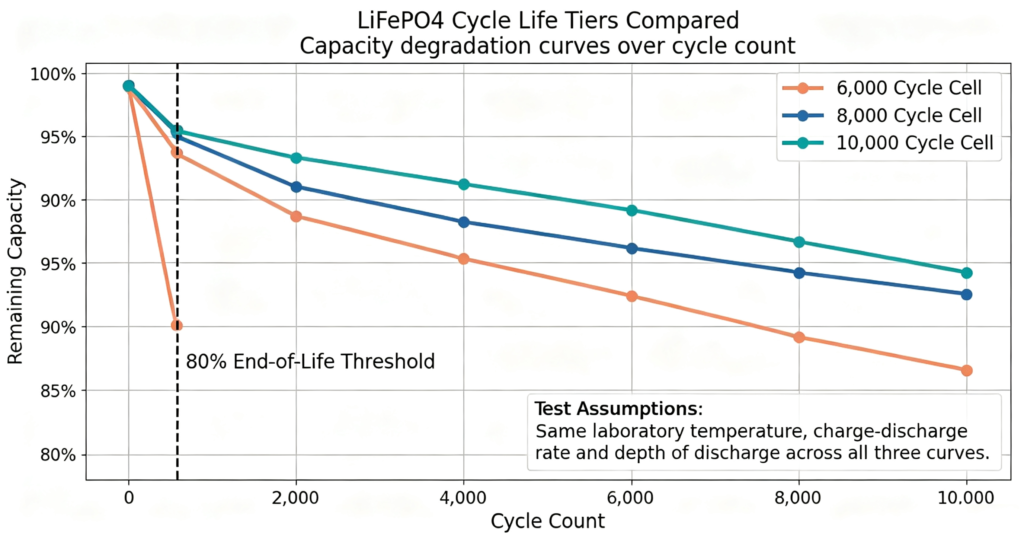
The shortest answer: pay for the cycle tier your duty cycle and project life actually consume — not the highest number on the market. A battery that cycles once a day for a fifteen-year project uses roughly 5,000 cycles, so a well-supported 6,000 cycle platform already covers it with margin; a battery in a daily-cycling commercial tariff-arbitrage role can consume a 10,000 cycle rating within its warranty window and justifies the premium. The price gap between an OEM/ODM 6000 cycle LiFePO4 battery pack and the higher tiers is real, but so is the calendar-life ceiling: cycles only matter until time, not usage, becomes the limiting factor.
Cycle life is the most quoted and least understood number on a lithium battery datasheet. It is also the number most responsible for price differences between otherwise similar LiFePO4 quotes, because higher cycle ratings come from better cell grading, tighter process control and longer test time — all of which cost the manufacturer money. This guide explains what the ratings measure, what separates the 6,000, 8,000 and 10,000 cycle tiers, and how to convert cycle ratings into a lifetime cost comparison you can defend in a procurement file.
What a cycle life rating actually measures
A cycle life rating counts full charge-discharge cycles until the cell delivers a defined fraction of its original capacity — typically 80 percent — under a specific laboratory test: a controlled temperature, a fixed charge and discharge rate, and a stated depth of discharge. Change any of those conditions and the count changes with it. Deeper cycles consume more life per cycle; faster rates and hotter cells do the same. That is why two “6,000 cycle” claims from two factories are not automatically equivalent: the honest comparison starts with the test conditions printed next to the number, not the number alone.
The second half of the picture is calendar life. Lithium cells age even when they sit idle, driven by temperature and state of charge. A battery installed in a hot plant room at full charge will lose capacity faster than the same battery in a cool, partially charged state. For slow-cycling applications, calendar life — not cycle count — is usually what ends the service life first. Buyers who pay for 10,000 cycles in an application that uses a fraction of them are, in effect, buying cycles that time will claim before usage does. The chemistry fundamentals behind this ageing behaviour are covered in #01 the LiFePO4 battery guide.
What separates the 6,000, 8,000 and 10,000 cycle tiers
The three common tiers are not three different chemistries — they are grades of the same LiFePO4 platform, separated by cell quality and manufacturing discipline. Moving up the tiers generally means better electrode material consistency, tighter impurity control, more thorough cell grading and matching, and more incoming inspection before a cell is allowed into a pack. The result is a slower capacity fade per cycle and better cell-to-cell consistency over life, which matters because a pack is only as durable as its weakest cell under a well-designed BMS.
The table summarises how the tiers differ in practice. Treat the price relationships as directional, not as fixed percentages — cell market prices move, and quote structures differ between suppliers.
| Dimension | 6,000 cycle tier | 8,000 cycle tier | 10,000 cycle tier |
|---|---|---|---|
| Typical cell grading | Standard grade | Higher-consistency grade | Top grade, tightest matching |
| Capacity fade per cycle | Baseline | Slower than baseline | Slowest of the three |
| Relative price per kWh | Lowest | Moderate premium | Highest premium |
| Who it suits | Backup-first, low-cycling sites | Daily-cycling residential / light C&I | Heavy daily cycling, long warranty demands |
| Cycles consumed per year (daily full cycle) | ~365 | ~365 | ~365 |
| Time to consume rating (daily full cycle) | ~16 years | ~22 years | ~27 years |
| Realistic limiting factor | Often calendar life first | Calendar life or warranty term | Warranty term, application economics |
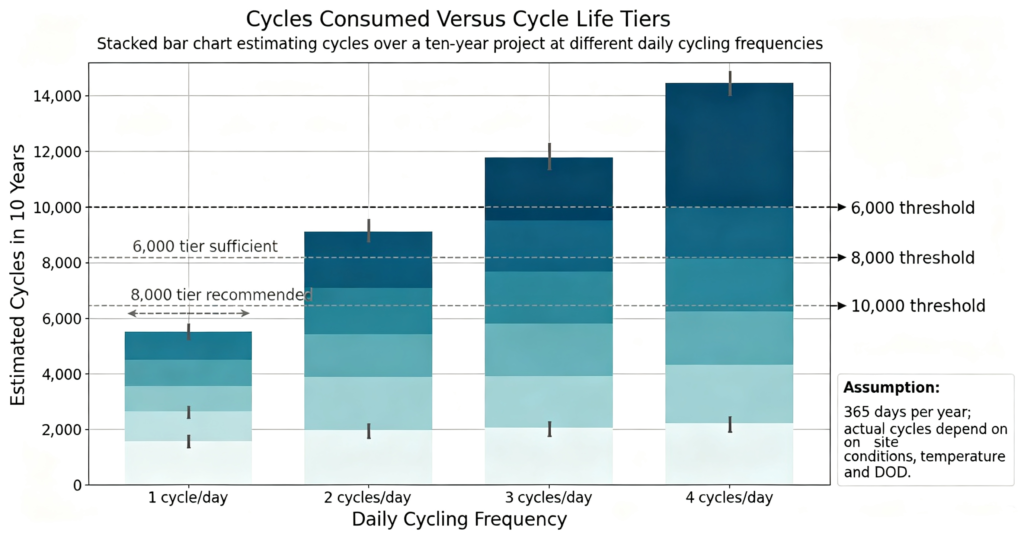
Read the “time to consume” row carefully, because it contains the whole decision. Even at one full cycle every single day, a 6,000 cycle rating represents roughly sixteen years of cycling — beyond the typical warranty term and beyond how long most stationary projects hold their original battery. The higher tiers earn their premium only when the battery cycles more than once a day (solar-plus-tariff sites, frequency-support roles) or when a warranty, an financing agreement or a service contract explicitly requires the higher rating.
The lifetime cost logic
The honest way to compare quotes across tiers is cost per kilowatt-hour actually delivered over the project life — not price per kilowatt-hour of nameplate capacity. The calculation has three inputs: the purchase price, the usable energy per cycle (which depends on depth of discharge and efficiency), and the number of cycles the application will realistically consume before the battery leaves service. A cheaper 6,000 cycle pack that covers the project’s entire consumption profile beats a 10,000 cycle pack on lifetime cost by definition, because the extra cycles are never sold, never used and never recovered.
Depth of discharge interacts with the tier choice in a way buyers often miss. The same battery cycled to a shallower depth consumes its life far more slowly than one cycled full-depth every time — so an installation that keeps state-of-charge swings narrow can stretch a standard tier well past its headline figure, while a tariff-arbitrage site that empties the pack daily consumes cycles at the full rate. When you model lifetime cost, model the duty cycle your site will actually run, not the datasheet’s. The sizing method that establishes the usable-energy figure in the first place is covered in #09 how to size a home battery, and the broader cost-structure context for solar battery purchases is in #07 solar battery cost.
What to verify beyond the headline number
A cycle rating is a claim; a procurement file needs evidence. Four checks separate a defensible rating from marketing. First, the test conditions: temperature, rate and end-of-life threshold should be stated next to the cycle figure, and two quotes should be normalised to comparable conditions before comparison. Second, third-party test evidence: cell-level cycle test summaries from an accredited laboratory carry more weight than an in-house curve. Third, the warranty terms: a warranty that promises a retained capacity at a given year, under defined cycling conditions, is the supplier sharing real risk — the cycle number on the datasheet is not. Fourth, the BMS limits: the pack’s management system decides the voltage window, current limits and temperature windows the cells actually operate in, which is why the BMS design matters as much as the cell grade; the selection logic is covered in #28 BMS 101.
Cell format also affects how the tiers price out in practice. The 280 Ah and 314 Ah large-format cells that dominate modern stationary storage have their own grading and matching considerations, which are compared in #25 280 Ah vs 314 Ah cells. A tier decision made at pack level should still be checked at cell level, because the same pack rating can be built from different cell grades with different consistency profiles.
The OEM/ODM angle: specifying cycle life in an RFQ
For wholesale buyers and brand owners, the cycle tier is a specification decision, not just a purchasing one. An RFQ for an OEM/ODM 6000 cycle LiFePO4 battery pack should state four things explicitly: the cycle rating with its test conditions, the retained-capacity threshold at end of rated life, the warranty structure the brand is prepared to stand behind, and the test documentation the factory must supply with each batch. Specifying the tier this way does two things — it removes the ambiguity that lets suppliers quote the cheapest interpretation, and it anchors the price conversation to a defined, auditable grade of cell.
Buyers who plan to offer multiple tiers in one market should also ask whether the factory can hold two cell grades on the same pack platform, because a shared mechanical and electronic design lets a brand cover the backup market and the heavy-cycling market without two separate product lines. The mechanics of commissioning a custom pack programme are covered in #20 custom battery pack OEM/ODM, and the supplier-side evaluation that should run alongside it in #21 how to evaluate battery manufacturers.
A decision guide by application
- Backup-first residential or small commercial: the battery rarely cycles; calendar life dominates. A well-warrantied 6,000 cycle tier is usually the rational buy.
- Daily self-consumption residential: one full cycle most days. The 6,000 tier still covers a typical project life; the 8,000 tier makes sense when the warranty term or financing horizon is long.
- Time-of-use tariff shifting: one to two full cycles daily. The 8,000 tier is the usual fit; model the 6,000 tier only if the tariff margin is thin.
- C&I demand management, multi-cycle sites: two or more cycles daily. The 10,000 tier, or a warranty structured around throughput, is the defensible choice.
- Any project under third-party financing: let the warranty and the lender’s requirements pick the tier — they, not the datasheet, define the risk transfer.
Q.Is a 10,000 cycle battery always better?
No. Cycle life only adds value when the application consumes it. A battery that completes few cycles per year is limited by calendar life, so paying for unused cycles raises lifetime cost. Match the tier to the duty cycle and the warranty term instead of the highest rating.
Q.Why do two 6,000 cycle batteries have different prices?
Because the rating is only one line of the specification. Cell grading, BMS quality, enclosure, certification scope, warranty depth and batch documentation all sit behind the same headline number. Normalise the test conditions first, then compare what each quote actually includes.
Q.Does depth of discharge change the cycle count?
Yes. Shallower cycles consume cell life more slowly, so a pack cycled within a narrow state-of-charge band will outlast its headline full-cycle rating, while full-depth daily cycling consumes it at the rated pace. Model the duty cycle your site will actually run.
Q.What does the warranty have to do with cycle life?
The warranty is where the supplier commits to the cycle claim under defined usage. Look for a retained-capacity promise at a fixed year, the cycling and temperature conditions attached to it, and what happens when conditions are exceeded. A long cycle rating with a short or vague warranty is a weaker position than a moderate rating with a strong one.
Q.Which tier should a wholesale buyer default to?
For a mixed market, the standard OEM/ODM 6000 cycle LiFePO4 battery pack covers the largest share of residential and backup demand, with the 8,000 tier as the upgrade SKU for daily-cycling customers. Keeping both on one pack platform lets a distributor serve both segments without doubling its product line.
Next step: price the tier that fits your duty cycle
Before requesting quotes, settle three inputs: the daily cycling profile, the project or warranty horizon, and the test evidence you will require. Then compare tiers on lifetime cost, not nameplate price.
- Review the chemistry fundamentals in #01 the LiFePO4 guide
- Compare cell platforms in #25 280 Ah vs 314 Ah
- Structure the OEM/ODM programme with #20 custom pack OEM/ODM
- Run the supplier check from #21 evaluate battery manufacturers
- Ask leekooenergy for 6,000 / 8,000 / 10,000 cycle tier pricing with test conditions and warranty terms for your platform