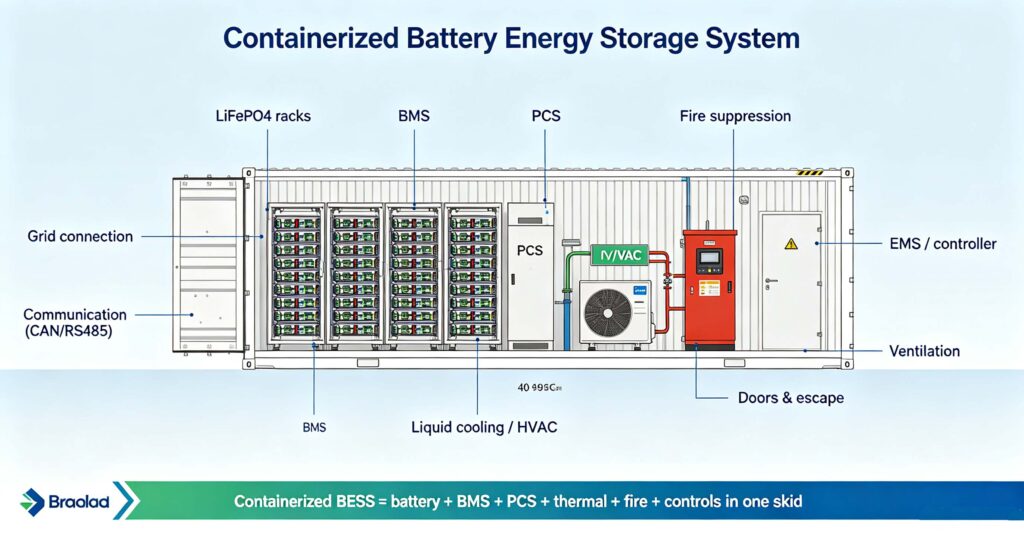
Containerized battery energy storage system (containerized BESS) is a battery storage plant built into a standard shipping container — battery racks, BMS, PCS/inverter, thermal management, fire suppression and controls all factory-integrated into one transportable unit, typically 1–10 MWh per container. It exists to solve what distributed storage cannot: large-scale energy in a modular, shippable, repeatable package. The main components of a containerized battery energy storage system are the battery racks (usually LiFePO4 cells), the BMS (cell and pack protection), the PCS (DC-AC conversion), thermal management (liquid cooling or HVAC), fire suppression, and the EMS/controller that runs the plant. A containerized system suits C&I projects, utility-scale plants, remote and island sites, and any project where factory integration, fast deployment and repeatability beat on-site assembly. The key specs to compare are energy capacity (MWh), power rating (MW and C-rate), round-trip efficiency, thermal approach (liquid vs air), safety certifications (including NFPA 855 / local codes), and grid interconnection requirements. The buying mistake to avoid is treating a container as a commodity — two containers with the same MWh can differ enormously in cycle life, efficiency, safety systems and service, so the evaluation is on system quality, not price per kWh alone.
The containerized battery energy storage system has become the default delivery format for larger storage projects because it turns a construction project into a factory product. This guide explains what it is, who it fits, and how to evaluate one before committing. For the broader utility-scale context, see #22 utility-scale battery storage explained.
What is inside a containerized battery energy storage system
Every container BESS has the same six subsystems, and the quality of integration between them decides performance and safety.
Battery racks: LiFePO4 cells in rack-mounted packs, sized in MWh. The cell source, pack design and connection method are the largest reliability variables.
BMS: monitors and protects each cell and pack — voltage, temperature, current, balancing and fault response. The BMS quality and its communication with the EMS matter as much as the cells.
PCS (power conversion system): converts DC from batteries to AC for the grid, sized in MW. Its efficiency, grid-support functions and fault ride-through affect both economics and grid compliance.
Thermal management: liquid cooling or air conditioning keeps cells in their operating window. The thermal design strongly influences cycle life and derating in hot or cold sites.
Fire suppression: detection and suppression per codes — gas detection, suppression agents, ventilation and fire-rated construction. This is a non-negotiable subsystem, not an option.
EMS / controller: runs the plant — charge/discharge scheduling, grid commands, alarms, reporting. The EMS is where the system earns or loses its revenue model. For the components in more depth, see #52 BESS components: battery, PCS, BMS and EMS.
Who should buy a containerized BESS — and who should not
Containerized battery energy storage systems are not the answer for every project. The fit depends on size, deployment speed and site conditions.
Good fit: projects needing 1 MWh to tens of MWh on one site — C&I peak shaving and arbitrage, utility-scale plants, remote and island power, microgrids, and projects with tight schedules where factory integration beats on-site assembly. Container delivery also suits sites where local construction labour or space is limited.
Poor fit: small residential or light-commercial needs (a rack or cabinet is cheaper and better matched), sites with access problems (a container needs crane and hardstanding), or projects where a distributed architecture is required by the site layout. For the form-factor decision, see #53 C&I storage forms: rack, cabinet or container.
The honest question is whether the site can host a container — delivery access, foundations, clearances, grid connection point — before the container itself is worth comparing.
Key specs to compare before you buy
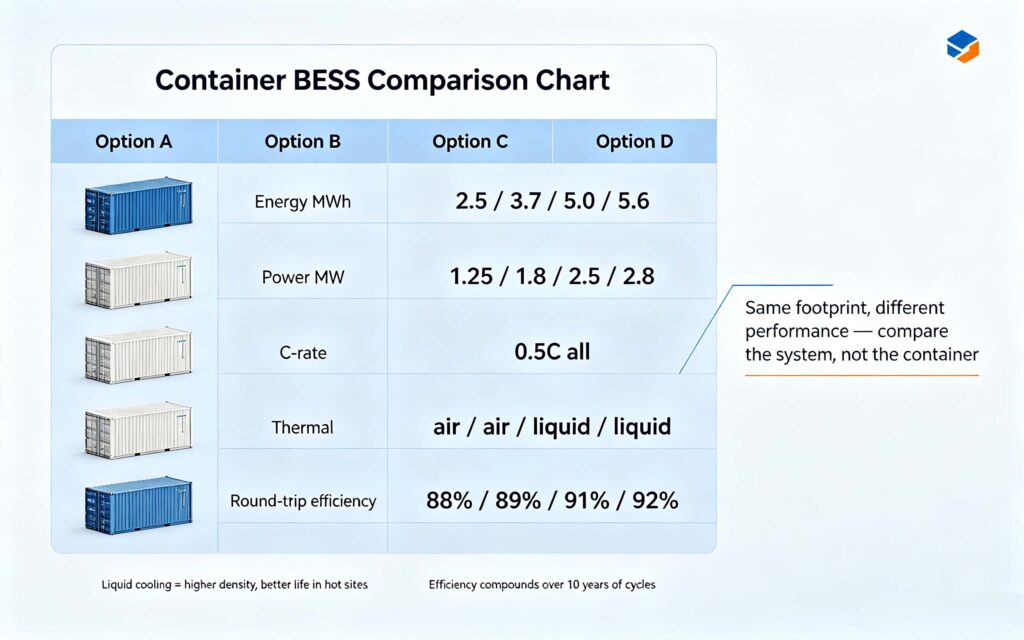
Two containers with the same MWh can differ enormously, which is why comparing a containerized battery energy storage system means comparing the system, not the footprint. Compare these numbers, each under its stated conditions:
- Energy and power: MWh capacity and MW power — and the C-rate (0.5C, 1C) that connects them, because it defines what the container can actually do.
- Round-trip efficiency: a few percent difference compounds into large lifetime energy losses — compare at the same temperature and cycle conditions.
- Cycle life and warranty: cycles at which DoD, and the warranty’s throughput or years cap — not the headline cycle number alone.
- Thermal approach: liquid vs air cooling, and the derating curve at your site’s ambient temperature range.
- Safety and compliance: fire suppression design, certifications, and local code compliance (NFPA 855 where applicable). For the safety layer, see #104 battery storage cabinet safety and NFPA 855.
- Grid interconnection: PCS grid functions, communication protocols, and the required interconnection studies and equipment.
The buyer checklist: what to ask before committing
For a cautious buyer evaluating a containerized battery energy storage system, the checklist below turns a container quote into a comparable proposal.
Ask for the datasheet with conditions: capacity at which temperature and C-rate; cycle life at which DoD; efficiency at which operating point. Ask for the safety case: the fire suppression design basis, the detection system, and the code compliance documentation. Ask for the service plan: spares availability, remote monitoring access, response times, and warranty claim process. Ask for references: operating sites with similar climate and duty, not just delivered projects. Ask what changes: container lead time, commissioning time, and who handles grid interconnection studies.
A cautious buyer also checks the commercial model: is the price per MWh comparable only if efficiency, cycle life and service are equal — and they are not, on any two quotes. For the EPC and delivery side of larger projects, see #66 choosing a BESS EPC contractor.
Q. What is a containerized battery energy storage system?
It is a battery storage plant built into a standard shipping container: battery racks, BMS, PCS, thermal management, fire suppression and controls, factory-integrated into one transportable unit, typically 1-10 MWh. It delivers large-scale storage in a modular, shippable, repeatable package, suited to C&I projects, utility plants, remote sites and microgrids.
Q. How much does a containerized BESS cost?
Cost depends on capacity, power, thermal approach and balance-of-system, and prices move with cell and metal markets, so there is no stable figure to quote. Compare on levelized terms — efficiency, cycle life, warranty throughput and service — not price per kWh alone. Ask for a breakdown that separates cells, PCS, thermal, safety, integration and logistics.
Q. What is the difference between liquid-cooled and air-cooled container BESS?
Liquid cooling circulates coolant through cold plates against the cells, removing heat more efficiently, which supports higher density and better cycle life in hot sites. Air cooling is simpler and cheaper but derates more in heat. The right choice depends on your site’s ambient temperature range and duty cycle — not on which is “newer”.
Q. Is a containerized BESS safe?
Yes when designed and operated per code: the container should include gas detection, fire detection and suppression, ventilation, fire-rated construction and proper clearances, and comply with local codes such as NFPA 855 where they apply. Safety is a subsystem to verify in the spec, not an assumption — ask for the fire suppression design basis and code compliance documentation.
Q. How long does it take to deploy a containerized BESS?
Factory integration and testing typically take weeks to months before shipping, and on-site commissioning days to weeks depending on grid connection and local permitting. The container format saves construction time compared with site-built systems, but grid interconnection studies and permits usually run on their own schedule — plan them early.
Next step: compare the system, not the container
Containerized battery energy storage systems turn a construction project into a factory product — but only if you compare efficiency, cycle life, safety and service, not just MWh per dollar. Run the checklist in this guide and ask for conditions, safety case, service plan and references before committing.
- Start with the utility-scale overview in #22
- Confirm the form factor with #53
- Verify the safety layer in #104
- Ask leekooenergy for a containerized BESS proposal that separates cells, PCS, thermal, safety and integration; states every spec with its condition; documents the fire suppression design basis; and names the service plan — so your comparison is between systems, not between containers