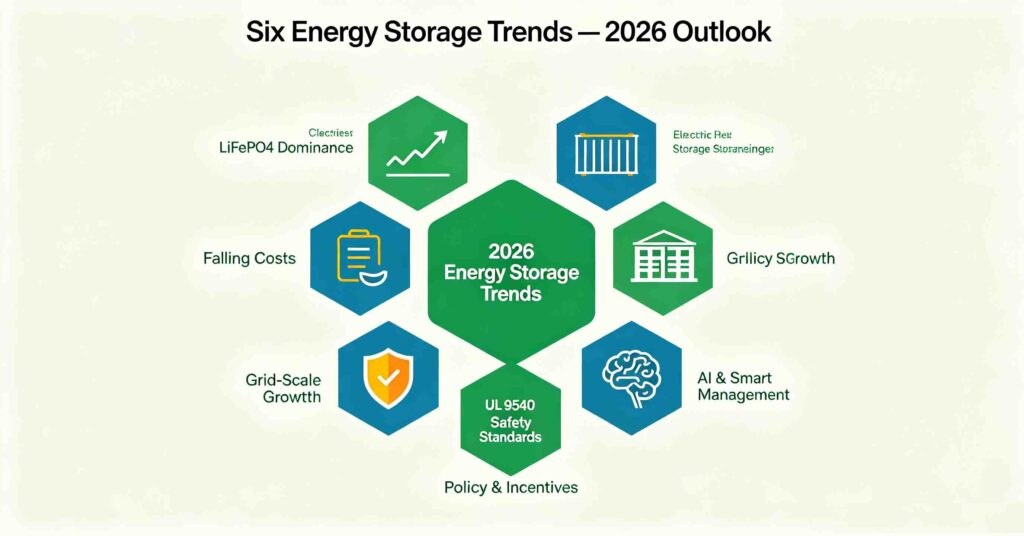
Energy storage trends 2026: LiFePO4 chemistry consolidates its dominance
Lithium iron phosphate (LiFePO4 or LFP) has become the dominant cathode chemistry for stationary energy storage, and its market share continues to grow in 2026. The reasons are well established: LiFePO4 offers longer cycle life (6,000–10,000+ cycles vs 3,000–5,000 for NMC), better thermal stability (lower fire risk), lower raw material cost (no cobalt or nickel), and a supply chain that is increasingly diversified. For stationary storage applications — where energy density is less critical than cycle life, safety and cost — LiFePO4 is the clear technical and economic choice.
What this means for buyers: Specifying LiFePO4 for a stationary storage project in 2026 is no longer a differentiator — it is the baseline. The more relevant questions are: what is the cell’s cycle life rating (6,000 vs 8,000 vs 10,000+), what is the capacity degradation rate, who manufactures the cells, and what quality control processes are applied. Buyers should also be aware that alternative chemistries — including sodium-ion, which uses no lithium at all — are beginning to enter the market for specific applications, particularly in cost-sensitive, low-energy-density use cases. For most B2B projects in 2026, LiFePO4 remains the safest and most cost-effective choice, but buyers should monitor sodium-ion developments for future procurement cycles.
Trend 2: Battery system costs continue to decline, but at a slower rate
Battery energy storage system costs have declined dramatically over the past decade, driven by manufacturing scale, improved cell chemistry, and supply chain maturation. In 2026, the decline continues but at a slower rate than in previous years, as the industry approaches the practical cost floor for LiFePO4 chemistry. System-level costs (including battery, inverter, BMS, thermal management, enclosure and installation) are now in a range where the balance-of-system costs (inverter, installation, civil works) are becoming a larger share of the total, and further cost reductions are increasingly coming from system integration, manufacturing efficiency and project optimisation rather than cell price reductions alone. For detailed cost and ROI analysis, see #56 BESS cost and ROI.
What this means for buyers: The era of dramatic year-over-year battery cost reductions is largely over for LiFePO4. Buyers who delay procurement in anticipation of significantly lower prices may find that the savings are modest — 5–10% per year rather than 20–30%. The more impactful cost lever is system-level optimisation: right-sizing the system for the actual load and duty cycle, selecting the appropriate voltage level and cooling architecture, and negotiating a complete turnkey price rather than purchasing components separately. Buyers should also be aware that raw material price volatility (lithium carbonate prices have fluctuated significantly) can cause short-term price swings, and that locking in a firm price with a supplier may be advantageous during periods of price volatility.
Trend 3: Grid-scale and commercial deployment accelerate, driven by renewable integration and grid stability
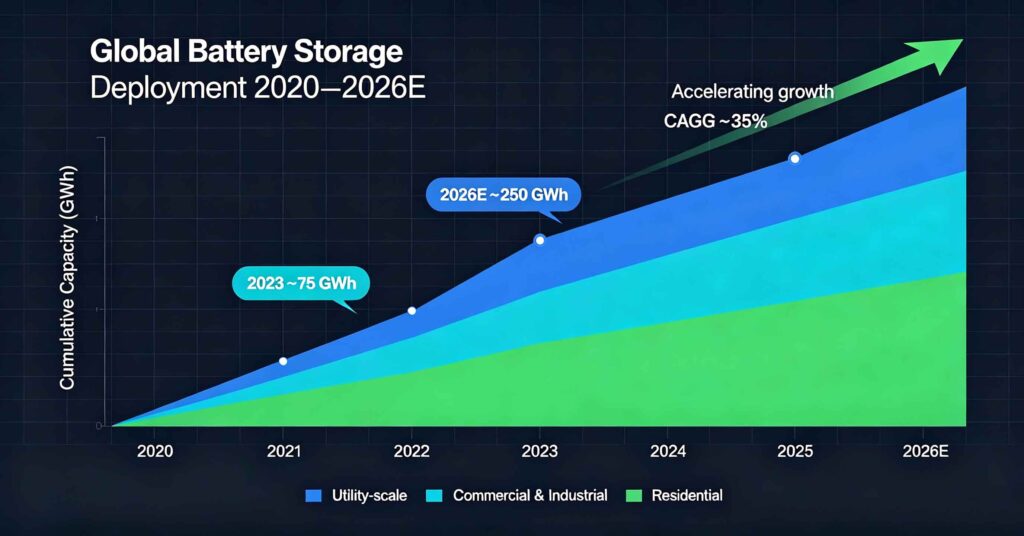
Grid-scale battery storage deployment continues to accelerate in 2026, driven by the rapid growth of renewable energy (solar and wind), the need for grid stability and frequency regulation, and the retirement of fossil-fuel peaker plants. Commercial and industrial (C&I) storage is also growing, driven by demand-charge reduction, peak shaving, backup power, and the increasing availability of time-of-use electricity tariffs that make storage economically attractive. The market is shifting from early-adopter projects to mainstream deployment, with utilities, independent power producers, and large commercial customers all procuring storage at scale.
What this means for buyers: The increasing scale of deployment is creating a more mature market with more suppliers, more standardised products, and more competitive pricing — but also more variability in quality and support. Buyers should prioritise suppliers with a proven track record of installed and operating systems (not just signed contracts), and should evaluate the total cost of ownership rather than the upfront price alone. For C&I buyers, the economic case for storage is improving in many markets as demand charges increase and time-of-use tariffs widen the arbitrage spread. Buyers should conduct a site-specific economic analysis based on their actual electricity tariff, load profile and backup power requirements, rather than relying on generic payback estimates.
Trend 4: Policy support and market incentives expand globally
Government policy support for energy storage continues to expand in 2026 across multiple markets. In the United States, the Inflation Reduction Act (IRA) provides investment tax credits (ITC) and production tax credits (PTC) for energy storage, including standalone storage (not just storage paired with solar). In the European Union, the Green Deal industrial plan and national recovery and resilience funds provide support for storage deployment and manufacturing. In China, the government’s dual-carbon goals and mandatory energy storage requirements for new renewable projects continue to drive the world’s largest storage market. Other markets, including Australia, India, the Middle East and Latin America, are introducing or expanding storage incentives and grid connection reforms.
What this means for buyers: Policy incentives can significantly improve the economics of a storage project, but they vary by market, by project size, and by application. Buyers should engage early with a qualified tax advisor or energy consultant to identify all applicable incentives, including tax credits, grants, rebates, demand-response programmes, and capacity market payments. In some markets, the incentives are time-limited or subject to prevailing-wage and apprenticeship requirements, and missing a deadline or failing to meet a requirement can mean forfeiting a significant portion of the project’s revenue. Buyers should also be aware that policy changes can affect the economics of existing projects — for example, changes to net metering or feed-in tariffs can affect the value of self-consumption and energy arbitrage.
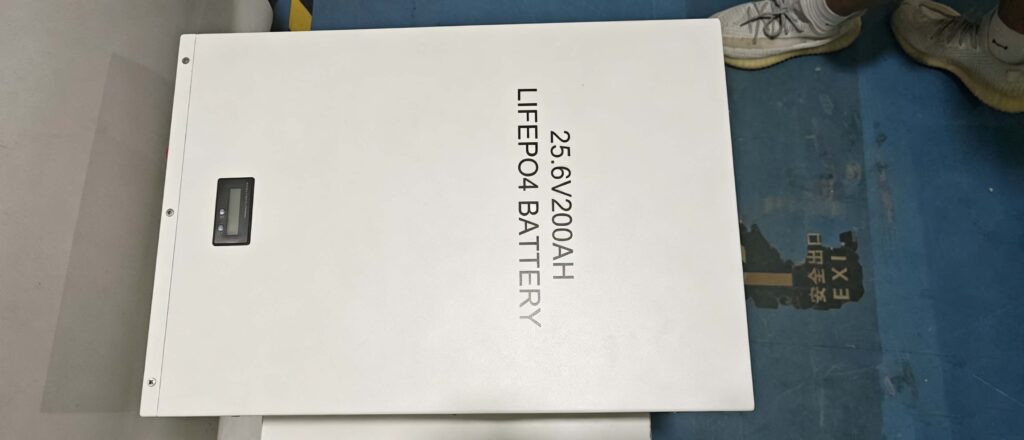
Trend 5: Safety standards and fire codes tighten, driven by high-profile BESS fire incidents
Safety has become an increasingly important focus of the energy storage industry, driven by high-profile battery fire incidents at utility-scale and commercial installations. In response, standards organisations and code bodies are updating and tightening safety requirements. UL 9540 (system safety) and UL 9540A (thermal runaway propagation testing) are becoming baseline requirements in many markets, and NFPA 855 (installation standard) is being updated with more stringent requirements for fire suppression, gas detection, ventilation and spacing. Some jurisdictions are introducing additional requirements for indoor storage installations, including mandatory gas detection, automatic fire suppression, and pre-installation fire marshal review.
What this means for buyers: Safety certification is no longer optional — it is a procurement requirement. Buyers should require UL 9540 and UL 9540A certification for any system purchased in 2026, and should verify that the certification covers the exact system configuration (battery + BMS + inverter + enclosure + thermal management) being quoted. Buyers should also engage the local authority having jurisdiction (AHJ) — typically the fire marshal or building official — early in the project to confirm the applicable code requirements, including fire suppression, gas detection, ventilation, spacing and setbacks. A system that meets the technical specifications but fails the AHJ’s review will not be permitted to operate, and retrofitting fire suppression or gas detection after installation is significantly more expensive than including it in the original design.
Trend 6: AI and smart energy management systems optimise storage performance and revenue
Energy management systems (EMS) for battery storage are becoming increasingly sophisticated, incorporating artificial intelligence (AI) and machine learning to optimise charging and discharging schedules, predict energy prices, forecast solar generation, manage battery degradation, and maximise revenue from multiple value streams (energy arbitrage, demand-charge reduction, frequency regulation, capacity markets). The latest generation of EMS platforms can integrate with weather forecasts, electricity market data, building management systems, and renewable generation forecasts to make real-time optimisation decisions that would be impossible for a human operator to replicate. Cloud-based monitoring and predictive maintenance are also becoming standard, enabling operators to identify potential failures before they occur and to optimise maintenance schedules.
What this means for buyers: The energy management system is no longer an afterthought — it is a critical component that determines how much value the battery system delivers. A battery system with a basic EMS (fixed charge/discharge schedule) may capture only 50–70% of the potential value of the same battery system with an AI-optimised EMS. When evaluating suppliers, buyers should ask detailed questions about the EMS capabilities: what optimisation algorithms are used, what data sources are integrated (weather, market prices, load forecasts), what value streams can be optimised simultaneously, what user controls are available, and what reporting and analytics are provided. Buyers should also consider the EMS’s cybersecurity measures, as a cloud-connected EMS that is not properly secured can be a vulnerability. The difference between a good EMS and a great EMS can be hundreds of thousands of dollars in additional revenue over the system’s operating life.
Q.Will battery storage costs continue to drop in 2026?
Yes, but at a slower rate than previous years. Battery pack costs have declined from ~$1,200/kWh in 2010 to ~$139/kWh in 2023. In 2026, expect further declines of 5–10% per year driven by manufacturing scale, improved cell chemistry, and supply chain maturation. However, lithium and material price volatility, tariff changes, and demand growth may slow the decline. System-level costs (inverters, BMS, installation) are also falling but more slowly. Buyers should not expect the 20%+ annual declines of the past decade; 5–10% is more realistic.
Q.Is LiFePO4 still the best chemistry for stationary storage in 2026?
Yes, LiFePO4 remains the dominant and recommended chemistry for stationary energy storage in 2026. Its advantages — high safety (thermal runaway at ~270°C), long cycle life (6,000–10,000 cycles), low cost (no cobalt/nickel), and abundant raw materials — continue to outweigh its lower energy density compared to NMC. New developments like manganese-doped LFP (LMFP) and improved LFP cell designs are further extending cycle life and energy density. While sodium-ion and other chemistries are emerging, LiFePO4 is expected to remain the mainstream choice for grid-scale and commercial storage through 2026 and beyond.
Q.What safety certifications should I require for a BESS purchased in 2026?
At minimum, require UL 9540 (system safety) and UL 9540A (thermal runaway fire propagation testing). Also require IEC 62619 (industrial battery safety), IEC 62933 (energy storage system safety), and UN 38.3 (transport safety). For grid-connected systems, require IEEE 1547 (grid interconnection) and UL 1741 (inverter safety). In 2026, also look for NFPA 855 compliance documentation and local AHJ approval support. Require that certifications cover your specific system configuration (not just a similar model), and verify certificate validity with the issuing body.
Q.How important is the energy management system (EMS) for a BESS project?
Very important — the EMS is the brain that determines how much value your BESS delivers. A good EMS optimizes charge/discharge schedules based on electricity tariffs, demand charges, grid signals, weather forecasts, and battery health, maximizing revenue and extending battery life. A poor or generic EMS may under-utilize the battery, cause unnecessary degradation, or miss revenue opportunities. In 2026, AI-driven EMS with machine learning optimization are becoming standard. Evaluate: does the EMS support your use case (peak shaving, arbitrage, frequency response)? Is it configurable? Does it provide analytics and reporting? Can it integrate with your existing systems?
Q.Should I wait for battery prices to drop further before purchasing a BESS?
Generally no — the cost of waiting often exceeds the savings from lower prices. If you have a clear use case (high demand charges, frequent outages, renewable integration), every month of delay means a month of lost savings or revenue. Battery prices are declining 5–10% per year, but financing costs, tariff changes, and incentive expiration may offset these savings. Additionally, lead times for quality systems can be 3–6 months. The best strategy is to define your requirements, get multiple quotes, and proceed when the ROI meets your threshold — rather than trying to time the market bottom.
Next step: align your 2026 procurement with the trends that matter
The energy storage market in 2026 offers better technology, lower costs, and smarter controls than ever before — but it also demands more from buyers in terms of safety certification, EMS capability, and policy awareness. The buyers who get the best value in 2026 will be those who specify based on current trends (LiFePO4 baseline, UL 9540/9540A required, AI-optimised EMS expected), who engage the AHJ and tax advisors early, and who focus on total cost of ownership and system-level optimisation rather than upfront price alone.
- Read the BESS definition and architecture in #8 what is battery storage (BESS)
- Review the cost and ROI analysis in #56 BESS cost & ROI
- See project examples in #65 BESS projects
- Understand safety standards in #44 BESS fires & energy storage safety codes
- Ask leekooenergy for a 2026-ready BESS proposal that includes: LiFePO4 cell specifications (cycle life rating, degradation rate, cell manufacturer), UL 9540 / UL 9540A certificates covering the exact system configuration, system-level cost breakdown (battery, inverter, BMS, thermal management, enclosure, installation), EMS capabilities (optimisation algorithms, data integration, value streams, reporting, cybersecurity), total cost of ownership estimate (10-year, including maintenance, spare parts, energy losses), and available policy incentive guidance — so your 2026 procurement is aligned with the current market trends and delivers the maximum value over the system’s operating life