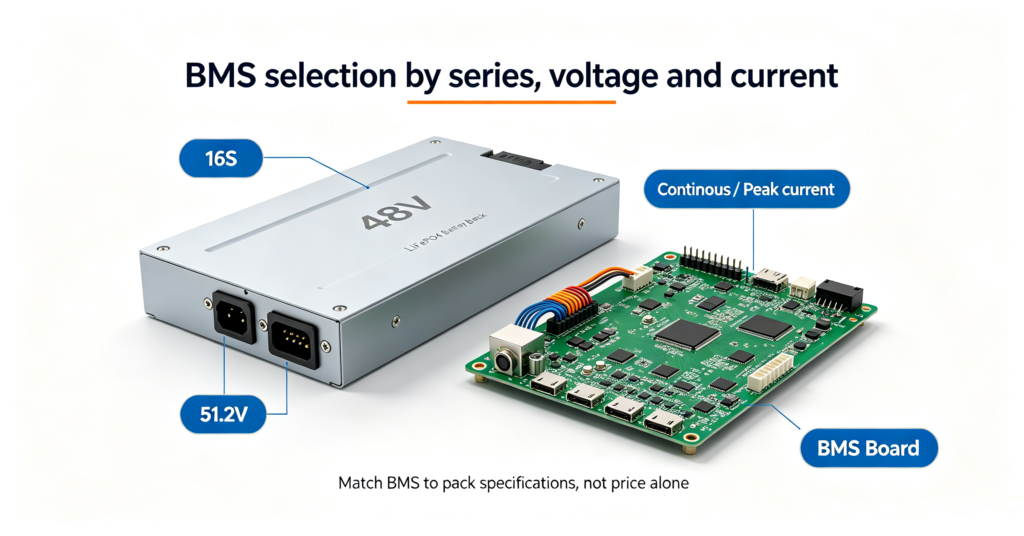
Choose a LiFePO4 battery management system by three hard numbers — cell count (series, or “S”), pack voltage, and continuous current — then by balancing type and communication protocol. A 16S LiFePO4 string rests near 51.2V and needs a BMS rated for that voltage and for current above your inverter’s peak draw. Price is the last filter, not the first; a BMS that cannot clear the numbers is unsafe at any discount.
The BMS is the part most likely to decide whether a LiFePO4 pack lives its full cycle life or fails early. The selection is engineering, not shopping — so start from the pack’s electrical reality.
Start from series count (S)
LiFePO4 cells sit around 3.2V nominal. A 16S string is the residential standard: 16 × 3.2V ≈ 51.2V resting, which the market calls “48V class.” The BMS must match the exact cell count — a 15S or 17S BMS will not manage a 16S pack. Count cells before anything else; the BMS 101 guide explains why cell count is the anchor.
Set voltage and current
| Parameter | How to set | Buyer’s focus |
|---|---|---|
| Series (S) | Cell count = 16S | Must match exactly |
| Voltage | Full charge ≈ 58.4V / open-circuit ≈ 51.2V | BMS upper limit > full charge |
| Continuous current | Inverter rated power ÷ 51.2V | Leave margin for motor inrush |
| Peak current | Inverter peak ÷ 51.2V | BMS peak > inverter peak |
Example: a 5 kW inverter on a 51.2V pack draws about 98 A continuous and more on motor start. Size the BMS above that, not at it.
Balancing: passive vs active
Passive balancing bleeds excess from stronger cells as heat — simple, cheap, fine for most residential packs that cycle daily. Active balancing moves charge between cells — more efficient, used in large banks that cycle hard and cannot afford the loss. For a typical 48V home pack, passive is the pragmatic default; ask for active only when the bank is large and deeply cycled.
Communication: CAN vs RS485
The BMS talks to the inverter over CAN or RS485. Closed-loop control — where the inverter reads state of charge and faults from the BMS — needs a protocol match with the inverter brand. Open-loop works without it but reports less. Confirm the match in writing; a mismatch means the battery runs blind or not at all. The BMS meaning guide frames what the communication actually carries.
Step-by-step selection framework
- Count S. Match BMS to your exact cell count (16S for 48V class).
- Set voltage. BMS max must exceed pack full-charge voltage.
- Set current. Continuous and peak must clear the inverter, with surge headroom.
- Pick balancing. Passive for most; active for large hard-cycled banks.
- Match protocol. CAN or RS485 must match the inverter brand.
- Confirm enclosure. BMS must sit in a rated, cooled enclosure with the cells.
Common mistakes
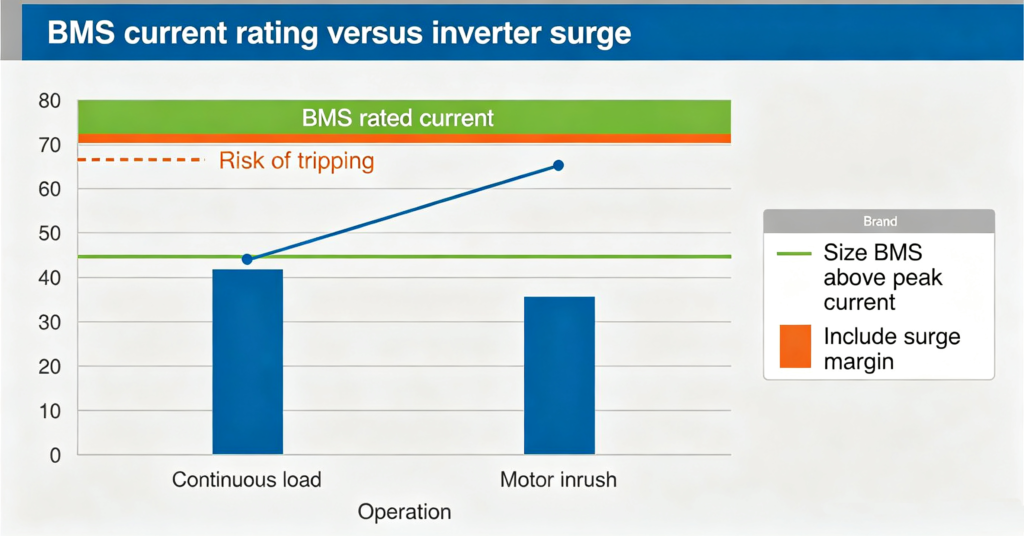
Buyers size current to average load and forget motor surge, or assume any “48V BMS” fits any 48V pack without checking S. Match the numbers first; the brand and price come after. A BMS that cannot clear peak current will trip exactly when the load is highest.
Worked example: a 48V 100Ah pack
A 48V 100Ah LiFePO4 pack holds about 5 kWh. On a 51.2V nominal bus, its continuous current at 5 kW is about 98 A, peaking higher with a motor load. The BMS must be a 16S unit rated above 98 A continuous and above the inverter peak – say 125 A continuous, 200 A peak. Choose passive balancing for this daily-cycled home pack; active would not return its cost. Confirm CAN or RS485 matches the inverter brand. The numbers, not the price, decide safety here.
Passive vs active balancing, deeper
Passive balancing bleeds the strong cells as heat during the top of charge; over weeks it pulls the pack even. Active moves charge between cells, recovering it, which matters when every percent of a large bank cycles daily. For a 5 kWh home pack the recovered energy is trivial; for a 100 kWh C&I rack it is real money over years. Size balancing to bank size, not to habit.
Protocol matching pitfalls
The usual failure is two devices that both say RS485 but use different register maps, so the inverter never sees state of charge. Ask the supplier for the map, not the protocol name, and for a written note that your inverter model is verified. Closed-loop control is only as good as that match; open-loop runs but reports less.
BMS enclosure and thermal notes
The BMS must sit in the same rated, cooled enclosure as the cells – not loose in a box. Heat shortens BMS life too. Confirm the enclosure rating and that the BMS has headroom above the pack peak current so it never trips under normal load.
Common spec omissions that bite later
- Operating temperature range stated, but no derating curve at the ends.
- Connector specified, but not the torque or gland rating.
- Enclosure rated, but cooling method left vague.
- Capacity at 25 C only, with no high or low temperature number.
Buying checklist recap
Write S, pack voltage, and peak current from the inverter nameplate, then match a BMS with headroom and a protocol the inverter speaks. Passive balancing fits most home packs; active pays in large hard-cycled banks. Confirm the match in writing and keep the record. The numbers decide safety – the brand and price come after.
Where to verify the match
Ask the battery supplier for the BMS protocol and register map and for a note that your inverter model is verified. A vague “compatible with most inverters” is not a match; a written model list is. This five-minute check prevents a blind-running battery after install.
BMS topology: centralized vs distributed
A small pack (under about 16 cells in series) is usually fine with one centralized BMS board that reads every cell and switches a single contactor. As the pack grows – multiple modules in parallel, or a rack of several batteries – a distributed or master-slave topology becomes safer: a slave board sits on each module close to the cells, and a master coordinates contactors and talks to the inverter. The distributed layout shortens sensor wiring, reduces noise on the sense lines, and localizes a fault to one module instead of taking the whole rack offline.
For a buyer, the practical question is whether the BMS architecture matches the physical pack. A centralized board on a 48V 200Ah rack with long sense leads invites balance drift and false alarms; a modular BMS with one slave per module ages better. Ask the supplier which topology they use and how a single-module fault is isolated – that answer tells you more about field reliability than the headline current rating.
Firmware and protection-parameter tuning
A BMS is partly software. The protection thresholds – over-voltage, under-voltage, charge/discharge over-current, short-circuit, and temperature cutoffs – should be set to your exact cells, not left at a generic default. A BMS tuned for one LiFePO4 cell grade can trip early or, worse, release too late on another. Confirm the supplier lets you read and adjust these parameters, and that the values match the cell datasheet you are actually buying.
Also check how the BMS reports and clears faults. A good unit logs the last fault with a code you can read over its communication port; a weak one just opens the contactor with no record, leaving you guessing. For a procurement manager, “can I see why it tripped” is a real support-cost question, not a nicety.
Q. What size BMS do I need for a 48V LiFePO4 pack?
Match it to cell count (16S), pack voltage (above ~58.4V full charge), and continuous current above your inverter’s draw plus surge. A 5 kW inverter on 51.2V needs roughly 100 A continuous and more at peak — size the BMS above that.
Q. Can I use a generic 48V BMS on any 48V pack?
Only if the series count matches. “48V” covers 15S and 16S configurations; a 16S pack needs a 16S BMS. Check S, not the label.
Q. Is active balancing worth the cost?
For most home packs, no — passive is sufficient and cheaper. Active pays off in large banks that cycle hard daily, where the recovered energy and even aging matter.
Q. Do I need CAN or RS485?
You need whichever your inverter speaks for closed-loop control. Open-loop works without it but reports less data; confirm the protocol match with the inverter brand before ordering.
Q. What happens if the BMS current is too low?
It trips on peak load, cutting the pack exactly when you need it — or worst case, the contactor wears. Size above the inverter’s peak, not its average.
Next step: write down the three numbers
Write S, pack voltage, and peak current from your inverter nameplate, then match a BMS with headroom. A correct BMS is the cheapest insurance on a LiFePO4 pack.
- See the leekooenergy BMS product page (high and low voltage families)
- use #28 System Composition List to check components
- ask the supplier for the inverter-brand compatibility certificate