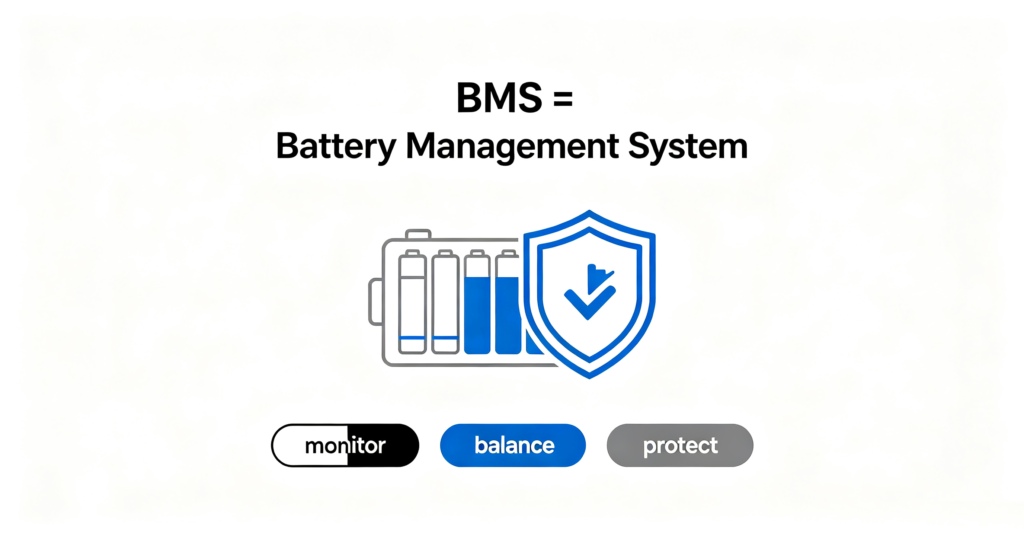
BMS stands for Battery Management System — the electronic controller inside a battery pack that monitors each cell, balances cells so they age evenly, and disconnects the pack if voltage, current, or temperature goes unsafe.
In one line: a BMS is the brain and safety switch of a lithium battery. Without it, cells drift apart and one weak cell can fail the whole pack. The BMS is why a modern pack can be left alone and trusted. For what it does in detail and how to choose one, see the BMS 101 guide.
BMS in plain terms
Think of a pack as a row of workers (cells) carrying a load. The BMS is the foreman who checks each worker’s pulse, nudges the strong ones to slow down so the team stays even, and pulls the alarm if anyone overheats. That foreman is what keeps the pack safe and long-lived.
Why the acronym matters for buyers
When a spec sheet says “with BMS,” it means the pack has protection and balancing built in — not just cells in a box. A bare cell stack is not a battery you can trust; the BMS is the difference. For LiFePO4 packs specifically, the LiFePO4 BMS 选型指南 shows how to match one.
BMS across battery types
The acronym means the same whether the pack is 12V, 48V, or a utility container: a Battery Management System that monitors, balances, and protects cells. Scale changes the numbers – more cells, higher voltage, more current – but the job is identical. A 48V home pack and a C&I rack both fail without one; only the BMS size differs. That is why BMS included is the line that separates a safe pack from a hazard.
Quick recap for buyers
If you remember one thing: BMS means Battery Management System, and any finished lithium pack you trust should have one matched to its cell count and current. For the parts inside and how to choose, the BMS 101 guide is the next read; for LiFePO4 specifics, the LiFePO4 BMS guide matches numbers to a pack.
Where the BMS sits in a system
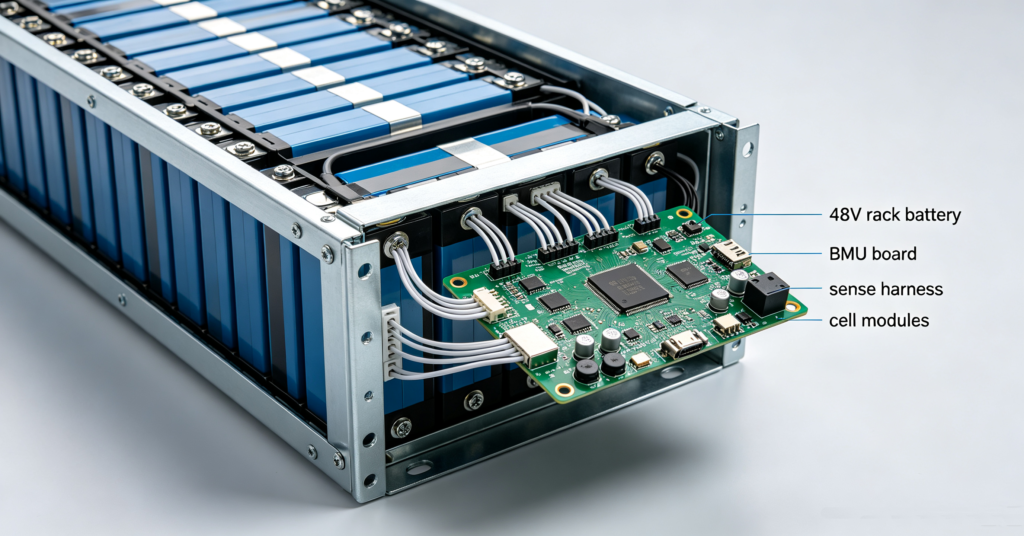
In a finished pack the BMS is wired to every cell through sensing lines and to the inverter through CAN or RS485. It is part of the pack, not an external add-on – which is why a bare cell stack is not a battery you can trust, and why “BMS included” is the line that matters on a spec sheet. For how that wiring chooses numbers, the LiFePO4 BMS guide is the practical next step.
Q.What does BMS stand for?
BMS stands for Battery Management System — the controller that monitors, balances, and protects the cells in a battery pack.
Q.Is BMS the same as a battery protector?
A basic protector only cuts off on faults; a full BMS also balances cells and reports state of charge. For lithium packs, balancing and communication are what keep capacity and safety over years.
Q.Do all lithium batteries have a BMS?
Safe, finished packs do. A bare cell or a DIY stack needs a BMS added. Every leekooenergy pack ships with a matched BMS sized to the cell count and current.
Q.What does a BMS protect against?
Over-voltage, under-voltage, over-current, and over-temperature — plus cell imbalance that would otherwise shrink usable capacity over time.
Q.Where is the BMS in a battery?
Inside the pack, wired to every cell via sensing lines and to the inverter via CAN or RS485. It is part of the pack, not an external add-on on a finished product.
Next step: from “what it is” to “how to choose”
You now know BMS meaning — the next step is matching one to your pack. Start from cell count and current.
- Read #28 BMS 101 see composition and selection
- See the leekooenergy BMS product page (high and low voltage families)
- use #32 choose to check string count