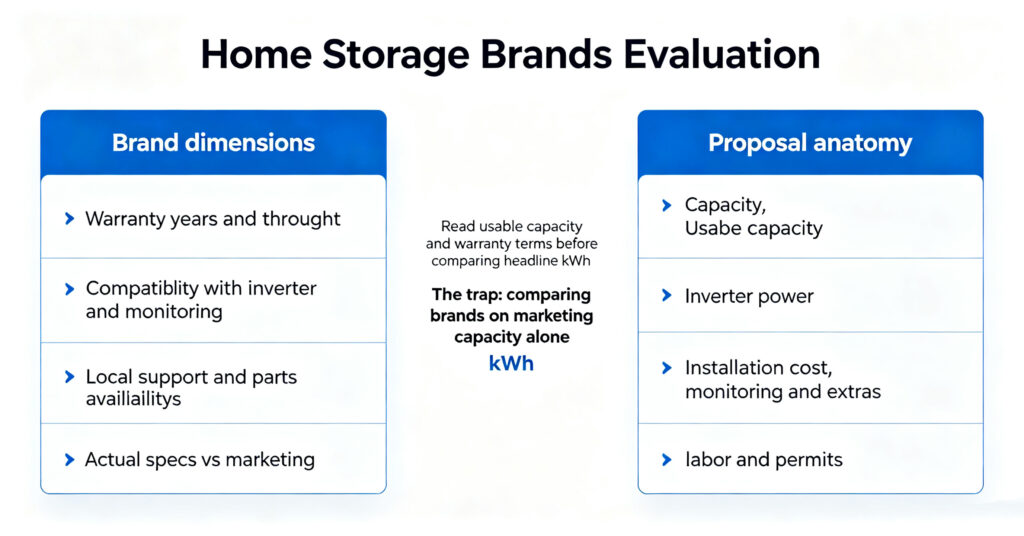
Evaluating home storage brands means comparing the dimensions that survive installation: warranty terms (years, throughput and degradation limits), system compatibility (inverter, monitoring and expansion), local support and parts availability, and the actual specification sheet rather than the marketing page. When proposals arrive, the headline capacity is the least informative number — usable capacity, round-trip efficiency, inverter power, installation scope and monitoring costs change the real price per useful kWh. A professional comparison builds a shortlist on warranty and compatibility first, then reads each proposal line by line, and asks every brand the same questions so the offers are comparable. The most common mistake is choosing a brand on advertised capacity and price, then discovering that usable energy, expansion limits or support terms do not match the marketing.
Home storage is a long-lived purchase: the battery may outlast the first inverter, and the brand relationship lasts through support calls and warranty claims. This guide gives the evaluation dimensions and the proposal-reading discipline that protect the buyer. For the system types available first, see #14 residential energy storage systems overview.
Home storage brands: the dimensions that survive installation
Marketing compares home storage brands on capacity and looks; buyers should compare on the dimensions that show up after year one.
| Dimension | What to check | Why it matters |
|---|---|---|
| Warranty | Years, cycles or throughput, degradation allowance | Defines the real cost if the battery fades early |
| Compatibility | Inverter and monitoring ecosystem, expansion path | Locks your options for upgrades and repair |
| Support | Local distributor, parts stock, response time | Determines downtime when something fails |
| Real specs | Usable capacity, efficiency, power, operating range | Separates the datasheet from the brochure |
For the manufacturer-evaluation angle that applies to the brand behind the system, see #21 how to evaluate battery manufacturers.
Reading a home storage proposal like a buyer
A proposal is a bundle of decisions wearing the shape of a price. Reading it line by line reveals what the bundle really contains.
- Usable vs headline capacity: the headline kWh is the raw cell capacity; usable capacity is what the system will actually let you draw. Compare usable numbers.
- Inverter power: capacity is energy; power is how fast the battery can deliver it. A large battery behind a small inverter cannot power heavy loads.
- Efficiency: round-trip efficiency decides how much of the stored energy comes out. Lower efficiency changes the economics of every cycle.
- Installation scope: what labor, permits, electrical work and monitoring are included, and what is quoted as an extra.
- Monitoring and extras: whether the app, gateway and connectivity are included or subscription-priced.
For the cost breakdown that sits behind these lines, see #7 how much does a solar battery cost.
The same questions to ask every brand
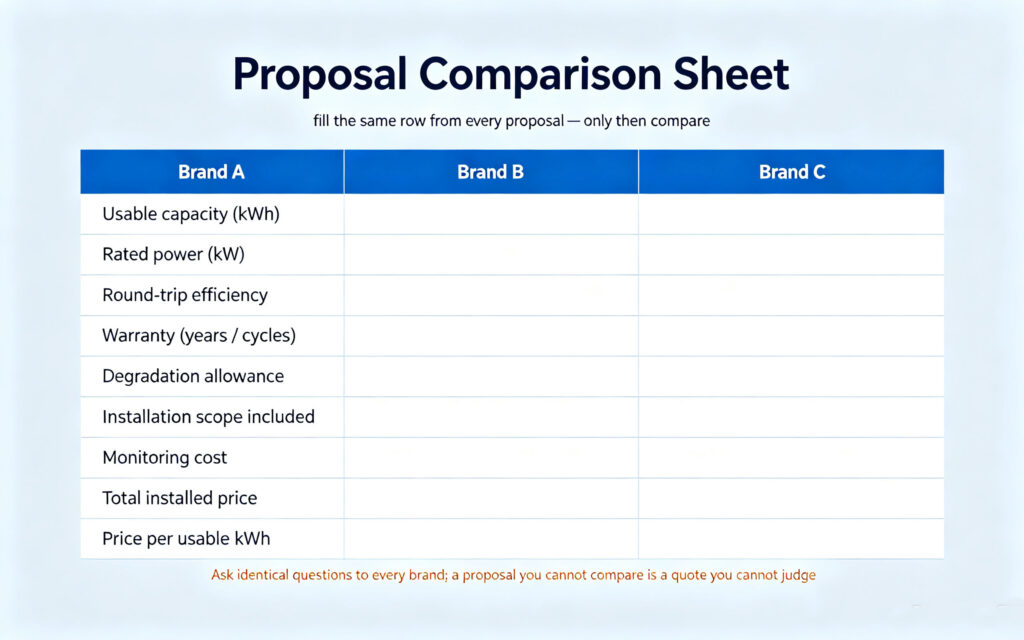
Asking identical questions is what makes proposals comparable. These are the ones that expose weak offers.
- What is the usable capacity under my temperature and discharge profile? The answer should be a number, not a range of marketing figures.
- What does the warranty actually cover, and what voids it? Read the exclusion list; installation mistakes and operating conditions void many warranties.
- Can the system expand, and at what cost? Future battery needs change the total cost of ownership.
- Who services this brand locally, and what is the response time? A brand without local support is a brand without service.
- What is the installed price per usable kWh, all included? This is the number that compares across brands, not the headline price.
For sizing the system before you compare, see #9 how to size a home battery.
Common ways proposals mislead
The misleading patterns repeat across the industry, and they are easy to spot once named.
Headline capacity vs usable: quoting raw kWh and letting buyers assume it is usable energy.
Price without scope: quoting hardware only, with installation, permits and extras added later as “discoveries”.
Warranty fine print: long warranty years with a degradation allowance that effectively reduces coverage early.
Vague compatibility: “works with most inverters” instead of listing the exact protocols and models. For the compatibility question in detail, see #18 battery-inverter compatibility guide.
Q. How do I compare home storage brands?
Compare on the dimensions that survive installation: warranty terms, system compatibility and expansion, local support and parts availability, and real specification sheet data. Use usable capacity, efficiency and installed price per usable kWh for the price comparison. Ask every brand the same questions, because proposals are only comparable when they are built on identical scope and definitions.
Q. What should I look for in a home battery quote?
Look for usable capacity rather than headline capacity, rated power, round-trip efficiency, and a clear installation scope that states what labor, permits, monitoring and extras are included. Check the warranty’s degradation allowance and exclusion list. A quote that cannot be compared line by line with another brand’s quote is not a complete quote.
Q. What is the difference between usable and headline battery capacity?
Headline capacity is the raw cell capacity of the battery, while usable capacity is what the system actually allows you to draw, after the BMS reserves and operating limits are applied. The difference can be significant and varies by brand and chemistry. Comparing usable capacity is the honest way to compare systems, because it reflects the energy you can actually use.
Q. How important is battery warranty when choosing a brand?
Warranty is one of the most important dimensions because it defines the real cost if the battery fades early. Read the years, the cycles or throughput covered, and the degradation allowance, since a long warranty with a generous degradation allowance can still leave you with less usable capacity than expected. Also check what voids the warranty, because installation and operating conditions often do.
Q. Can I add more batteries to a home storage system later?
It depends on the brand and the inverter. Some systems expand by adding battery modules to the same unit, while others require additional inverters or separate stacks. Confirm the expansion path and its cost before purchase, because future needs change the total cost of ownership. Ask the brand for the exact expansion options, not a general “yes”.
Next step: compare on evidence, not marketing
Home storage brands differ in the dimensions that appear after installation: warranty, compatibility, support and real usable specs. Build the comparison sheet, ask the same questions, and read each proposal line by line before signing. A brand that answers specifics is a brand worth buying from.
- Understand the system types in #14
- Read the cost breakdown in #7
- Size the system correctly in #9
- Ask leekooenergy for a comparison-ready home storage proposal: usable capacity, power, efficiency, warranty terms and installed price per usable kWh — so you can judge it against any other brand on the same lines