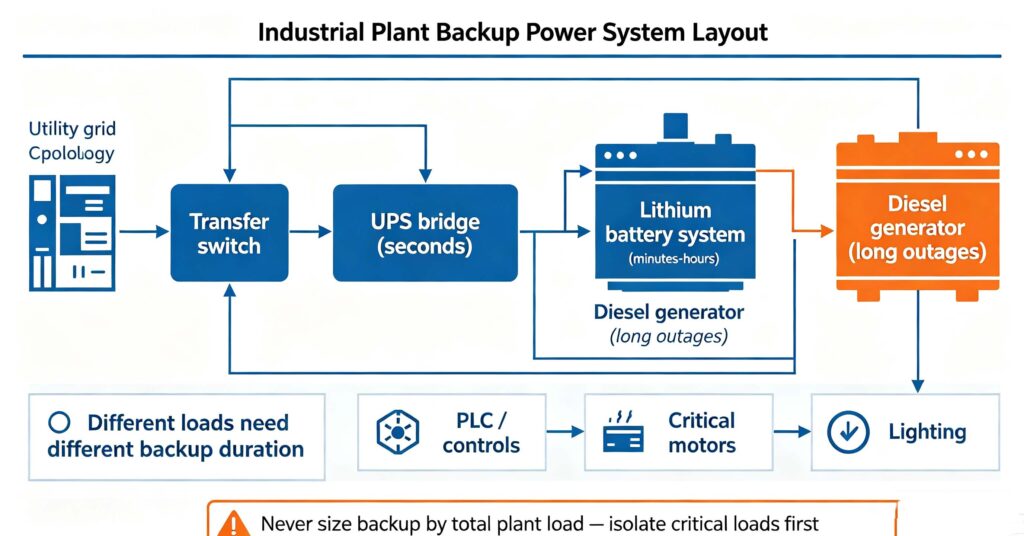
Industrial plant backup power service is the design, supply and maintenance of a system that keeps critical loads running when the grid fails. It starts with a load assessment — separating the few critical circuits (PLCs, controls, safety systems) from the rest of the plant — then chooses between UPS (seconds), lithium battery energy storage (minutes to hours) and diesel generators (long outages). A proper service includes sizing, integration, commissioning and ongoing maintenance, not just selling hardware. The biggest buyer mistake is sizing backup to the total plant load, which is expensive and unnecessary; the right approach is to protect only the loads that cause downtime, safety risk or product loss when power fails.
For a plant manager, the question of industrial plant backup power service is about risk: what breaks, what costs money, and what must stay running through an outage. This guide covers the assessment, the technology choices and how to evaluate a service provider. For the rack-scale battery hardware behind these systems, see #142 48V 300Ah rack mount battery.
The cost of an outage is what justifies the backup system, and it varies wildly by plant. A packaging line that stops for two hours loses finished product and labor; a chemical process that loses controls can damage the reactor or require a lengthy restart; a data center that drops power risks unrecoverable data. The backup system should be sized to the cost of the outage, not to a generic “plant power” number. A plant manager who cannot quantify the cost of a two-hour outage on each critical circuit will overbuy the non-critical loads and underbuy the ones that actually matter. The load study is also a financial exercise, not just an electrical one.
Industrial plant backup power service: assess the load first
The foundation of any industrial plant backup power service is a load assessment. You do not back up the whole plant; you back up what matters.
| Load type | Why it matters | Typical backup |
|---|---|---|
| PLC / controls | Loss = process stop, restart cost | UPS (seconds) |
| Safety systems | Safety, compliance | UPS + battery |
| Critical motors | Product / process loss | Battery or generator |
| Lighting / HVAC | Safety, comfort | Battery (minutes) |
| Non-critical loads | Deferrable | No backup needed |
Commissioning is where many backup systems fail in the first year. A system that has never actually carried a critical load through a simulated outage has no proven transfer logic: does the battery start within the 20ms the PLC expects, does the generator start and take over cleanly, and what happens when the battery is low? A proper service provider runs a full outage simulation on site, loads the battery to real current, and verifies the transfer sequence before signing off. Systems that are commissioned on paper but never load-tested are the ones that fail during the first real outage, when the plant cannot afford a second failure. Ask for commissioning test reports as part of acceptance.
For the commercial cabinet hardware, see #53 C&I cabinet.
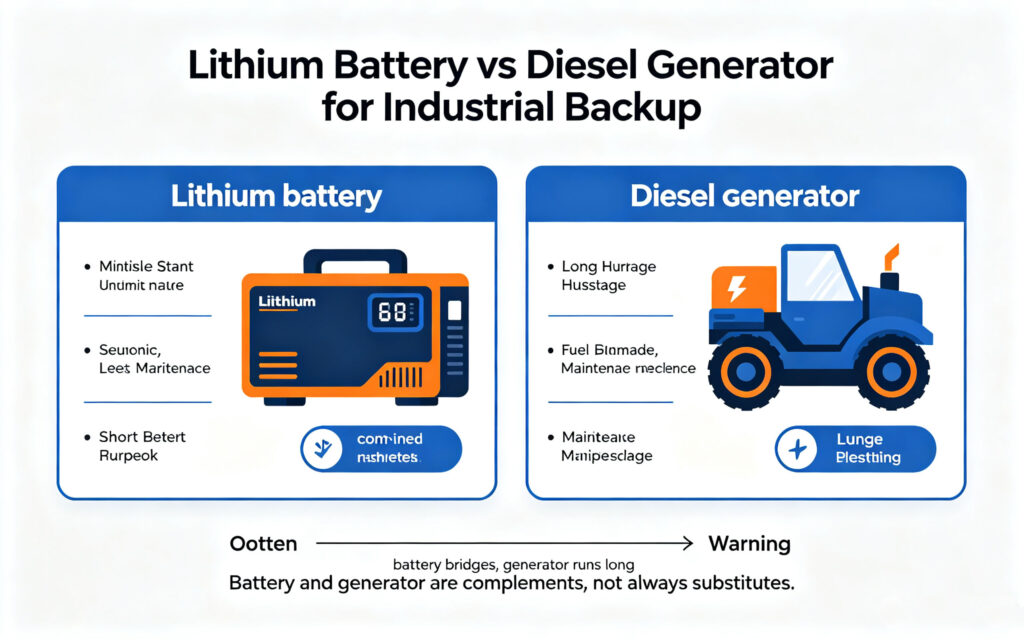
Lithium battery vs diesel generator
Choosing the technology in an industrial plant backup power service depends on outage duration and the value of instant, silent power.
Lithium battery (energy storage): starts instantly, runs silently, needs little maintenance, and also supports peak shaving and solar self-consumption. Best for short outages (seconds to hours) and sensitive loads.
Diesel generator: runs as long as fuel lasts, handles very high loads, but is loud, needs fuel and maintenance, and takes seconds to start. Best for long outages.
Combined approach: many plants use a battery/UPS to bridge the seconds before the generator starts, then the generator carries the long outage. The service provider should design this layering, not sell one box.
What a proper backup service includes
When you evaluate an industrial plant backup power service, the service matters as much as the hardware. A proper engagement includes five steps.
- Site survey and load study: actual measurements, not estimates.
- System design: battery capacity, inverter rating, transfer logic.
- Equipment supply: battery, inverter, switchgear, monitoring.
- Commissioning and testing: simulated outage, transfer verification.
- Ongoing maintenance: battery health checks, firmware, test schedule.
Q. How do I size backup power for my industrial plant?
Start with a load study, not a total-plant number. Measure the critical circuits: PLCs, controls, safety systems, critical sensors. Quantify the cost of a two-hour outage on each. Size the battery and generator to those circuits. Non-critical loads like lighting and HVAC do not need backup. The study is a financial exercise, not just an electrical one.
Q. Is lithium battery backup better than a diesel generator for industrial plants?
They solve different problems. Lithium batteries start instantly, run silently and need little maintenance, ideal for short outages and bridging. Diesel generators run for hours with fuel, handle large loads and take over for long outages. Most plants combine both: the battery bridges the first seconds, the generator runs long outages. They are complements.
Q. How long does industrial backup battery power last?
It depends on the critical load and system size. A 100kWh battery at a 50kW critical load delivers roughly two hours. At 20kW it lasts five hours. Calculate runtime as usable kWh divided by critical load in kW, with a 20% margin. Add solar or a generator for longer outages. Do not size to total plant load — size to critical load only.
Q. What should a backup power service contract include?
A proper service contract covers five things: initial site survey and load study, system design and equipment supply, installation and commissioning with load tests, annual battery testing and generator maintenance, and 24/7 monitoring with emergency response. Ask for a 4-hour response guarantee. Get the service level in writing, not just a price.
Q. Can I add solar to industrial backup power?
Yes. A lithium battery backup system can pair with on-site solar so the battery recharges from PV during the day. This extends runtime and reduces generator fuel use. The inverter must support solar input (MPPT). Solar works best in sunny regions and for daytime loads. It complements rather than replaces a generator for multi-day outages.
Next step: commission a load study, not a hardware quote
For industrial plant backup power service, the correct first step is a measured load study on your critical circuits. Size the system to those loads and the outage duration you must survive, then choose battery, UPS and generator layers together.
- See rack battery hardware in #142
- See commercial cabinet in #53
- Understand manufacturing in #145
- Ask leekooenergy for an industrial backup power consultation with a load study, system design and commissioning plan — not just a battery quote