An iron air battery is a rechargeable battery that stores energy by rusting iron and releases it by reversing the rust. During discharge, iron reacts with oxygen from the air to form iron oxide — rust — and gives up electrons; during charge, electrical energy drives the reaction backwards, turning the rust back into metallic iron. Because iron and air are abundant and cheap, the technology’s appeal is very low material cost and very long discharge duration, at the price of modest energy density and slow response. It is aimed not at replacing lithium ion batteries but at the long-duration and seasonal storage jobs that lithium handles expensively.
The phrase appears in grid-storage headlines, pilot-project announcements and net-zero modelling, often with the promise of batteries that can discharge for days at a fraction of lithium’s cost. Buyers and engineers evaluating storage portfolios need a calmer version of that story: the mechanism, the real trade-offs, the maturity today, and the honest answer to the question everyone asks — should we wait for it? This guide gives the working principle, compares iron air with the LiFePO4 chemistry that dominates today’s solar storage, and closes with a decision frame. The full menu of storage technologies sits in #11 types of energy storage systems, and the economics of the incumbent technology are in #56 BESS cost and ROI.
How an iron air battery works
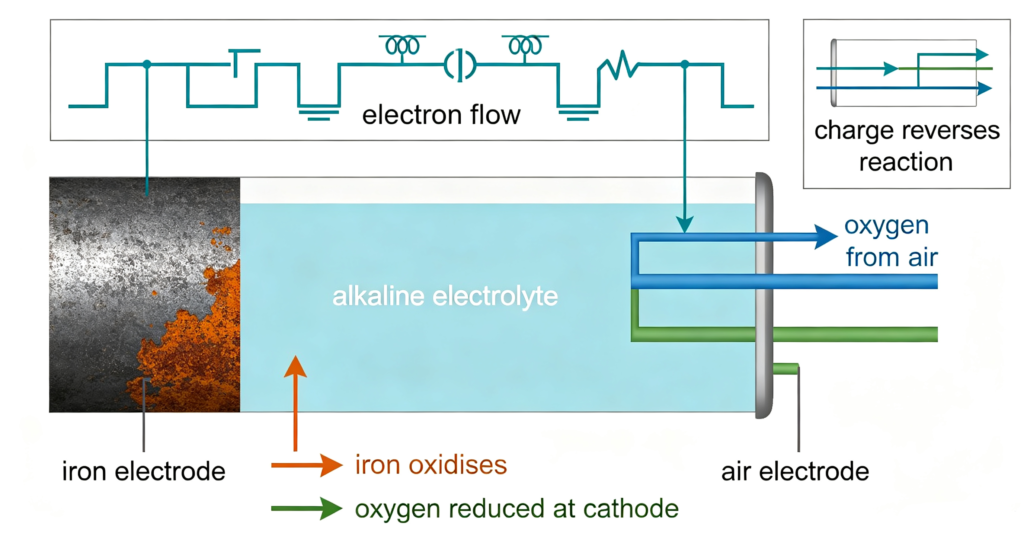
Rust is a chemical reaction, and that reaction stores energy. In an iron air cell, the negative electrode is metallic iron. On discharge, iron oxidises — it combines with oxygen and water from the electrolyte to form iron oxide, releasing electrons that travel through the external circuit to the positive electrode. The positive electrode is an air electrode: it does not store a chemical of its own but catalyses the reduction of oxygen drawn from ambient air, which is why these cells need airflow. On charge, the process inverts: current drives the iron oxide back to metallic iron and releases oxygen, effectively un-rusting the electrode. The quotable definition: An iron air battery is a rechargeable electrochemical cell that stores energy by converting iron to rust when discharging and converts the rust back to iron when charging, using oxygen from the air as the positive-side reactant.
Three engineering consequences follow. First, the chemistry is deliberately slow: iron air cells are designed for long, gentle discharge — hours to days — not for fast power delivery or second-scale response. Second, the cell needs to breathe, so the system includes air-handling that lithium packs do not need. Third, because the reactants are iron, water and air, the material cost is intrinsically low and the supply chain is not constrained by lithium, nickel or cobalt. The failure and ageing modes are also different from lithium’s, which is one reason the technology has to prove itself through the same certification and field data as every other chemistry before it earns mainstream procurement trust.
Iron air battery vs LiFePO4: an honest comparison
The comparison buyers actually need is not iron air versus an abstract lithium; it is iron air versus the LFP batteries they can buy today for solar self-consumption, peak shaving and backup. They occupy different jobs more than they compete head-on.
| Dimension | Iron air battery | LiFePO4 battery (LFP) |
|---|---|---|
| Energy density | Low (large volume per kWh) | Medium (practical for homes and containers) |
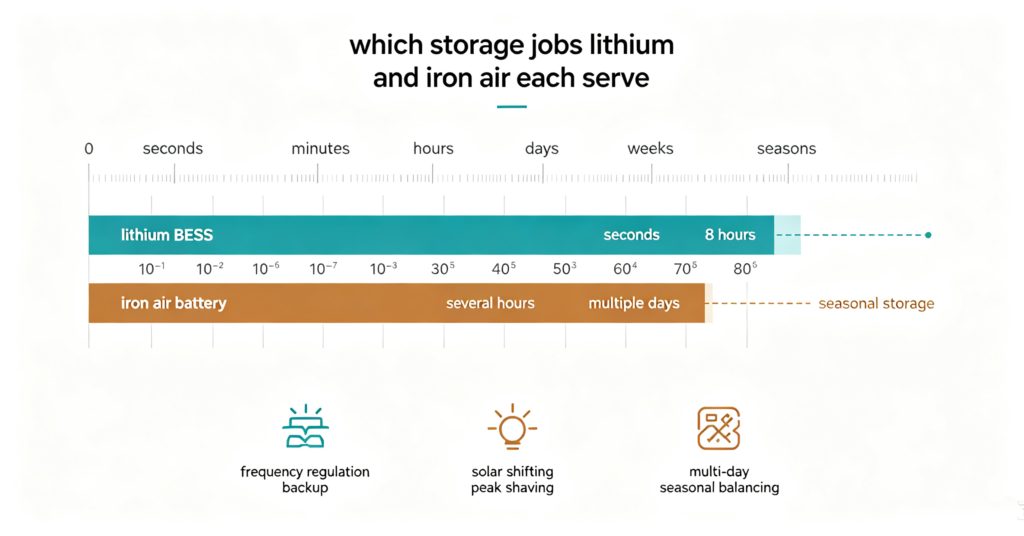
| Typical discharge duration | Hours to multiple days | 30 min – 8 h typical system designs |
| Response speed | Slow, energy-oriented | Fast enough for load-following and backup |
| Material cost outlook | Very low, iron and air | Low and falling, but lithium-constrained |
| Maturity | Early commercial pilots | Mass-produced for a decade+ |
| Certification & field data | Building | Mature (IEC/UL ecosystem) |
| Best fit | Grid-scale multi-day and seasonal storage | Home, C&I, solar pairing, UPS-style backup |
Two columns read together tell the real story. Iron air wins on long-duration economics at grid scale, where a multi-day discharge would force a lithium plant to buy enormous energy capacity that mostly sits idle. LFP wins on everything a building or a factory needs: compact footprint, fast and predictable response, daily cycling for solar self-consumption, certification depth and a supply chain a buyer can inspect today. The chemistry behind that LFP maturity is covered in #01 the LiFePO4 guide and #33 LFP vs NMC.
Where the technology stands today
Iron air is at the stage lithium was decades ago in reverse: the chemistry is old and well understood, but commercial scale is young. Today the technology exists mainly in grid-oriented pilot and early commercial projects aimed at multi-day storage, backed by manufacturers raising production capacity. What remains to be proven is not whether rust stores energy — it does — but whether real deployments hit their promised cost, round-trip efficiency and calendar life over years of field operation, and whether the supply chain and certification ecosystem mature enough for conservative buyers.
Three honest caveats belong in any evaluation. Round-trip efficiency is expected to be lower than lithium’s, which matters when electricity prices, not capital cost, drive the business case. Footprint is large because energy density is low, pushing the technology toward land-rich utility sites rather than building basements. Response is not built for frequency regulation or instant backup — the jobs that need fast power belong to lithium, as described in #22 utility-scale storage. None of these are fatal; they simply define where iron air earns its place. For sites where the job is daily cycling, fast response and compact installation — homes, businesses, solar farms — the decision frame below points the same way it has for years.
Should you wait for it? A decision frame
For a grid operator or utility modelling least-cost long-duration capacity, iron air deserves a serious line in the portfolio analysis, with the same scrutiny given to any emerging long-duration technology. For a home, a factory or a commercial building buying storage for solar self-consumption, peak shaving or backup, waiting is not rational: those jobs need daily cycling, compact installation, proven certification and predictable support — all properties of today’s LFP systems, at costs that have already fallen through mass production. A practical buyer watches iron air the way they watch any new chemistry: follow the field data, revisit in a few years, and buy what is proven for the job at hand. If the job is solar pairing for a building today, the reference architectures in #54 hybrid solar-storage systems and #14 residential systems are built on the chemistry that already works.
The vocabulary trap is worth one paragraph: iron air is frequently lumped together with other new chemistries such as sodium-ion, zinc and flow batteries. They share only the label “alternative to lithium.” Each has different materials, different strengths and a different maturity curve, so portfolio decisions should be made per technology, not per headline. The sodium-ion comparison and its realistic role are discussed in the broader chemistry context of #11 energy storage types.
Q. What is an iron air battery in simple terms?
It is a rechargeable battery that stores energy by rusting iron. Discharging lets the iron react with oxygen from the air to form rust and release electricity; charging reverses the reaction and turns the rust back into iron. It uses cheap materials and is aimed at long-duration storage.
Q. Is the iron air battery real or a concept?
It is real and based on well-understood electrochemistry. The technology is in early commercial and pilot deployment aimed at grid-scale multi-day storage, though it is far younger than lithium in production scale, certification depth and field track record.
Q. Why is everyone talking about a battery that uses rust?
Because iron and air are abundant and cheap, iron air batteries promise very low cost per unit of stored energy over very long discharge durations — the kind of storage grids need for multi-day and seasonal balancing. The trade-offs are low energy density, large footprint and slower response.
Q. Iron air battery vs lithium ion: which is better?
They serve different jobs. Lithium (and especially LiFePO4) wins where buyers need daily cycling, fast response, compact size and mature certification — homes, businesses and solar pairing. Iron air targets grid-scale storage lasting from hours to days, where lithium’s energy cost becomes prohibitive.
Q. Can I use an iron air battery at home?
Not practically today. The technology is aimed at large grid installations, and its low energy density means a huge footprint per kilowatt-hour. Home and commercial solar storage remains the domain of LiFePO4 systems, which are compact, certified and supported.
Next step: buy what is proven for today’s job
Iron air is a chemistry to follow, not a reason to postpone a solar storage decision.
- See the chemistry that already works at scale in #01 the LiFePO4 guide
- Understand the economics of today’s systems in #56 BESS cost and ROI
- Match a system to your site via #14 residential or #05 commercial storage
- Ask leekooenergy for LFP systems sized, certified and warranted for daily cycling — the job most sites actually have