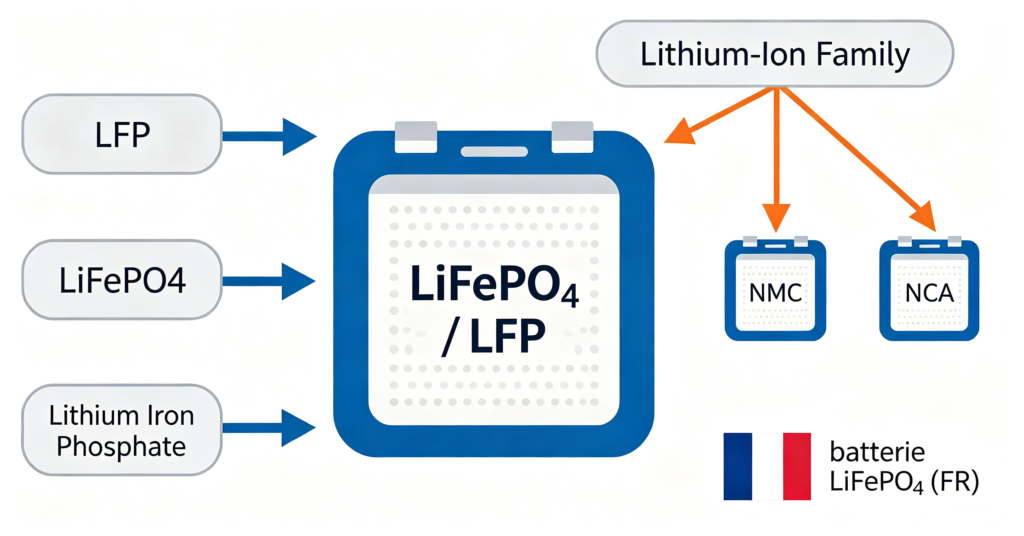
LFP batteries are rechargeable lithium-ion cells that use lithium iron phosphate (LiFePO₄) as the cathode material. “LFP”, “LiFePO4” and “lithium iron phosphate” are three different ways of writing the same chemistry — LFP is the industry abbreviation, LiFePO4 is the chemical formula, and lithium iron phosphate is the plain-English name. The distinction that actually matters for buyers is not between these three labels but between LFP and other lithium-ion chemistries such as NMC (lithium nickel manganese cobalt oxide) and NCA (lithium nickel cobalt aluminium oxide).
If you have ever sat in a procurement meeting where one person says “we need LFP”, another says “LiFePO4 is the way to go” and a third asks “so is that different from lithium-ion?”, you have encountered the nomenclature problem that this article solves. The three labels describe one chemistry. The broader category — lithium-ion — includes LFP as one member alongside several others. Getting this straight matters because a datasheet that says “lithium-ion” without naming the cathode chemistry is hiding the single most important specification a buyer needs.
The full chemistry and performance guide is in #1 LiFePO4 batteries complete guide; the broad “lithium vs lithium-ion” synonym question is in #38 lithium vs lithium-ion. This article stays on the terminology itself: what the abbreviations mean, where they come from, which variants and misspellings appear in sourcing, and how to read a label that uses them.
What “LFP batteries” actually means
LFP stands for lithium iron phosphate. The letters come from the chemical formula LiFePO₄: Li for lithium, Fe for iron (the Latin ferrum), and P for phosphate. The “O₄” (four oxygen atoms) is dropped from the abbreviation because every phosphate group contains it — there is no ambiguity.
An LFP battery is therefore a lithium-ion battery whose positive electrode (cathode) is made of lithium iron phosphate. It is not a separate battery family. It sits inside the lithium-ion family, distinguished from its siblings by the cathode material. The anode in nearly all commercial LFP cells is graphite, the electrolyte is a lithium salt in an organic solvent, and the separator is a microporous polymer film — the same building blocks as any other lithium-ion cell. What changes is the cathode, and that one change drives most of the performance differences that buyers care about: longer cycle life, better thermal stability, lower energy density, and a flatter discharge voltage curve.
The term “LFP batteries” is the one most commonly used by engineers, procurement teams and manufacturers in day-to-day communication. It is short, unambiguous inside the industry, and appears on datasheets, RFQs and shipping documents. If a supplier writes “LFP” on a quote, they mean lithium iron phosphate cathode chemistry — nothing more, nothing less.
LFP, LiFePO4 and lithium iron phosphate — same chemistry, three names
The three labels are not competing standards or different products. They are the same chemistry written at three levels of technical formality.
| Label | Type | Where you see it | Notes |
|---|---|---|---|
| LFP | Industry abbreviation | Datasheets, RFQs, quotes, meeting notes, product titles | Most common in B2B communication; derived from Li-Fe-P |
| LiFePO4 / LiFePO₄ | Chemical formula | Technical specifications, cell labels, academic papers, certification documents | The subscript 4 is often omitted in plain text (“LiFePO4”); both forms mean the same compound |
| Lithium iron phosphate | Plain-English name | Marketing material, product descriptions, explanations for non-technical stakeholders | The full name; sometimes written “lithium-iron-phosphate” with hyphens |
A buyer who sees all three on the same document — for example, a datasheet that says “LiFePO4 (LFP) lithium iron phosphate cells” — is not looking at three different things. The writer is being redundant on purpose, making the chemistry explicit for readers who may only recognise one of the three forms. This is good practice in international procurement, where a team in Germany may search for “LiFePO4”, a team in the United States may search for “LFP batteries”, and a manager reading the executive summary may only recognise “lithium iron phosphate”.
The lithium-ion family: where LFP sits among the chemistries
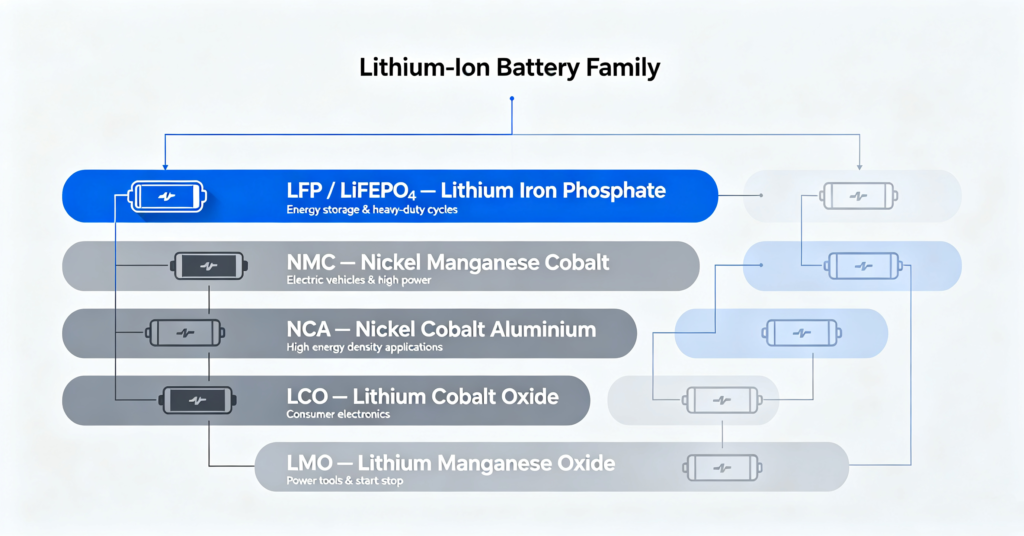
“Lithium-ion” is the umbrella term for any rechargeable battery that moves lithium ions between the anode and cathode during charge and discharge. LFP is one member of that family. The other commercially important members are defined by their cathode chemistry, and each has a different balance of energy density, cycle life, safety and cost.
| Chemistry | Abbreviation | Cathode material | Typical use |
|---|---|---|---|
| Lithium iron phosphate | LFP / LiFePO4 | LiFePO₄ | Stationary energy storage, solar batteries, electric buses, forklifts |
| Lithium nickel manganese cobalt oxide | NMC | LiNiMnCoO₂ | Electric vehicles, power tools, consumer electronics |
| Lithium nickel cobalt aluminium oxide | NCA | LiNiCoAlO₂ | Electric vehicles, high-energy-density applications |
| Lithium cobalt oxide | LCO | LiCoO₂ | Consumer electronics (phones, laptops) — declining in industrial use |
| Lithium manganese oxide | LMO | LiMn₂O₄ | Power tools, medical devices — often blended with NMC |
The practical implication for a buyer is straightforward: a product labelled simply “lithium-ion battery” could contain any of these cathodes. If the label does not say LFP, NMC, NCA or another specific chemistry, the buyer should ask. Two “lithium-ion” batteries of the same voltage and capacity can have radically different cycle lives, thermal behaviours and price points depending on the cathode. The chemistry comparison and performance trade-offs are covered in #33 LiFePO4 vs lithium-ion (NMC).
Common misspellings and variants buyers encounter
In real sourcing workflows, the chemistry name gets mangled in predictable ways. Some variants are legitimate (foreign-language spellings), some are common typos that still return search results, and a few are noise that should be ignored. A procurement team that knows which is which avoids wasting time on irrelevant search results and supplier listings.
| Variant | Type | What it means | Buyer action |
|---|---|---|---|
| lifepo4 | Formula without subscript | Standard plain-text rendering of LiFePO₄ | Correct; use in RFQs and searches |
| lifepo₄ | Formula with subscript | Chemically precise rendering | Correct; common in technical documents |
| lfp | Abbreviation | Lithium iron phosphate | Correct; industry standard |
| batterie lifepo4 | French-language variant | “LiFePO4 battery” in French | Legitimate; relevant for EU French-market sourcing and SEO |
| lifep04 (with zero) | Common typo | The letter O replaced by digit 0 | Understand it means LiFePO4; do not use in formal documents |
| lifemgpo4 | Spelling error / noise | Inserted “mg” — not a real chemistry | Ignore in sourcing; it is a keyboard slip that generates irrelevant search traffic |
| lifepo4 battery | Common search phrase | A battery using LiFePO4 chemistry | Correct; high-volume search term |
The French variant batterie lifepo4 deserves a note because it carries significant search volume in European markets. A supplier targeting French-speaking buyers should ensure that product pages and metadata include the French form, not only the English “LiFePO4 battery”. The typo lifep04 (with a zero instead of the letter O) is common enough that search engines auto-correct it, but it should never appear on a datasheet or quote — it looks unprofessional. The form lifemgpo4 is pure noise: there is no chemistry with “mg” inserted, and any listing using it is either a typo or a low-quality page.
Why terminology matters when sourcing batteries
The cost of terminology confusion is not abstract. A buyer who requests a “lithium-ion battery” without specifying LFP may receive quotes for NMC cells that cost more per kWh, have shorter cycle life, and require different thermal management — all because the supplier assumed the most common EV chemistry. Conversely, a buyer who asks for “LFP” but receives a product labelled only “lithium-ion” has no contractual basis to confirm the cathode is actually lithium iron phosphate.
Three rules prevent this:
- Name the cathode chemistry on every RFQ and PO. Write “lithium iron phosphate (LFP / LiFePO4)” rather than “lithium-ion”. This removes the supplier’s ability to substitute a different chemistry.
- Require the chemistry on the datasheet and cell label. A reputable manufacturer prints LiFePO4 or LFP on the cell nameplate and in the specification sheet. If it only says “lithium-ion”, ask for the cathode material in writing.
- Check the third-party test report. Certification documents (UL, IEC, UN38.3) typically list the cell chemistry. A report that says “lithium-ion” without naming LFP should be questioned.
These rules are especially important for OEM and custom-pack buyers, where the cell inside the pack may not be visible. A pack labelled “48V 200Ah lithium-ion” could contain LFP, NMC or a mix. The buyer who specifies “48V 200Ah LFP (LiFePO4)” gets what they expect. The OEM and custom-pack procurement process is covered in #20 custom battery pack OEM/ODM.
How to read a battery label when the chemistry is abbreviated
A typical LFP battery nameplate contains several abbreviations. Knowing what each one means lets a buyer confirm the chemistry at a glance without opening the manual.
- LFP or LiFePO4: cathode chemistry — lithium iron phosphate. This is the one to look for.
- 48V or 51.2V: nominal voltage. 51.2V is the precise nominal voltage of a 16-cell LFP battery (16 × 3.2V); “48V” is the industry shorthand for the same battery. The voltage question is covered in #12 48V vs 51.2V.
- 100Ah / 200Ah / 300Ah: capacity in ampere-hours. Multiply by nominal voltage to get kWh (e.g., 51.2V × 200Ah = 10.24 kWh).
- BMS: Battery Management System — the electronics that protect the cells from overcharge, over-discharge and over-temperature. Explained in #28 BMS 101.
- IP rating (e.g., IP65): ingress protection — dust and water resistance. Relevant for outdoor installations.
If the nameplate says “Li-ion” or “lithium” without LFP or LiFePO4, treat the chemistry as unconfirmed. Ask the supplier for the cell manufacturer’s datasheet, which will always list the cathode chemistry. This is not a bureaucratic detail — it determines the battery’s cycle life, safety profile, charging voltage and resale value.
Q. What does LFP stand for in batteries?
LFP stands for lithium iron phosphate. It is the common industry abbreviation for the LiFePO₄ cathode chemistry used in many stationary energy storage, solar and electric-vehicle batteries. The letters come from the chemical formula: Li (lithium), Fe (iron, from the Latin ferrum) and P (phosphate).
Q. Is LFP the same as LiFePO4?
Yes. LFP and LiFePO4 (or LiFePO₄) are two ways of writing the same battery chemistry — lithium iron phosphate. LFP is the industry abbreviation used in quotes, datasheets and day-to-day communication. LiFePO4 is the chemical formula, common in technical specifications and certification documents. Both refer to a lithium-ion battery with a lithium iron phosphate cathode.
Q. What is the difference between LFP and lithium-ion?
LFP is a type of lithium-ion battery. “Lithium-ion” is the umbrella term for all rechargeable batteries that move lithium ions between electrodes; LFP is one specific member of that family, defined by its lithium iron phosphate cathode. Other lithium-ion chemistries include NMC (nickel manganese cobalt), NCA (nickel cobalt aluminium) and LCO (lithium cobalt oxide). A product labelled only “lithium-ion” could contain any of these — buyers should always confirm the cathode chemistry.
Q. Why do some suppliers write “lithium-ion” instead of “LFP”?
Some suppliers use “lithium-ion” as a generic label because it is familiar to non-technical buyers, or because the product may be offered with multiple cathode chemistries. For a buyer, this is a red flag: if the label does not name LFP, NMC or another specific chemistry, the cathode material is unconfirmed. Always request the cell datasheet and require the chemistry to be named on the purchase order. A supplier that genuinely uses LFP will have no problem printing it on the label and the quote.
Q. What is “batterie lifepo4” and is it different from “LiFePO4 battery”?
“Batterie lifepo4” is the French-language way of saying “LiFePO4 battery”. It refers to the same lithium iron phosphate chemistry — there is no technical difference. The variant matters for European sourcing and SEO: French-speaking buyers search for “batterie lifepo4” rather than “LiFePO4 battery”, and suppliers targeting that market should include the French form in their product pages and metadata. Other common variants include “batterie lithium fer phosphate” (full French name) and “accumulateur LiFePO4”.
Next step: confirm the chemistry before you confirm the price
The most expensive mistake in battery sourcing is buying a “lithium-ion” battery without confirming the cathode chemistry. LFP, NMC and NCA all fit under that label, and they are not interchangeable in cycle life, safety, charging profile or total cost of ownership.
- Read the full chemistry and performance guide in #1 LiFePO4 batteries complete guide
- Compare LFP against NMC in #33 LiFePO4 vs lithium-ion (NMC)
- Understand the broad “lithium vs lithium-ion” question in #38 lithium vs lithium-ion
- Check the 48V vs 51.2V voltage question in #12 48V vs 51.2V solar battery
- Ask leekooenergy for a LiFePO4 (LFP) battery specification sheet that names the cathode chemistry on every page — including the cell nameplate, the BMS specification, the capacity rating and the third-party test report — so your RFQ, PO and incoming inspection all use the same terminology and there is no room for chemistry substitution