Buyer’s guide · Seplos manufacturing & sourcing team · Last reviewed: 2026-08
Two suppliers quote a 51.2 V, 100 Ah lithium ion battery pack. One price is 30 % below the other. Nothing in either datasheet explains why.
The gap is usually in three places: the cell grade, what the BMS is actually capable of, and how the current limits were measured. None of them show up in a nameplate comparison. This guide walks through the specifications that move the price, when a custom pack is worth the tooling, and what to verify on the first sample before you release a production order.
What Is a Lithium Ion Battery Pack?
A lithium ion battery pack is a finished assembly of lithium cells connected in series and parallel inside an enclosure, with a battery management system, protection devices and terminals. The pack is the smallest unit that can be installed and operated on its own — cells cannot, and modules generally cannot.
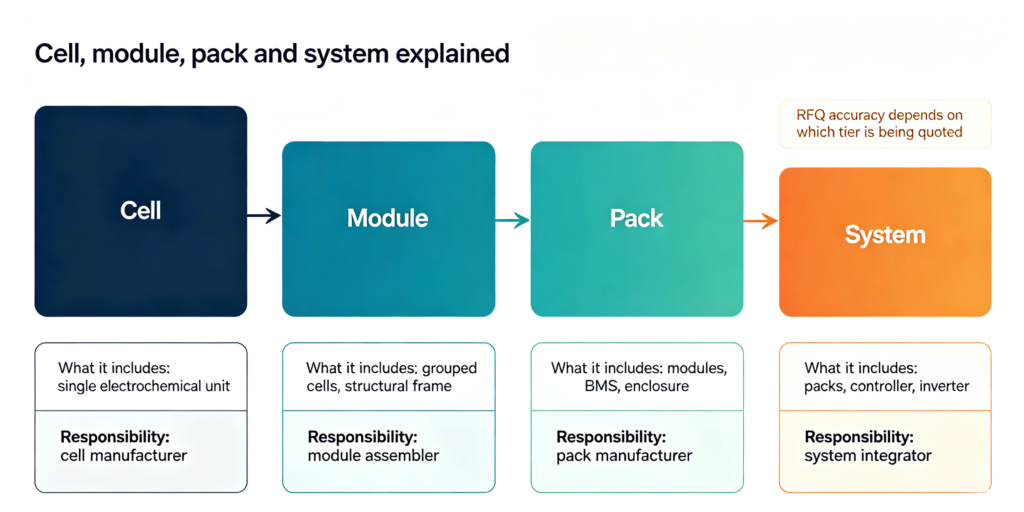
The vocabulary trips people up in RFQs. A cell is the electrochemical unit. A module is a group of cells mechanically joined, often without a full BMS. A pack has its own BMS and can be commissioned. A system combines packs with a controller, and sometimes an inverter.
Getting this right in the enquiry matters commercially. Ask for a “battery pack” when you mean a module and you will be quoted for BMS hardware you intend to supply yourself.
Which Chemistry Belongs in the Pack
For stationary storage and most industrial equipment, specify LiFePO4. For applications where weight or volume is the binding constraint, NMC remains the practical choice despite shorter cycle life at the same depth of discharge.
Most lifepo4 battery pack enquiries we see are already correct on this point — the buyer knows the chemistry and wants configuration help. The exceptions are portable and mobile products, where a customer specifies LFP for safety reasons and then finds the pack does not fit the housing. That conversation is easier before the enclosure is tooled. Chemistry background sits in the LiFePO4 battery guide.
The Specifications That Decide the Price
Five items account for most of the spread between quotes. They are worth writing into the RFQ explicitly, because suppliers will otherwise quote against their own default assumptions.
Usable capacity and voltage window
Nominal capacity is arithmetic. Usable capacity is a decision made by the BMS. Ask for both, along with the depth of discharge behind the usable figure, the charge voltage and the low-voltage cut-off. A pack that reports 5.12 kWh nominal and 4.6 kWh usable is not worse than one claiming 5.12 kWh usable — it is more likely to be honest.
Continuous and peak current
Continuous current is the number that limits your application. Peak figures are typically valid for seconds and are governed by BMS MOSFET thermal limits rather than by the cells. If the load includes a compressor, pump or inverter surge, specify the surge magnitude and its duration, then ask for the derating curve at your ambient temperature.
Cell grade and batch matching
This is where the 30 % appears. Grade A cells come from the primary production line with full capacity and internal-resistance data. B-grade and reclaimed cells may perform acceptably at first and then diverge, and once cells inside one pack diverge the BMS spends its life balancing instead of delivering energy.
Specify grade A, single manufacturer, single batch per pack — and ask for the cell brand and model in writing. A supplier who cannot name the cell is not a supplier you can hold to a cycle-life claim.
BMS functions and communication
Two packs can both have “a BMS” and differ enormously. Ask which protections are implemented (over-voltage, under-voltage, over-current, over-temperature, short circuit, cell imbalance), whether balancing is passive or active, what the balancing current is, and which communication protocol is supported. For storage packs, closed-loop CAN or RS485 communication with the target inverter is usually non-negotiable.
Enclosure, ingress protection and mechanical fit
Sheet metal thickness, coating, terminal position and cable entry direction all sound like details until the pack has to go into an existing cabinet. Send a drawing or the installation envelope with the enquiry. It costs nothing at quotation stage and prevents a redesign later.
| Specification | What to state | Why it changes the price |
|---|---|---|
| Nominal & usable capacity | kWh or Ah, plus assumed DOD | Determines cell count |
| System voltage | Nominal, max charge, cut-off | Series count and BMS variant |
| Continuous / peak current | Amps and peak duration | BMS MOSFET and busbar sizing |
| Cell grade | Grade A, brand, single batch | Largest single cost variable |
| BMS & protocol | Protections, balancing type, CAN/RS485 | Board cost and firmware work |
| Enclosure | Dimensions, IP rating, terminal position | Tooling and sheet metal cost |
| Certification | Destination market requirements | Testing cost and lead time |
| Quantity | First order and annual forecast | Tooling amortisation and pricing tier |
Standard Pack or Custom Pack?
Choose a standard pack when the electrical requirement fits an existing product and only branding or labelling changes. Choose a custom pack when the enclosure, voltage, current or communication requirement cannot be met by any catalogue item, and when the volume can absorb the development and tooling cost.
Between those two sits semi-custom work: a catalogue pack with a different connector, a modified BMS parameter set, a customer display or a private-label enclosure. Most OEM projects belong here, and they are the least risky because the electrical platform is already validated.
Full custom development is justified less often than buyers expect. Before committing, it is worth asking what specifically fails in the standard product. Sometimes the answer is a cable gland position — which is a two-week change, not a new platform. The full development sequence is documented in our custom battery pack OEM/ODM guide.
What Actually Moves the Lead Time
Buyers tend to assume quantity drives lead time. In practice configuration drives it harder.
- Cell availability for a specific model and batch — the most common cause of slippage.
- Custom sheet metal or tooling — adds weeks before the first unit exists.
- BMS firmware changes — including protocol work for a specific inverter.
- Certification testing — sample submission and report issuance sit outside the factory’s control.
- Shipping class and packaging — lithium packs have transport requirements that affect booking, not just cost.
Ask for the lead time broken down by these stages rather than as one number. A supplier who can break it down is telling you they have done it before.
Certification and Transport
Documentation for lithium packs is layered, and the layers are frequently merged in sales material. Three questions clear it up: which document, for which object, in which market.
UN 38.3 testing covers transport of the cell or battery and is required for shipping — it says nothing about stationary operating safety. Industrial cell and battery safety is addressed by standards such as IEC 62619. Product safety approvals in the destination market apply to a specific tested configuration, which means a modified pack may fall outside the report.
The accurate formulation for any supplier is that a pack is designed to meet or tested according to a named standard, in a stated configuration. Buyers should verify which requirements apply in their own market and ask for the report, not the logo.
First-Article Inspection: What to Check on the Sample
The sample stage is cheap. Correcting the same issue after 500 units have shipped is not. These checks catch the failures we see most often.
- Capacity test at the agreed C-rate, comparing measured usable kWh against the specification.
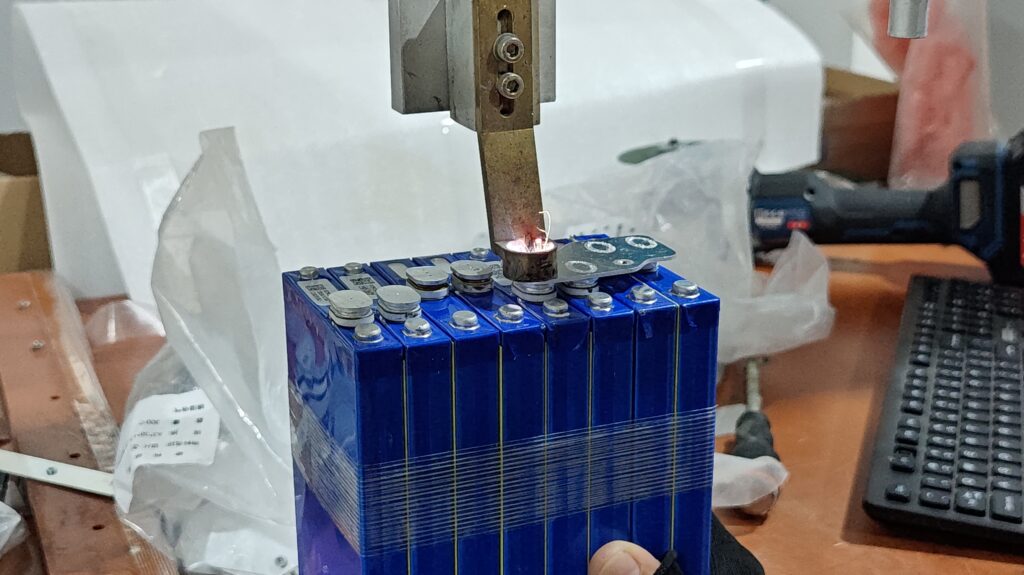
- Cell voltage spread after a full charge — a wide spread on a new pack indicates poor matching.
- Internal resistance reading, recorded as a baseline for future warranty discussion.
- Protection triggers: force over-current and over-temperature conditions and confirm the BMS behaves as documented.
- Communication test with your actual inverter model, not a lab simulator.
- Mechanical fit in the real cabinet, with the real cable route and bend radius.
- Labelling and traceability: serial number, cell batch reference, and whether they can be traced later.
- Packaging drop and vibration if the pack will be shipped as a spare part.
Record the results. A sample report becomes the reference document if a production batch later behaves differently.
What to Send a Supplier
A precise enquiry gets a precise quote. Nine lines are usually enough:
- Application and duty cycle (cycles per day, discharge duration).
- Nominal system voltage and required usable capacity.
- Continuous and peak current, with peak duration.
- Operating and storage temperature range.
- Communication requirement and target inverter or controller model.
- Enclosure constraints — drawing or maximum envelope, IP rating, terminal position.
- Destination market and certification requirements.
- First order quantity and annual forecast.
- Branding or private-label requirements.
If some lines are still open, say so rather than guessing. Suppliers can quote a range against an open item; they cannot recover from a wrong assumption presented as a fact.
Standard configurations and their current limits are listed on the lithium battery pack category page, and private-label or modified builds go through the OEM / ODM process.
FAQs About Lithium Ion Battery Packs
What is the difference between a battery module and a battery pack?
A module is a group of cells mechanically and electrically joined, usually without a complete BMS, and it is not intended to operate independently. A pack includes the BMS, protection devices and terminals, so it can be installed and commissioned as a unit. Quoting the wrong term in an RFQ typically produces a price that includes or excludes BMS hardware unexpectedly.
What does grade A cell mean?
Grade A refers to cells taken from the primary production line that meet the manufacturer’s full specification for capacity, internal resistance and self-discharge, with test data available. Lower grades are cells that failed one of those criteria or were reclaimed. In a series-connected pack the weakest cell governs behaviour, so grade and batch consistency matter more than the headline capacity.
Do lithium battery packs need UN 38.3 testing?
Yes, for transport. UN 38.3 is part of the transport regulations for lithium cells and batteries and is normally required before shipping by air, sea or road. It is a transport document, not a product safety approval, so it does not demonstrate suitability for stationary operation. Ask separately about applicable product safety standards in your market.
What is a typical MOQ for custom lithium battery packs?
It depends primarily on how much of the pack is custom. Private labelling or a parameter change on an existing platform can often be done at low quantities, while a new enclosure with tooling requires enough volume to amortise it. Ask suppliers to quote MOQ separately for semi-custom and fully custom scope, since the two figures are often very different.
Can I use one battery pack model across several markets?
Sometimes, but certification and labelling requirements differ by market and are the usual obstacle. The electrical platform can normally be shared; the documentation package, warning labels, language and sometimes the connector cannot. Confirm target markets before tooling, because retrofitting compliance is more expensive than designing for it.
Locking the Specification
A battery pack RFQ is finished when four things are unambiguous: usable capacity, current limits with duration, cell grade and batch rule, and the communication protocol. Everything else can be negotiated during development.
Suppliers quoting far below the market on those four points are usually quoting a different product. Ask what specifically differs — the answer tends to be brief and informative.
Send your specification for a configuration proposal
For a comparable quotation, send the nine enquiry lines above. If the design is still open, the useful minimum is:
- application and cycles per day;
- voltage and required usable capacity;
- continuous and peak current with duration;
- target inverter or controller model;
- destination market and quantity.
We will respond with a configuration and the specification gaps that still need a decision, rather than a catalogue.
Lithium Ion Battery Pack Sourcing: What to Specify and What to Check
Buyer’s guide · Seplos manufacturing & sourcing team · Last reviewed: 2026-08
Two suppliers quote a 51.2 V, 100 Ah lithium ion battery pack. One price is 30 % below the other. Nothing in either datasheet explains why.
The gap is usually in three places: the cell grade, what the BMS is actually capable of, and how the current limits were measured. None of them show up in a nameplate comparison. This guide walks through the specifications that move the price, when a custom pack is worth the tooling, and what to verify on the first sample before you release a production order.
What Is a Lithium Ion Battery Pack?
A lithium ion battery pack is a finished assembly of lithium cells connected in series and parallel inside an enclosure, with a battery management system, protection devices and terminals. The pack is the smallest unit that can be installed and operated on its own — cells cannot, and modules generally cannot.
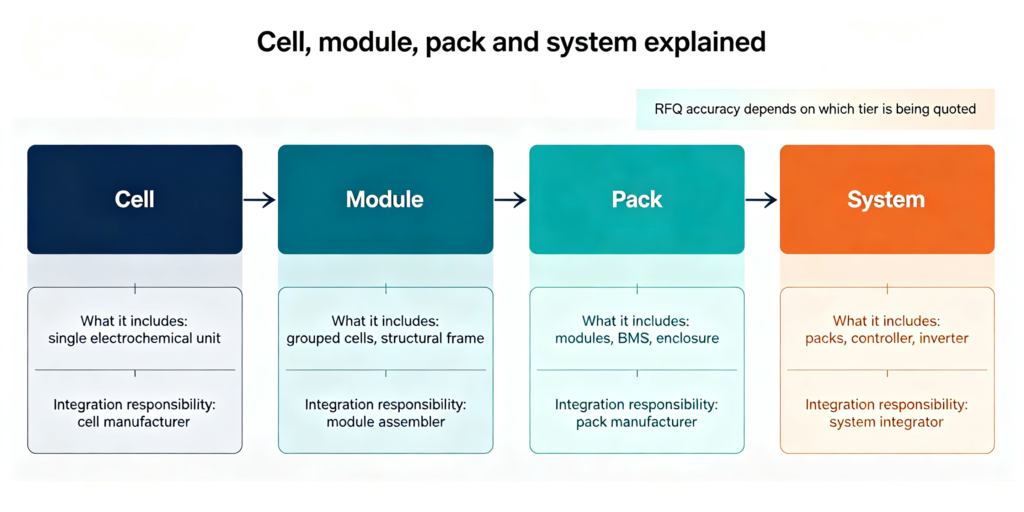
The vocabulary trips people up in RFQs. A cell is the electrochemical unit. A module is a group of cells mechanically joined, often without a full BMS. A pack has its own BMS and can be commissioned. A system combines packs with a controller, and sometimes an inverter.
Getting this right in the enquiry matters commercially. Ask for a “battery pack” when you mean a module and you will be quoted for BMS hardware you intend to supply yourself.
Which Chemistry Belongs in the Pack
For stationary storage and most industrial equipment, specify LiFePO4. For applications where weight or volume is the binding constraint, NMC remains the practical choice despite shorter cycle life at the same depth of discharge.
Most lifepo4 battery pack enquiries we see are already correct on this point — the buyer knows the chemistry and wants configuration help. The exceptions are portable and mobile products, where a customer specifies LFP for safety reasons and then finds the pack does not fit the housing. That conversation is easier before the enclosure is tooled. Chemistry background sits in the LiFePO4 battery guide.
The Specifications That Decide the Price
Five items account for most of the spread between quotes. They are worth writing into the RFQ explicitly, because suppliers will otherwise quote against their own default assumptions.
Usable capacity and voltage window
Nominal capacity is arithmetic. Usable capacity is a decision made by the BMS. Ask for both, along with the depth of discharge behind the usable figure, the charge voltage and the low-voltage cut-off. A pack that reports 5.12 kWh nominal and 4.6 kWh usable is not worse than one claiming 5.12 kWh usable — it is more likely to be honest.
Continuous and peak current
Continuous current is the number that limits your application. Peak figures are typically valid for seconds and are governed by BMS MOSFET thermal limits rather than by the cells. If the load includes a compressor, pump or inverter surge, specify the surge magnitude and its duration, then ask for the derating curve at your ambient temperature.
Cell grade and batch matching
This is where the 30 % appears. Grade A cells come from the primary production line with full capacity and internal-resistance data. B-grade and reclaimed cells may perform acceptably at first and then diverge, and once cells inside one pack diverge the BMS spends its life balancing instead of delivering energy.
Specify grade A, single manufacturer, single batch per pack — and ask for the cell brand and model in writing. A supplier who cannot name the cell is not a supplier you can hold to a cycle-life claim.
BMS functions and communication
Two packs can both have “a BMS” and differ enormously. Ask which protections are implemented (over-voltage, under-voltage, over-current, over-temperature, short circuit, cell imbalance), whether balancing is passive or active, what the balancing current is, and which communication protocol is supported. For storage packs, closed-loop CAN or RS485 communication with the target inverter is usually non-negotiable.
Enclosure, ingress protection and mechanical fit
Sheet metal thickness, coating, terminal position and cable entry direction all sound like details until the pack has to go into an existing cabinet. Send a drawing or the installation envelope with the enquiry. It costs nothing at quotation stage and prevents a redesign later.
| Specification | What to state | Why it changes the price |
|---|---|---|
| Nominal & usable capacity | kWh or Ah, plus assumed DOD | Determines cell count |
| System voltage | Nominal, max charge, cut-off | Series count and BMS variant |
| Continuous / peak current | Amps and peak duration | BMS MOSFET and busbar sizing |
| Cell grade | Grade A, brand, single batch | Largest single cost variable |
| BMS & protocol | Protections, balancing type, CAN/RS485 | Board cost and firmware work |
| Enclosure | Dimensions, IP rating, terminal position | Tooling and sheet metal cost |
| Certification | Destination market requirements | Testing cost and lead time |
| Quantity | First order and annual forecast | Tooling amortisation and pricing tier |
Standard Pack or Custom Pack?
Choose a standard pack when the electrical requirement fits an existing product and only branding or labelling changes. Choose a custom pack when the enclosure, voltage, current or communication requirement cannot be met by any catalogue item, and when the volume can absorb the development and tooling cost.
Between those two sits semi-custom work: a catalogue pack with a different connector, a modified BMS parameter set, a customer display or a private-label enclosure. Most OEM projects belong here, and they are the least risky because the electrical platform is already validated.
Full custom development is justified less often than buyers expect. Before committing, it is worth asking what specifically fails in the standard product. Sometimes the answer is a cable gland position — which is a two-week change, not a new platform. The full development sequence is documented in our custom battery pack OEM/ODM guide.
What Actually Moves the Lead Time
Buyers tend to assume quantity drives lead time. In practice configuration drives it harder.
- Cell availability for a specific model and batch — the most common cause of slippage.
- Custom sheet metal or tooling — adds weeks before the first unit exists.
- BMS firmware changes — including protocol work for a specific inverter.
- Certification testing — sample submission and report issuance sit outside the factory’s control.
- Shipping class and packaging — lithium packs have transport requirements that affect booking, not just cost.
Ask for the lead time broken down by these stages rather than as one number. A supplier who can break it down is telling you they have done it before.
Certification and Transport
Documentation for lithium packs is layered, and the layers are frequently merged in sales material. Three questions clear it up: which document, for which object, in which market.
UN 38.3 testing covers transport of the cell or battery and is required for shipping — it says nothing about stationary operating safety. Industrial cell and battery safety is addressed by standards such as IEC 62619. Product safety approvals in the destination market apply to a specific tested configuration, which means a modified pack may fall outside the report.
The accurate formulation for any supplier is that a pack is designed to meet or tested according to a named standard, in a stated configuration. Buyers should verify which requirements apply in their own market and ask for the report, not the logo.
First-Article Inspection: What to Check on the Sample
The sample stage is cheap. Correcting the same issue after 500 units have shipped is not. These checks catch the failures we see most often.
- Capacity test at the agreed C-rate, comparing measured usable kWh against the specification.
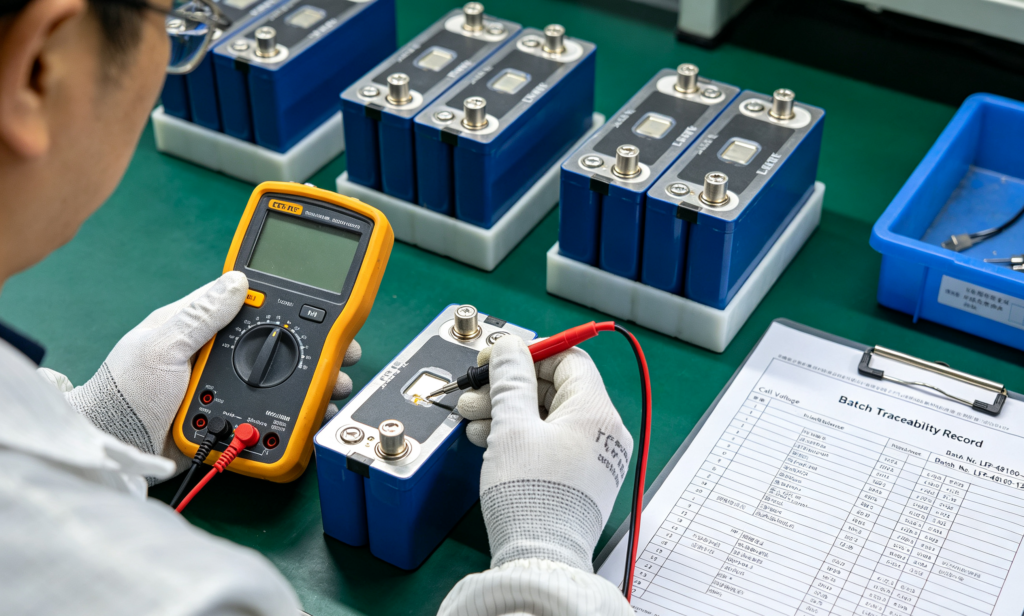
- Cell voltage spread after a full charge — a wide spread on a new pack indicates poor matching.
- Internal resistance reading, recorded as a baseline for future warranty discussion.
- Protection triggers: force over-current and over-temperature conditions and confirm the BMS behaves as documented.
- Communication test with your actual inverter model, not a lab simulator.
- Mechanical fit in the real cabinet, with the real cable route and bend radius.
- Labelling and traceability: serial number, cell batch reference, and whether they can be traced later.
- Packaging drop and vibration if the pack will be shipped as a spare part.
Record the results. A sample report becomes the reference document if a production batch later behaves differently.
What to Send a Supplier
A precise enquiry gets a precise quote. Nine lines are usually enough:
- Application and duty cycle (cycles per day, discharge duration).
- Nominal system voltage and required usable capacity.
- Continuous and peak current, with peak duration.
- Operating and storage temperature range.
- Communication requirement and target inverter or controller model.
- Enclosure constraints — drawing or maximum envelope, IP rating, terminal position.
- Destination market and certification requirements.
- First order quantity and annual forecast.
- Branding or private-label requirements.
If some lines are still open, say so rather than guessing. Suppliers can quote a range against an open item; they cannot recover from a wrong assumption presented as a fact.
Standard configurations and their current limits are listed on the lithium battery pack category page, and private-label or modified builds go through the OEM / ODM process.
FAQs About Lithium Ion Battery Packs
Q. What is the difference between a battery module and a battery pack?
A module is a group of cells mechanically and electrically joined, usually without a complete BMS, and it is not intended to operate independently. A pack includes the BMS, protection devices and terminals, so it can be installed and commissioned as a unit. Quoting the wrong term in an RFQ typically produces a price that includes or excludes BMS hardware unexpectedly.
Q. What does grade A cell mean?
Grade A refers to cells taken from the primary production line that meet the manufacturer’s full specification for capacity, internal resistance and self-discharge, with test data available. Lower grades are cells that failed one of those criteria or were reclaimed. In a series-connected pack the weakest cell governs behaviour, so grade and batch consistency matter more than the headline capacity.
Q. Do lithium battery packs need UN 38.3 testing?
Yes, for transport. UN 38.3 is part of the transport regulations for lithium cells and batteries and is normally required before shipping by air, sea or road. It is a transport document, not a product safety approval, so it does not demonstrate suitability for stationary operation. Ask separately about applicable product safety standards in your market.
Q. What is a typical MOQ for custom lithium battery packs?
It depends primarily on how much of the pack is custom. Private labelling or a parameter change on an existing platform can often be done at low quantities, while a new enclosure with tooling requires enough volume to amortise it. Ask suppliers to quote MOQ separately for semi-custom and fully custom scope, since the two figures are often very different.
Q. Can I use one battery pack model across several markets?
Sometimes, but certification and labelling requirements differ by market and are the usual obstacle. The electrical platform can normally be shared; the documentation package, warning labels, language and sometimes the connector cannot. Confirm target markets before tooling, because retrofitting compliance is more expensive than designing for it.
Locking the Specification
A battery pack RFQ is finished when four things are unambiguous: usable capacity, current limits with duration, cell grade and batch rule, and the communication protocol. Everything else can be negotiated during development.
Suppliers quoting far below the market on those four points are usually quoting a different product. Ask what specifically differs — the answer tends to be brief and informative.
Send your specification for a configuration proposal
For a comparable quotation, send the nine enquiry lines above. If the design is still open, the useful minimum is:
- application and cycles per day;
- voltage and required usable capacity;
- continuous and peak current with duration;
- target inverter or controller model;
- destination market and quantity.
We will respond with a configuration and the specification gaps that still need a decision, rather than a catalogue.