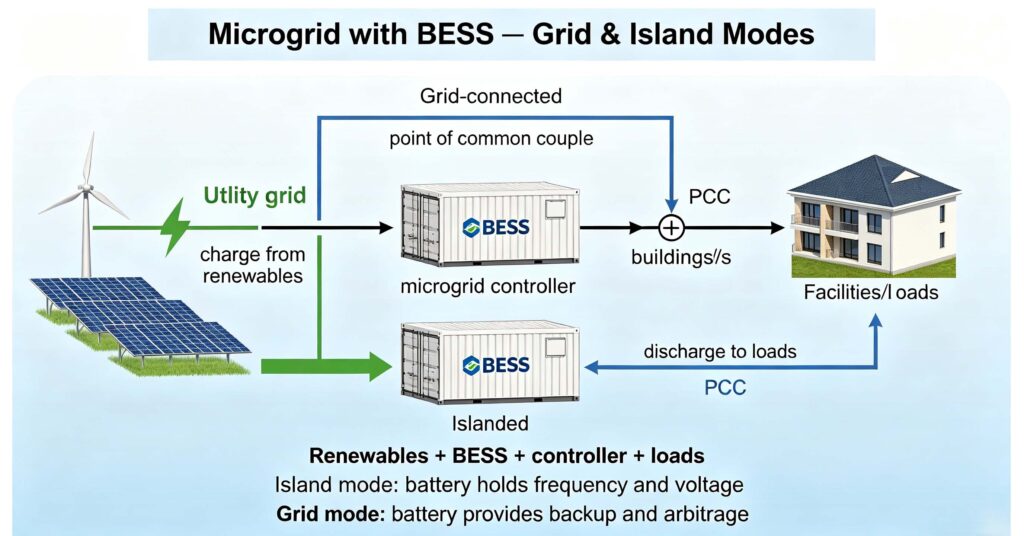
Microgrid battery storage is the energy storage component of a microgrid — a localised power system that can run connected to the main grid or islanded (independently) — and it does the jobs of balancing, backup and grid support. In a microgrid, the battery stores energy from solar, wind or the grid, releases it when loads need it, and in islanded mode acts as the source that holds the microgrid’s voltage and frequency, allowing the system to keep running without the main grid. A microgrid typically has four elements: generation (solar, wind, or a generator), storage (the BESS), a controller (which manages generation, storage and loads), and the loads themselves. Microgrid battery storage is used for resilience (keeping a campus, hospital, factory or remote community powered through outages), for economics (shifting energy and cutting peak demand), and for integrating renewable generation that would otherwise be curtailed. Sizing microgrid battery storage starts with the load profile and the resilience goal: the capacity (kWh) is set by how long you must run the critical loads through an outage or how much energy you want to shift, and the power (kW) is set by the peak load the battery must serve or absorb. A typical campus or facility microgrid might pair 500kW-5MW of generation with 1-10MWh of battery storage, but the right size comes from the load analysis, not a template. Microgrid battery storage is distinct from a simple backup battery because it actively manages generation, storage and loads as one system, not just a reserve. For the wider range of storage system types, see #11 types of energy storage systems.
Microgrids are how a campus, hospital, factory or remote community gains control over its own power — and the battery is what makes them work. This guide explains what microgrid battery storage does, how it works in both islanded and grid-connected modes, and how to approach sizing it. For the commercial and industrial context, see #15 industrial battery storage applications.
What a microgrid is and why it needs a battery
A microgrid is a localised energy system with its own generation, storage, controller and loads that can operate connected to the main grid or independently. The battery is central because it is what lets the microgrid balance and run without the grid.
In grid-connected mode, the microgrid imports and exports power but uses its battery to cut peak demand, shift energy and provide backup. In islanded mode, the microgrid disconnects from the grid and runs on its own generation plus storage; the battery then plays the critical role of holding voltage and frequency as loads change, filling the gap between intermittent generation (solar, wind) and demand. Without storage, an islanded microgrid with only intermittent renewables cannot maintain stable power. This makes microgrid battery storage the foundation of the whole system.
How microgrid battery storage works
A microgrid battery system has the same core components as any BESS — battery cells, a BMS, a PCS/inverter and a controller — but it is integrated with the microgrid’s generation and loads, and it behaves differently in each mode.
Grid-connected operation: the battery charges from solar/wind surplus or cheap grid power, and discharges to cut peak demand, shift energy to high-price hours, or provide backup if the grid fails. The microgrid controller decides when to charge, hold or discharge based on rates, load and generation. In this mode the battery behaves much like an optimized C&I storage system.
Islanded operation: the microgrid disconnects from the grid, and the battery becomes the system’s anchor. It holds voltage and frequency (grid-forming), absorbs surplus renewable energy to keep generation balanced, and supplies power to the loads as needed. The controller manages load-shedding if the battery cannot cover demand, keeping critical loads running. For the components of a BESS that make this possible, see #52 BESS components: battery, PCS, BMS and EMS.
How to size microgrid battery storage
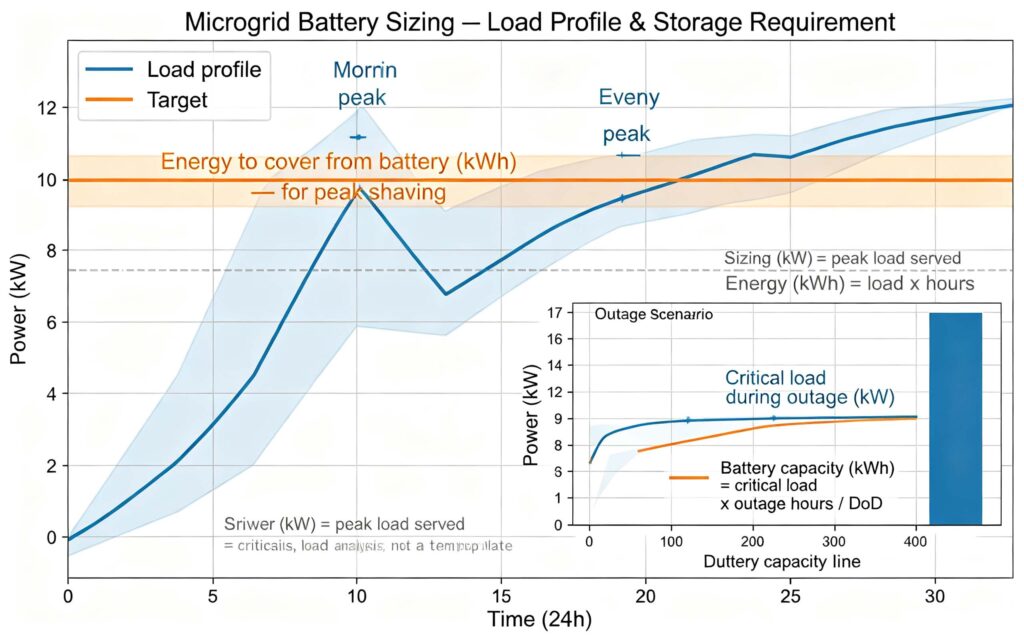
Sizing microgrid battery storage is a load analysis, not a guess. The two numbers that matter are power (kW) and energy (kWh), and each is set by a different requirement.
Power (kW): set by the peak load the battery must serve or absorb at any moment — the largest demand it must cover in island mode, or the charge/discharge rate needed for peak shaving. For islanding, the battery’s power rating must cover the load it will carry (or the controller sheds load to match). For peak shaving, it is set by the amount of peak demand to cut.
Energy (kWh): set by how long the battery must deliver that power. For resilience, capacity = critical load (kW) × outage duration (hours) ÷ usable depth of discharge. For economics, it is the energy shifted or arbitraged per cycle. Account for efficiency (round-trip ~90%) and avoid deep discharge to protect life.
The sizing steps: build the load profile (24-hour and seasonal), define the goal (resilience duration, peak-shaving target, or arbitrage window), calculate power and energy from the goal, add margin, then choose a system form factor. For the enclosure and form-factor decision, see #53 C&I storage forms: rack, cabinet or container.
Applications and when a microgrid makes sense
Microgrid battery storage earns its cost in specific situations where resilience, renewable integration or peak control are worth more than the grid alone provides.
Resilience-critical sites: hospitals, data centers, water treatment, manufacturing and emergency facilities value keeping critical loads running through outages. A microgrid with battery storage turns a multi-hour outage into a managed, continuous power supply.
Remote and islanded sites: facilities with unreliable or expensive grid supply, or no grid at all, use microgrid battery storage to run on local renewables around the clock. The battery smooths solar/wind variability.
Renewable integration and peak control: campuses and facilities with large solar want to maximise self-consumption and cut demand charges; the microgrid battery stores surplus solar and shaves peaks, improving the economics. For the economics of peak shaving, see #57 peak shaving and demand charges.
When to choose a microgrid over a simple battery: when you have multiple generation sources to manage, need islanded operation, or want to control the whole site’s energy as one system. A simple backup battery covers outages; a microgrid battery manages generation, storage and loads as an integrated system.
Q. What is microgrid battery storage?
It is the energy storage component of a microgrid — a localised power system with its own generation, storage, controller and loads that can run connected to the grid or islanded. The battery stores energy from solar, wind or the grid, releases it to loads, and in islanded mode holds the microgrid’s voltage and frequency. It is what lets a microgrid balance generation and demand without the main grid.
Q. How does a battery power a microgrid during an outage?
When the grid fails, the microgrid disconnects and the battery becomes the anchor: it supplies power to the loads and, acting as the grid-forming source, holds voltage and frequency. Surplus from solar or wind charges the battery while loads draw from it. If the battery cannot cover all demand, the controller sheds non-critical loads. The battery keeps critical loads running for as long as its capacity lasts.
Q. How do I size a battery for a microgrid?
Size power (kW) from the peak load the battery must serve or absorb, and energy (kWh) from how long it must run that load. For resilience, energy equals the critical load times the required outage hours divided by usable depth of discharge, adjusted for round-trip efficiency. Build a load profile, define your goal, calculate both numbers, add margin, then choose the system form factor. It is a load analysis, not a template.
Q. What is the difference between a microgrid battery and a backup battery?
A backup battery simply provides reserve power during an outage. A microgrid battery is part of an integrated system that manages generation, storage and loads as one: it not only provides backup but also balances renewable output, shaves peaks, shifts energy and, in island mode, actively holds voltage and frequency as the system’s anchor. The controller and integration, not just the battery, are what make it a microgrid.
Q. Is microgrid battery storage worth it for a small facility?
It depends on the site. For a facility that just needs outage backup, a simpler battery is cheaper and sufficient. A microgrid earns its cost when you have multiple generation sources to manage, need islanded operation, face high demand charges, or want to control the whole site’s energy as one system. Start with the load profile and the resilience goal; if they need integrated management, a microgrid is justified.
Next step: size your microgrid from the load, not a template
Microgrid battery storage is the foundation that lets a campus or facility run on its own generation, stay powered through outages, and control peaks. Sizing is a load analysis: power from the peak load, energy from the duration you must cover. Define your resilience and economic goals, build the load profile, and size the battery to match.
- Review storage system types in #11
- Explore industrial storage in #15
- Choose a form factor in #53
- Ask leekooenergy for a microgrid battery storage specification that includes: a load profile and resilience-goal analysis for your site, recommended battery power (kW) and capacity (kWh) from your load data, the right system form factor (rack, cabinet or container), integration with your generation and controller, and islanded and grid-connected operation requirements — so your microgrid battery storage is sized to your real loads and goals, not a generic template