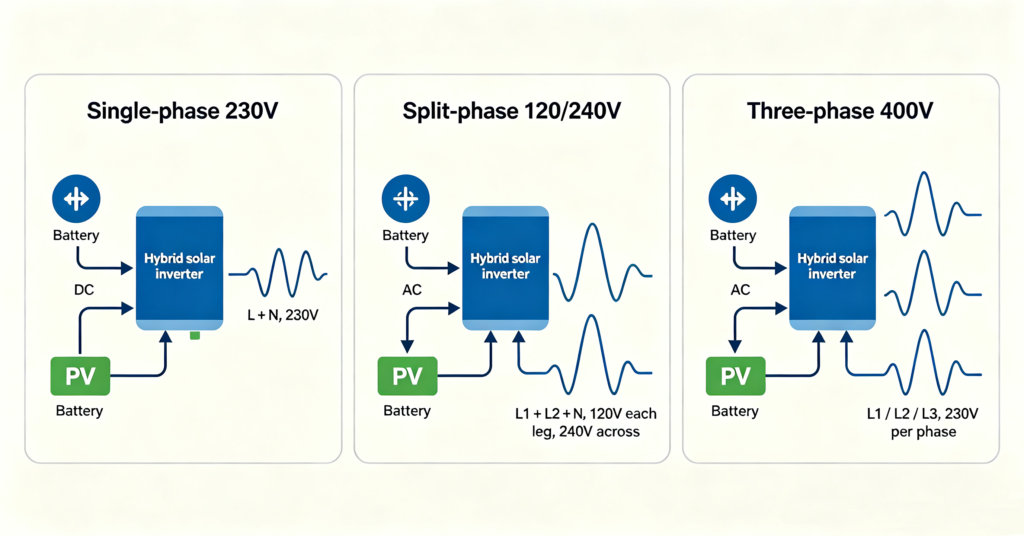
A hybrid solar inverter is an inverter that ties together a PV array, a battery bank and the grid (or a stand-alone AC microgrid) in a single box — and the choice between a single-phase, split-phase and three-phase model is decided almost entirely by the grid profile of the building, not by the inverter’s rated power or its brand. A North American suburban home with 120/240V split-phase service needs an inverter that can output both legs simultaneously; a European urban flat on 230V single-phase needs a single-phase inverter with a battery interface that can take the full PV and battery current on one leg; a small European workshop on three-phase 400V needs an inverter that can balance the three legs without exporting imbalance to the grid. The one-line version worth quoting: the inverter kW rating says how much power the unit can move; the phase configuration says which building it can legally and physically live in — and skipping that question is how buyers end up with an inverter that cannot be commissioned.
Phase configuration is the question most residential and small commercial buyers skip past, because the spec sheet headline is in kilowatts and the battery in kilowatt-hours, and the diagram on the box looks the same. The grid, the meter and the load panel do not care about the box; they care about whether the output is one sine wave, two interleaved sine waves or three rotating sine waves. This article is written for the buyer who has already decided on hybrid topology and now has to pick a phase configuration, and for the installer or distributor who has to stock the right unit before the truck arrives. The hybrid inverter selection framework is in #17 how to choose a storage / hybrid inverter; the 48V battery platform is in #35 48V lithium batteries explained; this article stays on the phase dimension.
What “phase configuration” actually means in a hybrid inverter
An AC waveform has a single sine wave in single-phase, two interleaved sine waves 180° apart in split-phase (NA 120/240V), and three sine waves 120° apart in three-phase (EU 400V inter-phase / 230V per-phase). A hybrid solar inverter that outputs in one of these configurations has to match not just the voltage but the way the grid expects the current to balance across legs. A single-phase inverter feeds one leg and a neutral; a split-phase unit feeds two legs and a neutral; a three-phase unit feeds three legs and a neutral. The DC side — battery and PV array — is identical across the three, which is why the difference is invisible until commissioning day. The way the same battery interfaces to all three is in #18 battery-inverter compatibility.
The three phase profiles side by side
The differences only become visible when the building, the grid and the loads are written into the same table. Below is the practical comparison for a battery-tied hybrid solar inverter at residential or small commercial scale; utility-scale three-phase is a separate design exercise and is not in scope.
| Configuration | Typical grid voltage | Typical output waveform | Typical building | Typical inverter size | Key constraint |
|---|---|---|---|---|---|
| Single-phase | 230 V (L + N) | one sine wave | European urban flat, small single-storey home, light commercial with single-phase service | 3–10 kW | leg limit; large loads trip the leg |
| Split-phase | 120/240 V (L1 + L2 + N) | two interleaved sine waves, 180° apart | North American suburban home, small US commercial | 5–12 kW | leg balance; PV and battery on one leg limit export |
| Three-phase | 400 V inter-phase / 230 V per-phase | three sine waves, 120° apart | European villa with three-phase service, small EU/US commercial, agricultural | 8–30 kW | imbalance limit (typically 16–25 A per leg back to grid) |
Read the table as a hard constraint, not a preference. A split-phase inverter will not legally or physically connect to a 230V single-phase service; a three-phase unit will not balance the legs on a single-phase service without an active balancer that costs more than the saving; a single-phase unit will not supply the three-phase loads in a workshop. The right column says where each fails first, which is the rule of thumb to keep in mind when the spec sheet is otherwise close.
Why the phase configuration matters for batteries
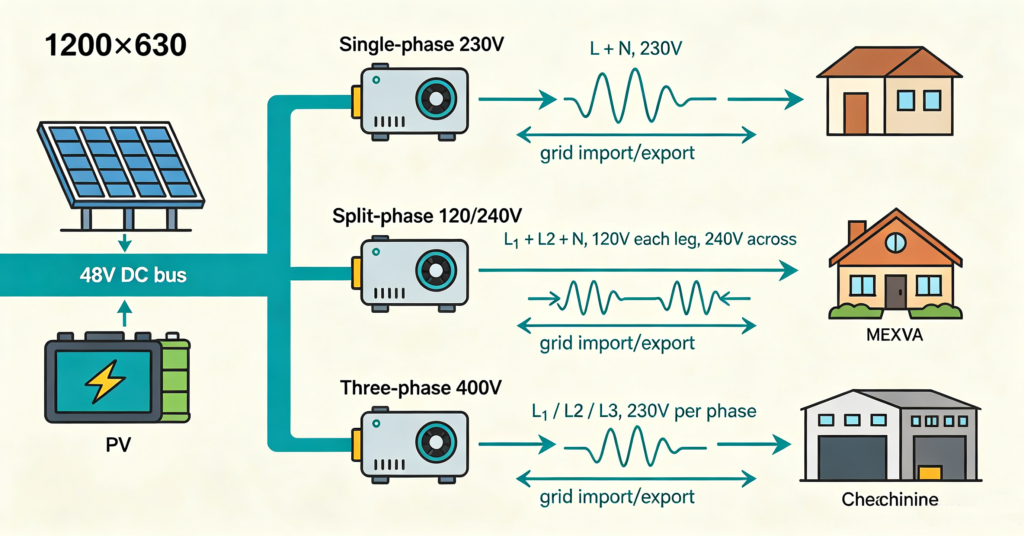
A battery bank stores DC; the inverter’s job is to convert that DC into the AC the building expects. In a single-phase hybrid solar inverter, the entire battery current passes through one set of output switches on one leg. In a split-phase inverter, the battery current still flows through a single DC bus, but the AC output is split between the two legs — why a 10 kW split-phase unit can be sized for 5 kW continuous per-leg current and still feed a 240V dryer across the legs. In a three-phase inverter, the same battery current is divided across three output legs — why a three-phase unit can charge and discharge at a higher total kW on the same battery amp-hour rating, but the imbalance limit imposed by the grid operator sets the real ceiling. The way battery current translates into AC kW is in #61 battery energy storage system design.
Matching the inverter to the load profile
Phase configuration is decided by the building; the inverter size within that configuration is decided by the load profile. The table below shows how three common profiles map onto the phase configurations.
| Load profile | Typical building | Typical peak load | Recommended phase | Recommended inverter size |
|---|---|---|---|---|
| Apartment or small flat | European 1-bed flat, 230V service | 3–5 kW | single-phase | 3–5 kW hybrid solar inverter |
| Suburban family home | NA split-phase 120/240V, EU single-phase villa | 5–10 kW | split-phase (NA) or single-phase (EU) | 5–10 kW hybrid solar inverter |
| Small workshop or office | European 400V three-phase service | 10–25 kW | three-phase | 10–25 kW three-phase hybrid solar inverter |
| Large villa or small commercial | Three-phase EU villa or NA small commercial | 15–30 kW | three-phase | 15–30 kW three-phase hybrid solar inverter |
When the peak load exceeds the single-phase leg limit — typically around 10–15 kW — the choice stops being optional. A 15 kW load on a single-phase service would require an unrealistically large main breaker; the right answer is to step up to three-phase service from the utility and a three-phase hybrid solar inverter. The cost of upgrading the service entrance is significant, which is why some installers use a load-shedding scheme with a smaller inverter — the trade-off is in #61 battery energy storage system design.
Unbalance, export limits and the rules each grid imposes
Every grid imposes two limits on a battery-tied hybrid solar inverter: how much current can flow back to the grid per leg, and how unbalanced the legs can be.
- Single-phase — the inverter output is the leg; the limit is usually the main breaker size (typical residential 40–80 A).
- Split-phase — both legs must export within a few amps of each other; total is bounded by the service entrance rating (common residential 5–10 kW per leg).
- Three-phase — imbalance limit usually 16–25 A per leg back to the grid; most EU operators require all three legs within ±5% of each other.
A three-phase inverter that fails to balance the legs trips an anti-islanding protection or refuses to export, and a split-phase inverter that pushes all PV production to one leg trips the leg breaker. The way the inverter handles this imbalance is part of the firmware, and the firmware version is one of the questions the installer must verify — the same supplier-evaluation logic that applies to batteries applies to inverters and is in #50 evaluating inverter suppliers.
Buying and stocking for an installer or distributor
For an installer or distributor, the stocking question is “how many of each phase configuration do I keep on the truck”. A North American suburban-only installer stocks split-phase. A European urban installer stocks single-phase. An installer serving mixed residential and small commercial stocks all three. Three rules keep the decision honest:
- Match the unit to the service: confirm the grid profile before quoting — 120/240V split-phase in NA, 230V single-phase in EU urban, 400V three-phase in EU commercial.
- Match the firmware to the export rule: the same hardware may need different firmware for different grid codes; ask which firmware version is locked to which country’s grid code.
- Match the battery to the inverter: the battery must speak the inverter’s protocol (CAN, RS485 or vendor-specific); the protocol match is the topic of #30 BMS technology.
Q. Can I use a single-phase hybrid solar inverter on a three-phase service?
Not usefully. A single-phase inverter feeds one leg; the other two legs of a three-phase service remain powered by the grid but cannot benefit from battery backup. If you need battery backup on all three legs, a three-phase inverter is the right answer.
Q. What is the difference between split-phase and single-phase?
Split-phase (120/240V) is two interleaved sine waves 180° apart, common in North American residential service. Single-phase (230V) is one sine wave, common in European residential and most of the rest of the world. A split-phase inverter can power both legs of a 120/240V home; a single-phase inverter can power one leg of a 230V home.
Q. How do I know which phase my building has?
Look at the main breaker: a 100A single-pole breaker is single-phase (230V); a 100A double-pole breaker on adjacent legs is split-phase (120/240V); three breakers ganged together indicate three-phase (400V). If unsure, an electrician can confirm in five minutes.
Q. Can a three-phase hybrid inverter feed a single-phase load?
Yes, it can feed single-phase loads across one or more of its legs while keeping the others grid-tied. The catch is imbalance: if one leg carries far more than the others, the inverter will limit output to stay within the grid’s imbalance rule.
Q. Do I need a different battery for each phase configuration?
No. The battery is on the DC side and is identical across all three phase configurations. What changes is the inverter’s output stage and the way the BMS communicates with it; the same 48V LiFePO4 bank can back any of the three with the right inverter.
Next step: confirm the grid profile before quoting the kW
The right hybrid solar inverter is the one that matches the grid profile of the building it will live in — single-phase 230V, split-phase 120/240V or three-phase 400V — and that speaks the right protocol to the battery bank.
- Start with the hybrid inverter selection framework in #17 how to choose a storage / hybrid inverter
- Confirm the 48V battery platform in #35 48V lithium batteries explained
- Check the inverter-battery protocol match in #18 battery-inverter compatibility
- Evaluate the supplier on firmware discipline via #50 evaluating inverter suppliers
- Ask leekooenergy for the inverter model that matches your grid profile, the firmware version locked to your country’s grid code, and the BMS protocol supported — a hybrid solar inverter that lives happily on the right phase, on the right grid