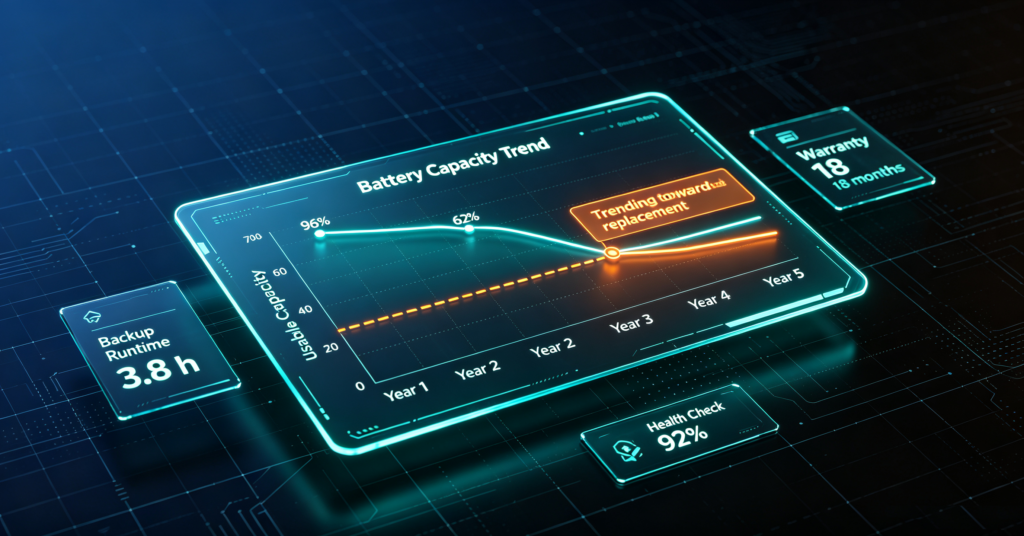
The shortest answer: plan a solar battery replacement when measured, usable capacity has fallen to the point that the system no longer does its job — backup hours are short, self-consumption is slipping, or the warranty and its capacity promise are ending — not simply because a number of years has passed. Most lithium systems age gracefully for a decade or more; the decision belongs to the monitoring data and to changes in what you need the battery to do. When the data says replace, the next questions are whether to replace like-for-like, upgrade to a modern LiFePO4 platform, or augment the existing battery with a parallel unit.
Batteries are the one part of a solar system that is consumed by use. Panels degrade slowly and inverters fail suddenly, but a battery fades in a way you can watch on a graph if you know where to look. That visibility is good news: it means a solar battery replacement can be a planned purchase made from evidence, at a chosen time, with the old unit handled properly — rather than an emergency forced by a winter outage. This guide walks through what actually ages, which signals to read, the triggers that commonly start the project, and how to choose between replacing, upgrading and augmenting.
What actually ages in a battery
Two clocks run against every battery from the day it is installed. The cycle clock counts charge-discharge cycles; each one consumes a small amount of life, and deeper, faster, hotter cycles consume more. The calendar clock runs regardless of use, driven by time, temperature and the state of charge the battery sits at. Which clock dominates depends on the application: a daily-cycling tariff system wears by cycles, while a backup battery that rarely discharges is mostly aged by the calendar. The interplay of these clocks, and how they map onto the cycle tiers a buyer pays for, is covered in #46 cycle life vs price.
Ageing shows up as capacity loss — the battery holds less energy each year — and, eventually, as rising internal resistance, which limits how much power it can deliver at once. Both are normal. What is not normal is a sudden step change: a battery that loses a large share of its capacity in months, or begins throwing cell-imbalance errors, is signalling a fault, not ageing, and the first call is a diagnostic inspection rather than a shopping trip.
The signals worth measuring
- Usable capacity trend: most monitoring platforms chart the energy delivered over recent full cycles. A slow decline is ageing; the number that matters is where the trend crosses the level your household or business actually needs.
- Backup runtime: the practical version of capacity. When an outage that the system once rode through comfortably now ends with a shutdown, capacity has crossed the line — backup behaviour is covered further in #26 solar battery backup for outages.
- Self-consumption rate: on solar systems, the share of PV energy stored and used in the evening falls as capacity falls. A rising grid import in the same weather pattern is the same signal seen from the other side.
- Error and alarm history: recurring cell imbalance, temperature warnings or communication dropouts indicate problems that capacity charts do not show.
- Warranty status: the warranty’s retained-capacity promise defines the supplier’s own line for what counts as acceptable ageing. Crossing it while the warranty runs is a claim; crossing it after is a purchase.
Owners without monitoring history are not stuck: a solar professional can run a controlled discharge test and measure delivered capacity directly. One honest measurement beats years of assumptions, and it is the natural first step of any replacement assessment.
Triggers that commonly start the project
Capacity decline is the main trigger, but four others regularly start a solar battery replacement earlier than the chemistry alone would require. Warranty expiry converts a supported asset into an unsupported one, and many owners prefer to replace on their own schedule while the old unit still has residual value. Load growth — a heat pump, an electric vehicle, a growing business — changes what “enough capacity” means even if the battery itself is healthy. Chemistry vintage: systems built on older lead-acid banks, or early lithium platforms past their parts availability, are often replaced wholesale because servicing them costs more than modern hardware. And system upgrades: an inverter replacement or a move to time-of-use tariffing sometimes justifies refreshing the battery at the same time to avoid paying installation labour twice.
Replace, upgrade or augment
| Option | Best when | Watch out for |
|---|---|---|
| Replace like-for-like | The platform is current, supported and matched to the inverter; capacity simply wore out | Buying yesterday’s technology at today’s price; check the platform is still in production and supported |
| Upgrade to modern LiFePO4 | The system is on lead-acid or an early lithium generation; loads or cycle duties have grown | Inverter compatibility with the new battery; charge settings must be reconfigured, not reused |
| Augment with a parallel unit | Existing battery is healthy but undersized for new loads | Mixed-age parallel strings need matching platforms and BMS support — verify the combination is officially supported |
| Repair / module swap | One module or connection failed in an otherwise healthy, supported system | Availability of spare modules for the exact vintage; economics versus a full refresh |
The lead-acid-to-lithium upgrade deserves a note because it remains the most common version of this project. The chemistry argument is covered in #01 the LiFePO4 guide: usable depth of discharge, cycle life and weight all move decisively in lithium’s favour. But the project is an electrical one, not a swap — different charge voltages, different current behaviour and a BMS that must talk to the inverter. The compatibility rules that govern that handshake are in #18 battery-inverter compatibility.
The economics: when waiting stops paying
The financial heart of the decision is simple in shape: compare the value the battery creates each month (backup security, self-consumption savings, tariff arbitrage) against the rate at which it is losing the ability to create that value. A slowly degrading battery that still covers the evening load is paying its way; the same battery that now covers only half the evening is leaving savings on the table every day, and those daily losses are the true cost of waiting. Against that cost, weigh the new system’s price and the fact that battery value per kilowatt-hour has generally improved over the years — the replacement is usually better hardware for the money than the original was. The cost-structure context for the purchase side is in #07 solar battery cost.
One timing rule serves most owners: start planning when the capacity trend approaches the threshold your loads require, and buy when the plan is ready — not when the first outage forces the decision. Planned replacements get comparison quotes, proper commissioning and a chosen install date; emergency replacements get whatever is in stock.
The replacement project, step by step
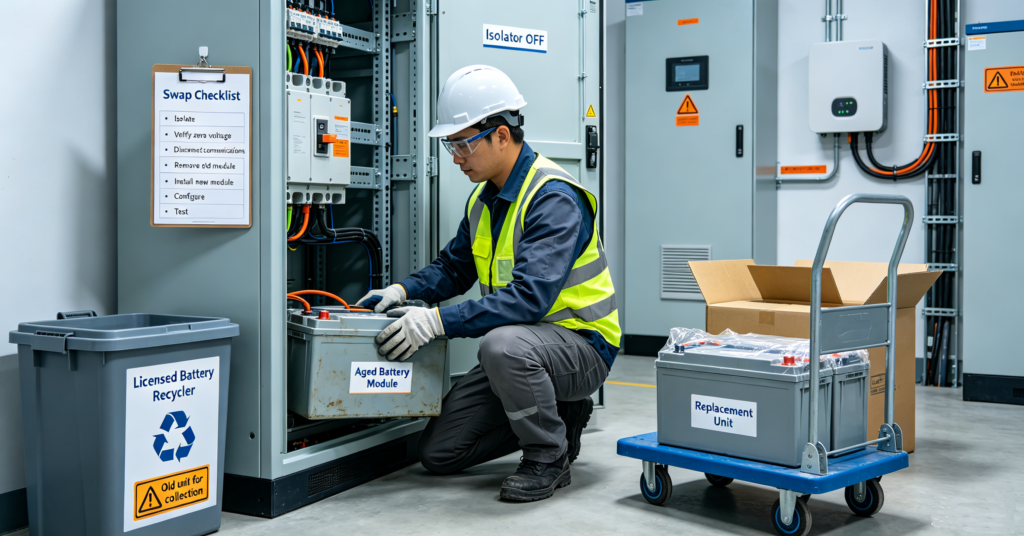
- Measure first: get an honest capacity figure — from monitoring history or a discharge test — before quoting anything.
- Re-specify the load: re-run the sizing question against today’s loads and tomorrow’s plans, not the ones from the original installation; the method is in #09 how to size a home battery.
- Check compatibility: confirm the new battery is supported by the existing inverter — or fold the inverter into the project scope.
- Compare the four options: like-for-like, upgrade, augment, repair — with quotes for each that survives scrutiny.
- Plan the cutover: replacements are usually a same-day job; schedule it outside storm season and, for backup systems, keep a contingency for the hours of downtime.
- Handle the old unit properly: lithium batteries are recyclable and, in many jurisdictions, must not enter general waste — arrange collection through the installer or a licensed recycler, and wipe any monitoring account of the old unit.
Q.How long does a solar battery last before replacement?
It depends on chemistry and duty. Modern LiFePO4 systems are typically described in terms of a decade or more of service, limited by cycles or calendar life depending on how they are used. Lead-acid banks last far fewer years in cycling duty. The honest answer for a specific system comes from its own capacity trend, not from a category average.
Q.Should I replace my battery before the warranty ends?
If the battery still meets your needs, no — let the warranty run. If capacity has crossed the warranty’s retained-capacity line while the warranty is active, that is a claim, not a replacement. The owners who replace slightly early are usually those planning a system upgrade anyway and preferring one installation visit to two.
Q.Can I add a new battery next to my old one instead of replacing it?
Sometimes, and it is the most economical path when the existing battery is healthy but undersized. The conditions are strict: the same platform and voltage, an officially supported parallel configuration, and a BMS that manages the mixed-age group. Mixing brands or chemistries in one string is not a supported configuration on any serious platform.
Q.Is a degraded battery dangerous?
Normal capacity ageing is not a safety issue — the battery simply holds less. Safety concerns arise from faults, not from ageing: physical damage, sustained operation outside temperature limits, or recurring protection alarms. A battery that shows swelling, heating or repeated errors should be isolated and inspected by a professional promptly, whatever its age.
Q.What happens to the old battery after replacement?
It should be recycled through a licensed lithium battery recycler, usually arranged by the installer at the time of the swap. Recycling recovers metals and keeps damaged or degraded cells out of the waste stream where they can become fire risks. Some programmes also offer residual value for units that still test usefully — worth asking about when scheduling the replacement.
Next step: get the number, then the plan
The replacement decision starts with one honest capacity measurement. From there it is a planning exercise with four options and a chosen date.
- Re-check the cost picture with #07 solar battery cost
- Pick the right cycle tier with #46 cycle life vs price
- Re-size against today’s loads with #09 how to size a home battery
- Choose the new platform with #02 how to choose a solar battery bank
- Ask leekooenergy about LiFePO4 replacement and parallel-augmentation options for your existing system