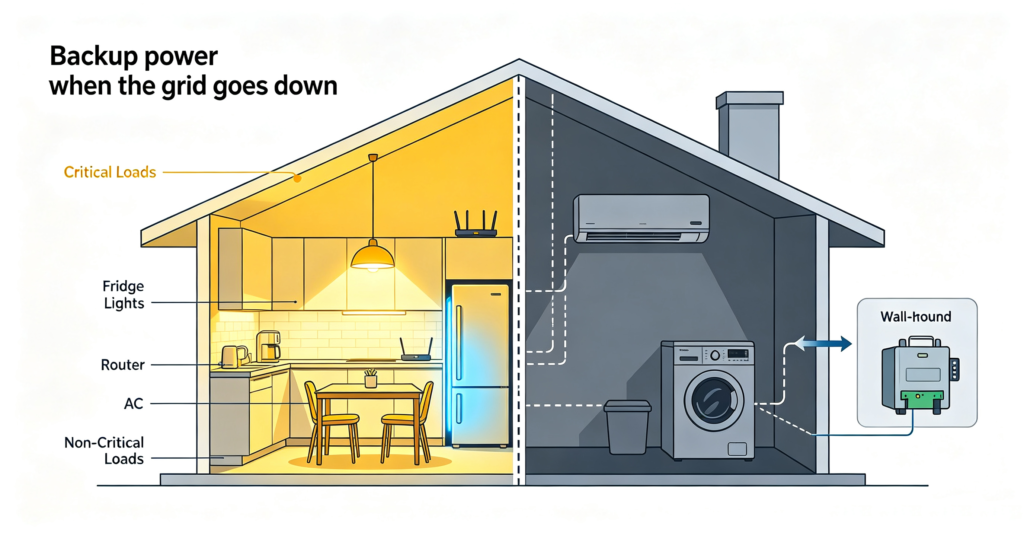
A home solar battery for power outage use stores energy — either from your panels or the grid — and releases it the moment the grid fails, so refrigerators, lights, internet, and medical devices keep running. How long it lasts depends on capacity (kWh) divided by what you power; a typical 10 kWh unit covers essentials for a night, while whole-home backup needs a larger inverter and often a sub-panel. Size to the loads you refuse to lose, not to the whole house.
Outages are the single most concrete reason homeowners ask about storage. Unlike a generator, a battery responds instantly, runs silent, and needs no fuel — but it stores a finite amount of energy. This guide covers what actually stays on, for how long, and how to size and confirm a system with your installer.
Why a battery beats a generator for short outages
A portable generator needs fuel, manual start, and outdoor placement for fumes; it also cannot power sensitive electronics cleanly without an extra inverter. A home battery bridges the gap silently and automatically. Most homeowners pair both: battery for the frequent short outages, generator for extended multi-day grid-down events. See the without-solar guide for homes with no panels at all.
What a backup battery can actually power
Backup value follows from which circuits you protect. Split loads into “must-run” and “nice-to-have”:
| Protection tier | Typical loads | Backup time (approx.) | Notes |
|---|---|---|---|
| Critical loads | fridge, lights, router, phone charge | 12–24 h | A minimal battery suffices |
| Comfort | + well pump, freezer, TV | 6–12 h | Needs 10–15 kWh |
| Whole home | + HVAC, dryer, oven | 2–6 h | Large inverter + multiple batteries |
Exact duration shifts with your real draw and depth of discharge; treat the table as a planning sketch, then confirm against your bill.
Step-by-step: sizing backup for outages
- List must-run circuits. Write the appliances you cannot lose during an outage.
- Estimate their watts. Add running watts; note any motor surge (pump, fridge start).
- Decide backup hours. One night of essentials, or a full day? Hours drive capacity.
- Match capacity. Capacity (kWh) ≈ load (kW) × hours, plus 20% reserve at your depth of discharge.
- Match power. Inverter continuous kW must exceed simultaneous load, not just average.
For the load math, the home battery sizing guide walks the table method in detail.
Whole-home vs critical-loads backup
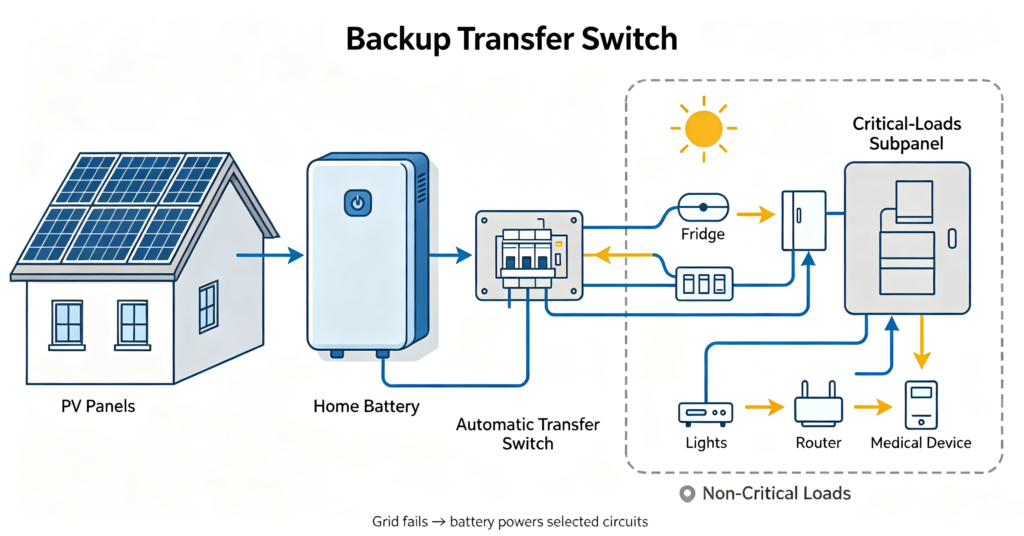
An islanding (whole-home) setup powers everything but needs a larger inverter and often a sub-panel; a critical-loads setup powers selected circuits and costs less. Decide by which appliances must run — fridge and lights versus AC and a well pump change the size dramatically. The residential overview explains the two models side by side.
What to confirm with your installer
A buyer should walk away from the quote knowing four things — these questions separate a real backup design from a box drop:
- Does the system island (run with grid down) or only self-consume? Many batteries do not backup by default.
- Which circuits are on the critical-loads panel, and can they be changed later?
- What is the usable capacity at the planned depth of discharge — not the nameplate?
- Was a grid-loss test performed and documented at commissioning?
A supplier that answers these precisely is easier to trust than one that only repeats “whole-home backup.” The installation guide lists the full acceptance checklist.
Common mistakes
Buyers over-size power and under-size energy, or assume every battery backs up the whole house. Match capacity to backup hours and power to simultaneous load; the cheapest box is rarely the cheapest ownership when the fridge dies at hour three.
Backup runtime in practice: a worked example
Take a home whose must-run load is a fridge (~150 W), lights and router (~100 W), and a phone or CPAP (~50 W) – about 300 W. A 10 kWh battery at 90 percent usable delivers roughly 9 kWh; at 300 W that is about 30 hours of essentials, far beyond one night. Double the load or add a well pump and the same battery covers about 12 h. The point: runtime is load divided by usable capacity, so the backup question is really a load question. Write the watts first, then size – the sizing guide turns that into a battery number.
Permits and grid-tied notes for backup
A backup battery on a grid-tied solar system usually needs the same electrical permit as any storage install, plus utility interconnection if it exports. Islanding, running with grid down, must be approved and configured at commissioning – it is not automatic. Ask the installer whether your authority requires fire-department sign-off for lithium systems; the answer changes lead time more than hardware cost. A solar battery for power outage use is only as good as the commissioning that proves it trips over correctly.
Monitoring after install
Set alerts for low state of charge, communication loss, and out-of-range temperature in the app, then watch the first month. A system that warns beats one that fails silently; most residential issues show as an early alert you can act on the same day. Keep the commissioning record – it speeds any future warranty claim and confirms the backup actually engages on grid loss.
Q. How long will a solar battery last during an outage?
It depends on capacity and load. A 10 kWh unit on essentials (fridge, lights, internet) typically runs 12–24 hours; the same unit powering HVAC may last only 2–4 hours. Size to your refused-to-lose load, not the whole house.
Q. Will my battery work if the sun isn’t shining?
Yes. A backup battery discharges stored energy whether or not panels are producing. Solar only refills it; if the outage is long and sunny, the panels can extend runtime, but the battery itself does not need daylight to deliver power.
Q. Does a home battery need the grid to charge?
No. It can charge from solar during the day or from the grid at night (time-of-use). For true off-grid use, size the array and battery together; most backup systems are grid-tied with islanding.
Q. Can I add backup later to an existing solar system?
Often yes, via an AC-coupled battery or a hybrid inverter swap. Confirm your existing inverter’s age and warranty first; retrofit adds an interface and sometimes a sub-panel, which the installation guide covers.
Q. Is a battery safer than a generator for outages?
For short, clean, automatic backup, yes — no fuel, no fumes, no manual start. For multi-day grid-down events, a generator still wins on runtime. Many homes use both, which is why leekooenergy frames battery as the daily-and-short-outage layer.
Next step: lock down your never-off circuits
Pick the appliances you cannot lose, estimate their watts, and decide backup hours — then share that list with an installer for a sized quote. A storage-ready home starts with the circuit list, not the battery model.
- Download the leekooenergy residential storage product page and compare the 5 / 10 / 15 / 20 kWh tiers
- use #9 Battery Capacity Calculator to size capacity
- ask the installer for an islanding test record (see #13 commissioning checklist)