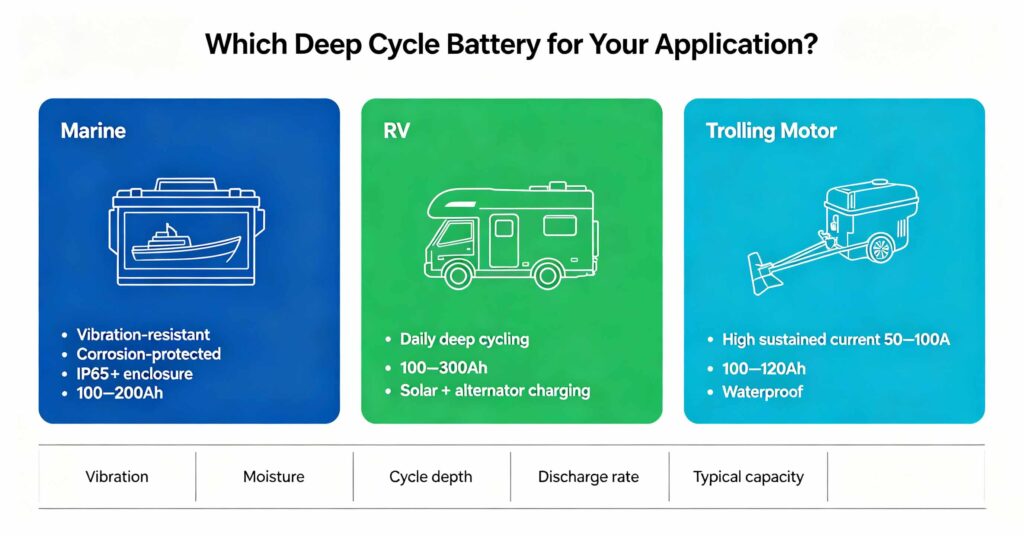
Marine RV deep cycle battery refers to deep cycle batteries used in boats, RVs, camper vans, and trolling motors — applications that require sustained power delivery over hours, unlike car starter batteries that deliver short high-current bursts. While all these applications use 12V deep cycle batteries, they have different requirements: marine batteries must withstand constant vibration, moisture, and corrosion; RV house batteries must handle daily cycling and varying loads; trolling motor batteries must deliver high sustained current (50–100A) for 4–8 hours. LiFePO4 (lithium iron phosphate) is the preferred chemistry for all three applications due to its 6,000–10,000 cycle life, 80–90% usable depth of discharge, 50–60% weight savings, and zero maintenance — but marine-specific LiFePO4 batteries include additional vibration resistance and corrosion protection that standard RV batteries may not have. A typical marine/RV deep cycle battery setup uses 1–2 × 12V 100–200Ah LiFePO4 batteries, charged by alternator (while driving/engine running), solar panels, or shore power.
Choosing the right marine rv deep cycle battery is more nuanced than simply buying a “12V deep cycle battery.” Boats, RVs, and trolling motors each impose different stresses on the battery: boats subject batteries to constant vibration, salt spray, and humidity; RVs require batteries that can handle daily deep cycling and varying loads from fridges to microwaves; trolling motors demand sustained high-current output for hours. Using the wrong battery type — such as a car starter battery in a trolling motor, or a standard RV battery in a saltwater boat — leads to premature failure, safety risks, and wasted money. This guide explains the specific requirements for each application, compares LiFePO4 vs AGM for marine/RV use, and provides capacity sizing and charging recommendations. For 12V LiFePO4 battery specifications and capacity comparison, see #96 12V LiFePO4 deep cycle battery hub.
Marine vs RV vs trolling motor: different battery requirements
While all three applications use 12V deep cycle batteries, the operating environments and discharge profiles are significantly different. Understanding these differences is essential for choosing a battery that will last and perform reliably.
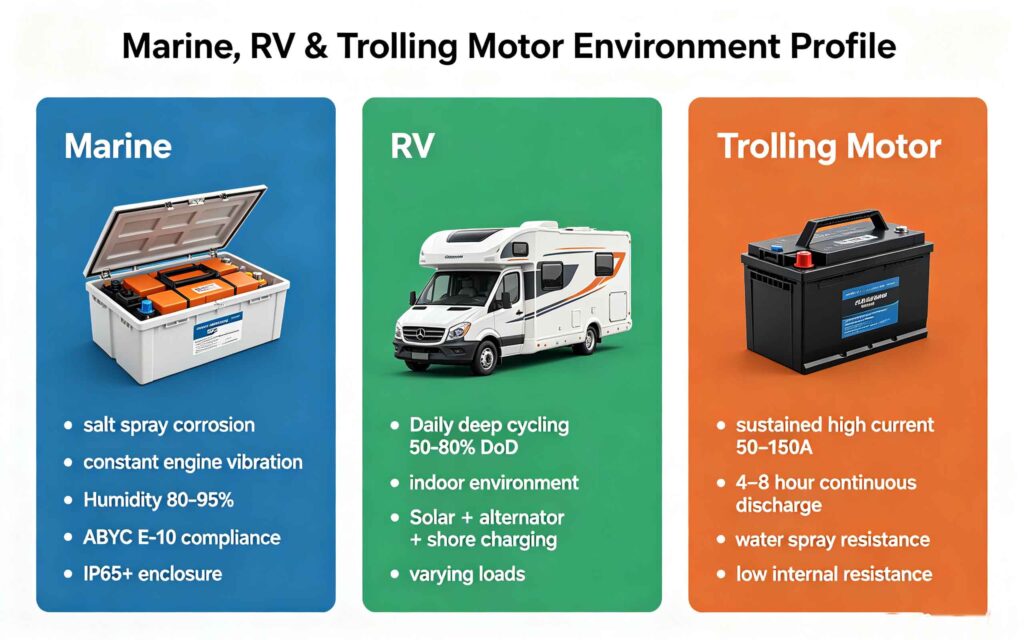
Marine batteries operate in one of the harshest environments for electronics: constant vibration from engines and waves, high humidity, salt spray (for saltwater boats), and wide temperature swings. Marine batteries must have vibration-resistant internal construction (welded or bonded cell connections), corrosion-resistant terminals (tin-plated or stainless steel), and often an IP65 or higher enclosure rating. Marine batteries are also subject to ABYC (American Boat and Yacht Council) standards for electrical systems on boats.
RV house batteries operate in a relatively benign environment (inside the RV, under a seat or in a compartment), but are subjected to daily deep cycling — often discharged to 50–80% every day and recharged by solar, alternator, or shore power. RV batteries must handle varying loads (fridge compressor cycling, microwave surges, water pump, lights) and tolerate partial state of charge for extended periods (during storage or cloudy weather). The key requirement for RV batteries is high cycle life and high usable depth of discharge.
Trolling motor batteries have the most demanding discharge profile: they must deliver sustained high current (50–100A for a 55lb thrust motor, up to 150A for a 112lb motor) for 4–8 hours continuously. This is a high-rate discharge that most deep cycle batteries are not designed for. Trolling motor batteries must have high continuous discharge current rating, low internal resistance, and robust cell construction. They also operate in a marine environment (vibration, moisture), so marine-grade construction is important.
| Requirement | Marine (boat) | RV (house battery) | Trolling motor |
|---|---|---|---|
| Vibration resistance | High (engine + waves) | Low (road vibration) | High (waves + motor) |
| Moisture / corrosion | High (salt spray, humidity) | Low (indoor) | Medium (spray, humidity) |
| Discharge profile | Moderate, varying | Daily deep cycle (50-80% DoD) | Sustained high current (50-150A) |
| Typical capacity | 100–200Ah | 100–300Ah (often 2 in parallel) | 100–120Ah (high discharge rate) |
| Charging source | Alternator (engine), shore power | Solar, alternator, shore power | Alternator, dedicated charger |
| Key standard | ABYC E-10, UL 1973 | UL 1973, RVIA | UL 1973, ABYC |
| Enclosure rating | IP65+ recommended | IP20 sufficient | IP54+ recommended |
LiFePO4 vs AGM for marine and RV deep cycle applications
The choice between LiFePO4 and AGM for marine/RV deep cycle batteries depends on your budget, usage pattern, and weight sensitivity. For most full-time users (liveaboard boats, full-time RVers), LiFePO4 is the clear choice due to dramatically longer life and higher usable capacity. For occasional users (weekend boaters, part-time RVers), AGM may be more cost-effective despite shorter life.
The weight advantage of LiFePO4 is particularly significant for boats and RVs, where every kilogram affects performance and fuel efficiency. A 12V 200Ah LiFePO4 battery weighs 22–26kg, compared to 55–65kg for an equivalent AGM battery (which also has only half the usable capacity). Replacing 4×AGM 100Ah (240kg, 200Ah usable) with 2×LiFePO4 200Ah (50kg, 320Ah usable) saves 190kg and provides 60% more usable capacity — a transformative upgrade for boat handling and RV payload.
The primary concern with LiFePO4 in marine/RV applications is low-temperature charging: LiFePO4 batteries should not be charged below 0°C (32°F), as this can cause lithium plating and permanent capacity loss. For boats and RVs operating in cold climates, choose a LiFePO4 battery with a built-in low-temperature charge cutoff (the BMS prevents charging when cell temperature is below 0°C). Some marine-specific LiFePO4 batteries also include self-heating features for cold-weather operation.
How to size a marine or RV deep cycle battery bank
Sizing a marine or RV battery bank follows the same basic formula as any off-grid system, but with application-specific considerations. The formula is: Required capacity (Ah) = Daily energy consumption (Wh) / 12.8V / 0.85 DoD / desired autonomy days.
For a typical RV, daily energy consumption ranges from 800Wh (small camper van: lights, phone charging, water pump) to 3,000Wh (full-time RV: fridge, lights, TV, microwave, laptop charging). A 200Ah LiFePO4 battery (2.3kWh usable) provides 1–3 days of autonomy depending on usage. Most full-time RVers install 2×200Ah (400Ah total, 4.6kWh usable) paired with 400–600W of solar for indefinite off-grid capability.
For a boat, daily consumption depends on whether you are at anchor (house loads only: lights, fridge, water pump, stereo — typically 500–1,500Wh/day) or underway (navigation instruments, autopilot, radar, AIS — adding 500–1,000Wh/day). A 100–200Ah LiFePO4 battery is typically sufficient for a day boat with shore power access; a 200–400Ah bank is recommended for overnight anchoring or extended cruising.
For a trolling motor, capacity sizing is based on motor thrust and desired run time. A 55lb thrust motor draws ~50A at full speed (but typically averages 20–30A with varying speed), so a 100Ah battery provides 3–5 hours of fishing. A 112lb thrust motor (24V) draws ~50A, requiring 2×12V 100Ah batteries in series for 3–5 hours. For all-day fishing, consider a 120Ah high-discharge LiFePO4 battery or a 24V system.
Q.What is the difference between a marine battery and an RV battery?
Marine batteries and RV batteries are both deep cycle batteries, but marine batteries are built to withstand harsher conditions: constant vibration from engines and waves, salt spray and humidity (requiring corrosion-resistant terminals and IP65+ enclosures), and compliance with ABYC electrical standards. RV batteries operate in a relatively benign indoor environment and primarily need high cycle life for daily deep discharging. A marine battery can be used in an RV (it will be overbuilt but safe), but an RV battery should NOT be used in a marine environment (lack of vibration resistance and corrosion protection can lead to premature failure or safety hazards). For saltwater boats, always choose a marine-specific or marine-rated battery.
Q.Can I use a car starter battery as an RV house battery?
No. A car starter battery is designed to deliver a short, high-current burst (300–800A for 5–10 seconds) to start an engine, then be immediately recharged by the alternator. It is not designed for deep discharge — repeatedly discharging a starter battery below 50% will destroy it in 20–50 cycles. A deep cycle battery (AGM or LiFePO4) is designed to be discharged to 50–80% repeatedly and recharged, with 1,000–10,000 cycle life. Using a starter battery as an RV house battery will result in failure within months and potentially leave you without power. Always use a deep cycle battery for house loads. For starting the RV engine, use a separate starter battery (or a dual-purpose battery if space is limited).
Q.How long do RV house batteries last?
The lifespan of an RV house battery depends on chemistry and usage: AGM batteries last 3–5 years (1,000–2,000 cycles) when properly maintained and not regularly discharged below 50%; LiFePO4 batteries last 10–15 years (6,000–10,000 cycles) even with regular 80% depth of discharge. Factors that shorten battery life include: regular deep discharge below the recommended DoD (50% for AGM, 80–90% for LiFePO4), chronic undercharging (especially with AGM, which causes sulfation), overcharging (exceeding the recommended charge voltage), high operating temperatures (above 30°C accelerates aging), and lack of maintenance (for flooded lead-acid). With proper charging and moderate discharge, a LiFePO4 RV house battery can outlast the RV itself.
Q.What is the best battery for a trolling motor?
The best battery for a trolling motor is a 12V (or 24V for larger motors) LiFePO4 deep cycle battery with a high continuous discharge current rating (≥100A for 12V systems). LiFePO4 is superior to AGM for trolling motors because: it maintains a flat voltage curve throughout discharge (your motor maintains full speed until the battery is nearly empty, whereas AGM voltage drops steadily, slowing the motor); it weighs 50–60% less (critical for boat balance and handling); it provides 60–80% more usable capacity; and it lasts 4–6× longer. For a 12V 55lb thrust trolling motor, a 100–120Ah high-discharge LiFePO4 battery provides 4–6 hours of fishing. For a 24V 80–112lb motor, use 2×12V 100Ah LiFePO4 batteries in series. Ensure the battery has a waterproof or water-resistant enclosure (IP54+) for marine use.
Q.Do I need a special charger for my marine or RV LiFePO4 battery?
Yes. LiFePO4 batteries require a charger with a LiFePO4-specific charge profile: 14.2–14.6V bulk charge, followed by either no float stage or a low maintenance float at 13.5–13.8V. A standard AGM/lead-acid charger (14.4–14.8V absorption, 13.2V float) will undercharge or potentially damage a LiFePO4 battery. For marine/RV applications, you have three charging sources to consider: (1) Shore power — use a LiFePO4-compatible battery charger or inverter/charger with selectable chemistry; (2) Alternator — use a DC-DC charger with LiFePO4 profile (do not connect directly to the alternator); (3) Solar — use an MPPT solar charge controller with a LiFePO4 setting. Many modern RV and marine chargers have a selectable battery type (AGM/Gel/LiFePO4) — always select LiFePO4. If your existing charger does not support LiFePO4, replace it or add a LiFePO4-specific charger.
Next step: choose the right marine/RV battery for your application
The right marine rv deep cycle battery depends on your application: a saltwater boat needs a marine-specific battery with vibration and corrosion resistance; a full-time RV needs a high-cycle-life battery with large capacity; a trolling motor needs a high-discharge-rate battery. LiFePO4 is the best choice for all three applications, but the specific model, capacity, and features (low-temp cutoff, Bluetooth monitoring, waterproof enclosure) vary by use case. Take the time to calculate your daily energy usage, verify your charging system compatibility, and choose a battery that meets the specific environmental requirements of your application.
- Compare 12V LiFePO4 battery capacities in #96
- Read the 12V LiFePO4 system guide in #70
- Learn about AGM to LiFePO4 upgrades in #86
- Understand parallel battery connections in #93
- Ask leekooenergy for a marine/RV deep cycle battery specification that includes: recommended battery type (marine-specific vs standard RV) based on your application, capacity (Ah) based on your daily energy calculation and desired autonomy, required features (vibration resistance, IP rating, low-temp cutoff, Bluetooth monitoring), charging solution for all three sources (shore power, alternator, solar), series/parallel configuration for 24V trolling motors, ABYC/UL certification verification, weight and dimensions for your installation space, and a comparison of LiFePO4 vs AGM total cost of ownership for your usage pattern — so your marine or RV battery is correctly specified for the unique demands of your application