The direct answer: demand charges are billed on your highest power draw, not your total energy use, and a battery energy storage system for peak shaving earns money by discharging during the short windows that set that peak — cutting the kW the meter records, and with it the demand line on the bill. For many commercial sites the charge is 20–40% of the electricity bill, so the mechanism is worth understanding before anyone sells you a battery: peak shaving works only when three things are true — your tariff has a real demand charge, your peak is short and predictable, and the spread between what shaving saves and what the battery costs is positive.
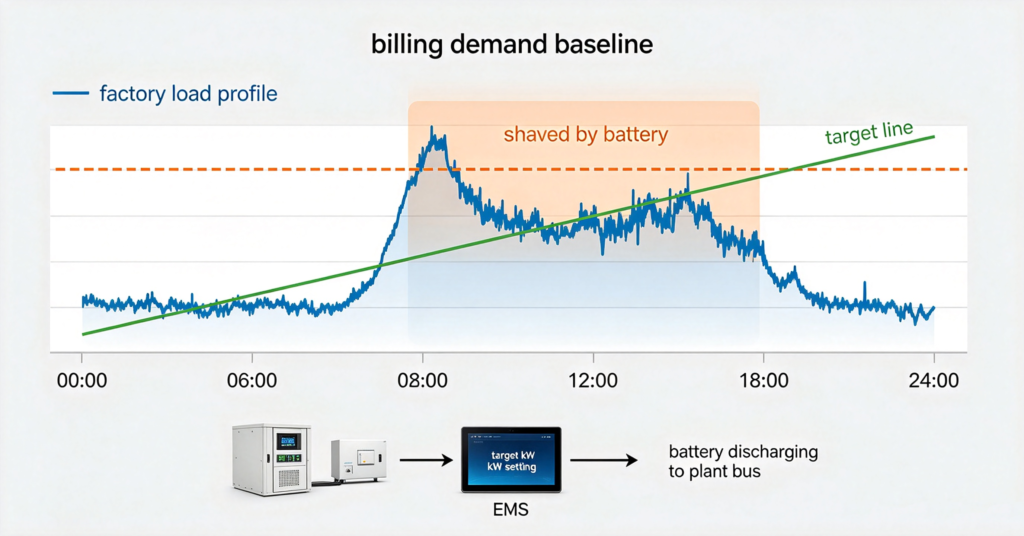
Energy professionals throw the phrase around casually, but the economics are precise and unforgiving. A factory that runs smoothly all month can still pay a punishing demand charge because of one 15-minute spike when two machines started together on a hot afternoon. A battery sized for that site is a different product from a battery sized for a site with a broad, flat afternoon peak. This guide gives facility managers and owners the working knowledge to judge both the bill and the proposal. The wider selection context for commercial storage sits in #05 commercial battery storage and the solar-specific view in #16 commercial solar battery storage.
Read the bill: energy charge vs demand charge
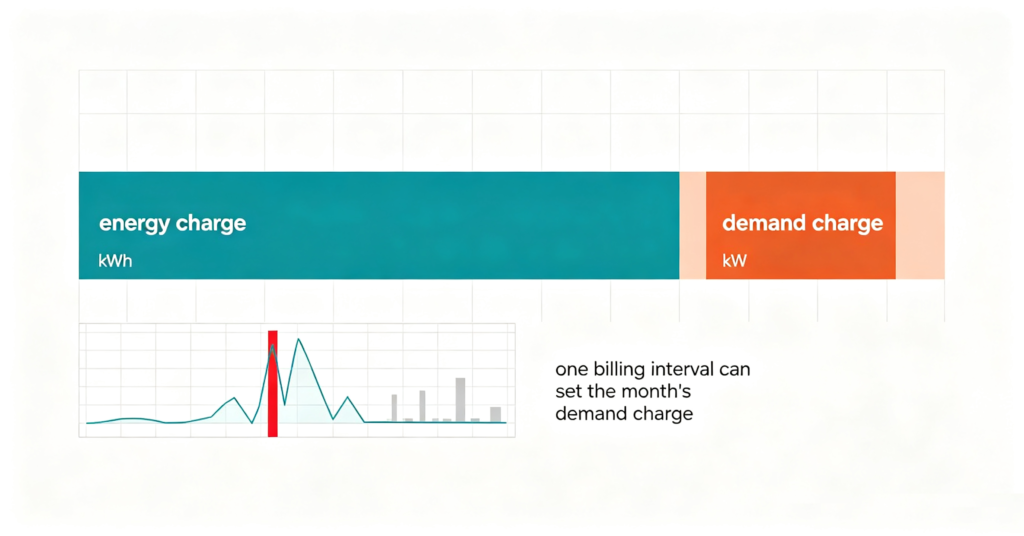
Commercial electricity bills are split into two charges, and confusing them is the root of every bad storage proposal. The energy charge bills kilowatt-hours — how much electricity you consumed over the month; it is the number a home user recognises. The demand charge bills kilowatts — the highest rate of consumption recorded in any billing interval (commonly 15 or 30 minutes) during the month. The utility charges it because it must build and keep generation and grid capacity for your worst moment, whether you use it once or every day.
The consequence is striking: on a site where demand charges are a third of the bill, one careless half-hour can add as much cost as days of normal operation. It also means the meter reading that matters is not your average behaviour but your worst behaviour — and that single worst interval is exactly what a storage system can change. Energy efficiency reduces kWh but does little for a demand charge unless it directly shaves the peak; load shifting does the reverse. Both belong in the toolkit, and neither alone answers the question the way storage can when the tariff rewards it.
How peak shaving works: three steps
- Measure — establish the real load profile with interval data across weeks or seasons, because the peak that sets the bill is a weather-and-production event, not an average.
- Set the target — choose the kW ceiling the site wants to stay under, which defines how much peak must be shaved and therefore how much discharge power the battery must deliver.
- Dispatch — the EMS watches the live meter and discharges the battery only in the windows that would otherwise breach the target, then recharges when load is low and power is cheap.
Note what the battery is doing: it is providing power (kW) for short periods, not bulk energy (kWh). This inverts the usual sizing instinct. A peak-shaving system is sized first by its power rating against the spike, and only then by the energy needed to sustain that power for the duration of the window. A site whose peak lasts 15 minutes needs far less energy than its peak kW suggests — and paying for excess energy capacity that never cycles is the classic oversizing mistake. Form-factor and configuration options for C&I systems are compared in #53 rack, cabinet and container formats.
The cycle also has a cost side that belongs in the model. Every kilowatt-hour the battery delivers to shave a peak must be replaced by recharging, so the real saving is the avoided demand charge minus the energy cost and round-trip losses of that recharge. That is why peak timing decides the economics as much as peak size: a site that peaks in the morning and can refill on cheap midday or overnight power keeps most of the saving, while a site that peaks at the end of its most expensive tariff period and has no low-cost window to recharge will hand a meaningful share of it back. The bill checks below are designed to expose exactly this — the recharge question, not the headline rate, is where marginal proposals quietly fail.
The conditions that make the math close
| Site condition | Favourable for peak shaving | Unfavourable |
|---|---|---|
| Demand charge share of bill | High (20% or more) | Low or no demand charge |
| Peak shape | Short, sharp, predictable spikes | Broad plateau through the day |
| Peak timing | Same windows daily, off cheaper tariff periods | Random or coincident with costly energy |
| Headroom to recharge | Low-load periods between peaks | Load stays near peak all day |
| Alternative measures | Peak already minimised by controls | Uncontrolled starts, oversized equipment |
The decisive sentence for a buyer: peak shaving with storage pays when the demand charge is large, the peak is short and repeatable, and the battery can recharge outside the peak window. When any of those fails, cheaper measures come first — staggering machine starts, upgrading controls, or shifting processes to off-peak hours. A competent supplier says this out loud before selling hardware; the site-level economics framework that tests it properly is laid out in #56 BESS cost and ROI, and the lifetime price trade-off of the battery itself in #46 cycle life vs price.
Beyond the demand charge: stacking value on the same battery
The same hardware that shaves peaks can usually earn a second and third income stream, which is what separates a marginal project from a good one. Outside the peak window the battery can shift energy from high-priced to low-priced tariff periods; where the market allows, it can offer grid services; and it can double as backup for critical loads. The principle is stacking, not double-counting: each stream must use capacity and cycles that the peak-shaving duty is not already consuming. Integrated systems with EMS scheduling make this stacking practical — see #42 all-in-one vs split systems for how configuration affects the control options. Utility-scale sites play the same game with market revenue as the anchor, covered in #22 utility-scale storage.
The bill anatomy buyers should ask for
- Demand charge rate and billing interval (15 vs 30 minutes changes the battery maths)
- Whether the charge is based on the single monthly peak or an average of several
- Seasonal differences in both the rate and the site’s peak behaviour
- Ratchet clauses that carry a historical peak forward for months
- TOU energy prices, which decide when the battery should recharge
With those five facts a competent analyst can size a system and estimate savings within a defensible band. Without them, every number in a proposal is a guess dressed as engineering.
What to verify before signing
Finally, the proposal itself deserves the same scrutiny as the bill. Confirm the EMS actually controls discharge against the live meter (some low-cost systems only schedule, which misses unpredictable peaks). Confirm the battery’s power rating is available for the full billing window at the operating temperature of the site. Confirm the warranty allows the daily cycle pattern peak shaving implies. And confirm the savings model states its assumptions — interval, target kW, tariff, degradation — in writing. Each of these checks is a normal part of evaluating C&I storage suppliers and is treated in depth in the supplier evaluation guide on this site; the hardware stack those checks run against is itemised in #52 BESS components.
Q. What is a demand charge on a commercial electricity bill?
It is the charge based on the highest rate of power use recorded in a billing interval during the month, measured in kilowatts rather than kilowatt-hours. Utilities use it to recover the cost of capacity built for your peak demand. On many commercial sites it is 20–40% of the bill.
Q. How does a battery reduce peak demand?
The system watches the live meter through its EMS. When load approaches the target ceiling, the battery discharges to serve the difference, so the grid draw never crosses the line. Outside the peak window it recharges during low-load, low-price periods, ready for the next spike.
Q. Is peak shaving with a battery worth it for my factory?
Run the three conditions: a real demand charge with meaningful share, a peak that is short and repeats predictably, and off-peak windows to recharge. If all three hold and the savings exceed the battery’s lifecycle cost, it is worth modelling seriously. If not, fix the peak with controls first.
Q. How is a peak-shaving battery sized?
By power first and energy second. The power rating must cover the spike above the target line; the energy capacity must sustain that power for the duration of the billing window. Sites with short spikes need modest kWh, and oversizing energy is the most common waste.
Q. Can one battery do peak shaving and backup at the same time?
Yes, with a control strategy that reserves energy for the backup duty. Peak shaving consumes capacity during the day, so the EMS must keep a reserve and know when to stop shaving. Stacking value is good economics — but only if each job’s energy is budgeted explicitly rather than assumed.
Next step: check your own bill before you talk to anyone
Pull your last three months of interval data and tariff sheets — that is the only input a credible peak-shaving study needs to start.
- Benchmark the system economics in #56 BESS cost and ROI
- Pick the right hardware form via #53 C&I storage formats
- Check the component stack in #52 BESS components
- Send leekooenergy your bill and load data for a peak-shaving sizing study with the savings band stated in writing