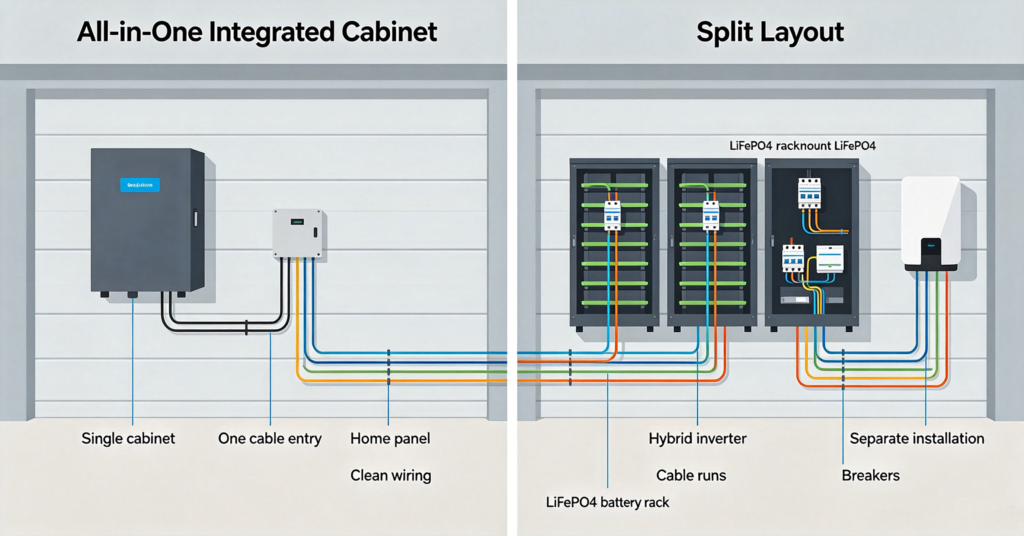
The shortest answer: an integrated energy storage system — battery, hybrid inverter, EMS and often a backup sub-panel in one cabinet — is the better buy when you are doing a fresh install, want one warranty and one app, and expect the system to stay the size you buy. A split system — a separate LiFePO4 battery bank plus a separately chosen hybrid inverter — is the better buy when you are retrofitting an existing solar inverter, expect to grow the battery in steps, or want to replace components on their own cycles. Everything else is detail; those three conditions settle most decisions before you compare price lists.
Homeowners and installers keep asking the same question in different words: should the battery and the inverter live in one box or two? The answer is not “one is better” — it is “which constraints apply to this house.” This guide defines both architectures, works through where each wins, and ends with a six-question checklist you can run on any quote. It is written for the installer and the technical buyer, and it deliberately stays at architecture level: the companion guides on inverter selection, battery sizing and voltage choice are linked where they are needed.
The two architectures, defined
An integrated energy storage system ships as a single indoor or outdoor cabinet that already contains the battery modules, the hybrid inverter, the battery management system (BMS) and the energy management logic. You feed it a solar array, an AC feed, or both; it outputs AC to the home panel and handles grid connection, backup switching and charging decisions internally. The buyer specifies one model and one capacity; the commissioning is mostly menu-driven, and firmware updates cover the whole unit. These systems are what most people picture when they say “all-in-one home battery” or “ESS box.”
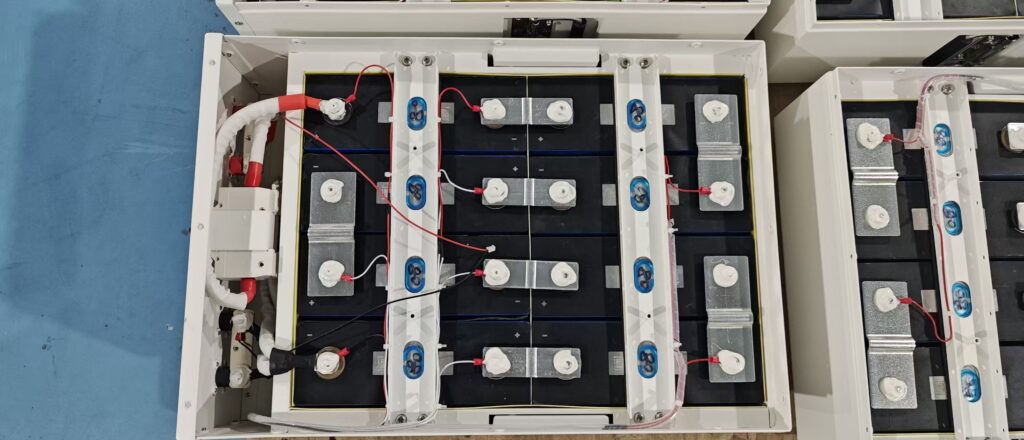
A split system is what it sounds like: a battery bank — wall-mount, rack-mount or stackable modules — connected by DC cable to a separately purchased hybrid inverter, which is in turn connected to the solar array and the home panel. The battery and the inverter each carry their own BMS or firmware, their own warranty, and their own installation requirements. The two must be compatible at the voltage platform and communication-protocol level, which is exactly the territory covered in #18 battery-inverter compatibility (CAN/RS485). The words “modular energy storage system” usually describe this approach, because the battery side is designed to grow module by module.
There is a third pattern worth naming so it does not confuse the comparison: an all-in-one cabinet that is AC-coupled to an existing inverter. In that case the “integration” is at the AC terminal, not inside one box, and the purchase logic is closer to a split system (you are adding storage to equipment you already own). The AC vs DC coupling architecture is explained separately in #43 AC-coupled vs DC-coupled.
Where the integrated energy storage system wins
New construction and full retrofits are the natural home of the integrated unit. When there is no legacy inverter to respect, one cabinet is faster to install, easier to commission and simpler to support than two components from one vendor — and far simpler than two components from two vendors. The practical wins stack up: a single wall footprint instead of a battery stack plus an inverter panel; one set of cable runs and breakers; one commissioning app; and one warranty claim if something misbehaves. For the homeowner, the visible benefit is a system that behaves as one product: charge, backup, export and tariff settings live in a single menu.
Integrated units also carry the efficiency story most cleanly. Because the power conversion, battery interface and control logic are engineered together, the manufacturer can optimise the DC link, the charge profile and the switchover logic as a unit. That does not mean every all-in-one is more efficient than every split system — measured round-trip efficiency depends on the specific hardware — but it means the vendor has no excuse for a handshake problem between their own battery and their own inverter. For an installer whose margin lives in labour hours, the faster commissioning of a single unit is often the deciding factor, especially on smaller systems where two trips to site would eat the profit.
Where split systems win
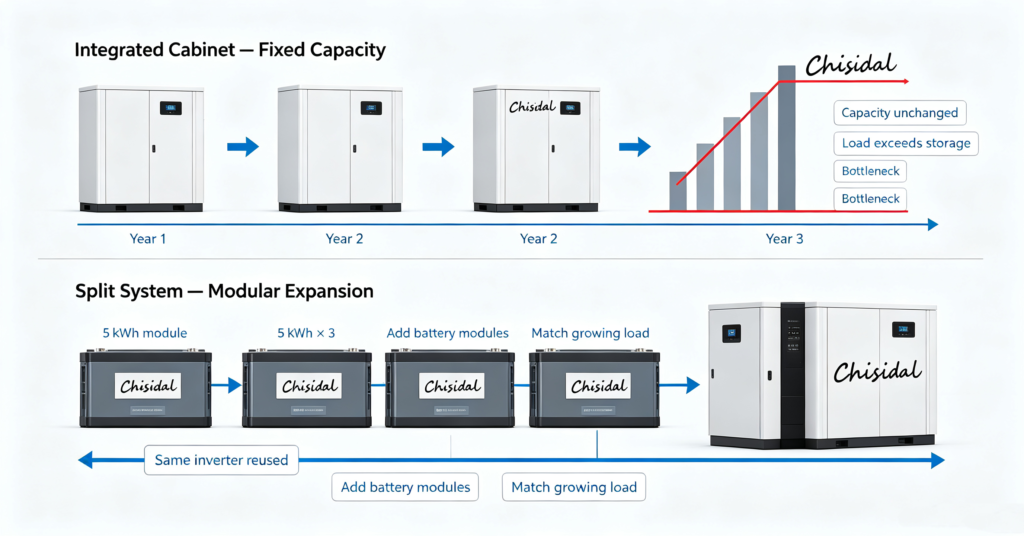
The split architecture wins on the three things a fixed cabinet cannot do: grow, mix and replace independently. Battery demand has a habit of growing after the first winter, and a modular bank grows by adding a module — same BMS family, same voltage platform — without touching the inverter. An integrated unit grows only by buying a bigger integrated unit, or by accepting that its internal inverter becomes oversized for the added battery. The same logic applies to replacement: when a battery reaches end of life after ten years of cycling, a split system replaces just the bank; an integrated system retires the inverter too, even if the inverter was still healthy.
Mixing is the second advantage. A split system lets the buyer pair the battery that fits the budget with the inverter that fits the site — a 48 V or 51.2 V bank with a hybrid inverter that speaks its protocol, or a high-voltage battery with a matching high-voltage inverter. That matters for installers who standardise on one inverter brand but sell batteries competitively, and for projects where the inverter choice is constrained by an existing solar array or a three-phase feed. It also keeps the door open to protocol-level flexibility; the compatibility rules are the ones in #18.
Finally, split systems usually quote lower on the battery-only upgrade path and avoid forcing a technology refresh early. If the inverter market moves to a new feature set (new grid codes, new tariffs, bidirectional EV charging) inside the battery’s service life, a split system swaps the inverter and keeps the bank. Buyers who plan for a 10–15 year battery life and a 5–8 year inverter life will often find that two replaceable boxes are cheaper over the full period than one sealed cabinet.
Cost, efficiency and service trade-offs
On first cost, an integrated unit is usually cheaper per installed kWh at small sizes because it bundles the inverter into one enclosure and one installation visit. Split systems tend to quote lower per kWh at larger sizes, where the battery modules are commodity-priced and the inverter is amortised over more capacity. Neither rule is a law — the honest position is that first cost crosses over somewhere in the 10–20 kWh band, and the buyer should compare installed quotes at their target size, not list prices at the catalogue size.
Efficiency is the trade-off people most often misread. Both architectures can be DC-coupled — the solar DC feeds the battery DC bus with a single conversion before inversion to AC — and in that configuration their round-trip losses are close. AC-coupled add-on batteries pay an extra conversion each way and lose a few percentage points of round-trip efficiency, but that penalty belongs to the coupling topology, not to the integrated-versus-split question. The service trade-off is simpler: one vendor, one app and one warranty versus two components you can service and upgrade independently. Write down which of those two sentences describes your support reality, and the architecture decision mostly makes itself.
Integrated vs split at a glance
| Decision factor | Integrated (all-in-one) | Split (battery + inverter) |
|---|---|---|
| Best starting point | New install, no legacy inverter | Retrofit to existing inverter |
| Footprint | One cabinet | Battery stack + inverter panel |
| Battery expansion | Buy a larger unit | Add modules in steps |
| Component replacement | Whole unit on one cycle | Battery and inverter on own cycles |
| Brand mixing | Locked to one vendor | Mix by protocol compatibility |
| Warranty claims | Single point | Two vendors to manage |
| Commissioning | One app, faster | Two menus, more steps |
| First cost at small size | Usually lower installed | Usually higher at ≤10 kWh |
| Cost at large size | Premiums flatten slowly | Battery modules commoditise |
| Technology refresh | Rides the whole unit | Inverter can refresh alone |
A six-question decision checklist
Run these six questions on any quote and the architecture recommends itself:
- Is there an existing inverter I am keeping? Yes → split (or AC-coupled add-on). No → integrated is on the table.
- Will the battery realistically grow beyond today’s size? Likely → split, so growth adds modules, not a new cabinet.
- Who services this system, and how many vendors can they handle? One remote vendor → integrated’s single warranty has real value.
- Is the inverter choice already constrained by the site? Three-phase, generator interlock, legacy solar → split pairs the right inverter with the right bank.
- What is the expected inverter life versus battery life? Planning 10+ years on the battery → split lets the inverter refresh on its own cycle.
- Is this a price-driven tender at a defined size? Tender at ≤10 kWh → compare installed all-in-one quotes first; the labour saving often wins.
One caution applies to both paths: never mix a battery and an inverter that have not been verified to talk to each other, even inside a “compatible” catalogue. The protocol, speed and role checks in #18 battery-inverter compatibility apply to split systems today and to integrated systems the moment someone adds an external battery port or an AC-coupled second unit.
Q.Is an all-in-one home battery better than a separate battery and inverter?
For a fresh install with no legacy inverter and no near-term expansion plan, the all-in-one is usually the better buy: faster install, single warranty, one app. For retrofits, planned growth or mix-and-match needs, a split system is better because the battery and inverter can be upgraded independently.
Q.What is an integrated energy storage system?
It is a single cabinet that contains battery modules, a hybrid inverter, a BMS and energy management logic, delivering AC to the home from solar, grid or stored energy. The buyer specifies one model and capacity instead of pairing separate components.
Q.Can I add more battery to an all-in-one system later?
Only if the specific model supports external battery modules. Most sealed all-in-one units grow by buying a larger unit; modular split systems grow by adding a module to the same bank, which is usually cheaper than replacing the whole system.
Q.Which is more efficient, all-in-one or split?
When both are DC-coupled, round-trip efficiency is close and depends on the specific hardware. The visible efficiency penalty belongs to AC-coupled add-on batteries, which pay an extra conversion in each direction. Compare the datasheet round-trip figure at the size you plan to run, not at peak rating.
Q.Do I need a separate inverter if I buy an all-in-one?
No — the hybrid inverter is built in. If you already own a good inverter and only want storage, an all-in-one is the wrong purchase; the right purchase is a battery bank that is protocol-compatible with your existing inverter, sized and installed as a split system.
Next step: pick the architecture, then size it
The architecture question narrows the catalogue but does not size the system. Follow the capacity math and the inverter rules before you compare quotes.
- Size the bank with #09 home battery sizing
- Check the voltage platform in #12 48V vs 51.2V
- Match inverter and battery protocols in #18 compatibility guide
- Browse leekooenergy all-in-one and split battery + inverter options for home