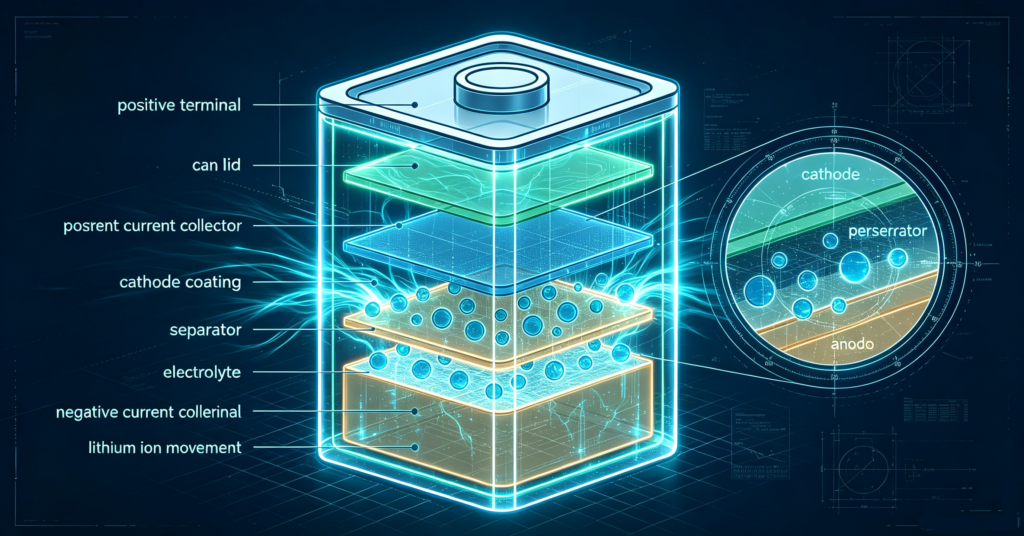
The direct answer to what is inside a lithium ion battery is a repeating sandwich of six functional layers: a positive electrode (cathode), a negative electrode (anode), an electrolyte that carries lithium ions between them, a separator that keeps the two electrodes apart, thin metal current collectors on both sides, and a sealed can with safety fittings that holds everything. Charge pushes lithium ions out of the cathode and into the anode; discharge lets them flow back while electrons travel through the external circuit. A one-sentence version worth quoting: inside every lithium ion battery is a thin, layered electrochemical sandwich — cathode, electrolyte and separator between two current collectors inside a sealed can — where lithium ions shuttle back and forth to store and release energy.
That sandwich is why a battery is nothing like a tank you fill with electricity. The energy lives in the position of the ions, not in any liquid or moving part, and every layer exists to make that ion shuttle safe, fast and repeatable for thousands of cycles. Understanding the layers matters for buyers because most price and quality differences between cells — grade, cycle life, thermal behaviour — trace back to choices made inside the can. The chemistry-level story of how the whole battery works is told in #59 what is a lithium ion battery; this guide opens the can and names what each layer is, what it does, and what you are actually looking at in a teardown.
The six layers inside a lithium ion battery cell
Every commercial lithium ion cell, whatever its shape, is built from the same six functional layers. The table below names them, states what each is made from, and lists the failure mode a buyer should keep in mind. Details such as exact coating recipes vary between manufacturers; the roles do not.
| Layer | Typical material | Job in the cell | What its failure looks like |
|---|---|---|---|
| Cathode (positive electrode) | Metal oxide or phosphate on aluminium foil | Stores lithium at higher voltage; names the chemistry (NMC, LFP, NCA) | Capacity fade, voltage sag |
| Anode (negative electrode) | Graphite, often with small silicon additions, on copper foil | Accepts and holds lithium ions while charging | Lithium plating, accelerated ageing in cold |
| Electrolyte | Lithium salt dissolved in organic solvents | Conducts lithium ions between electrodes | Breakdown at high temperature, gas generation |
| Separator | Microporous polyolefin membrane | Blocks electron flow between electrodes while letting ions pass | Shrinkage or puncture can lead to internal short |
| Current collectors | Aluminium foil (cathode side), copper foil (anode side) | Carry electrons to and from the external circuit | Corrosion or poor tab welds raise resistance |
| Can, vent and terminals | Aluminium or steel can, CID and vent disc | Seals the cell, vents pressure, interrupts current on overpressure | Leak, swelling, vent activation |
Two details in this table explain most real-world battery behaviour. First, the electrodes are coatings on foil, not solid blocks — the active material is a powder bound onto a thin metal sheet, which is why cells are light and why manufacturing quality (coating thickness, drying, calendering) shows up as capacity consistency between cells. Second, the separator is the safety backbone: it physically stops the two electrodes touching while letting ions through, so any defect that pierces or shrinks it is the starting point of an internal short. The thermal-runaway chain that can follow is explained in #44 BESS fire and safety codes, and the electronics that monitor the layers are covered in #49 BMS protection.
What is inside a lithium ion battery cell: the electrodes first
The cathode is where the chemistry is chosen, because it sets the cell voltage and how much lithium the cell can hold. In the cells buyers meet most, the cathode is one of two families: nickel-based oxides (NMC, NCA) that store more energy per kilogram but run hotter and age faster, or lithium iron phosphate (LFP), which stores slightly less per kilogram but tolerates more cycles and resists thermal runaway. The same can, separator and electrolyte can house either cathode — which is why two cells that look identical outside can behave very differently inside. The head-to-head between the two families is worked through in #33 LFP vs NMC.
The anode is simpler in material and just as important in behaviour. Graphite hosts lithium ions between its layers when the cell charges; the ions are literally stored inside the graphite structure, which is why a discharged cell has most of its lithium parked at the anode. Some modern anodes add a small share of silicon to hold more lithium, at the cost of more swelling — a trade-off manufacturers manage with binder and cell design. Buyers rarely see anode chemistry on a datasheet, but they see its consequences: cells that lose capacity fast in cold weather, or that age quickly when stored fully charged, are usually showing anode-side stress.
The middle layers: separator and electrolyte
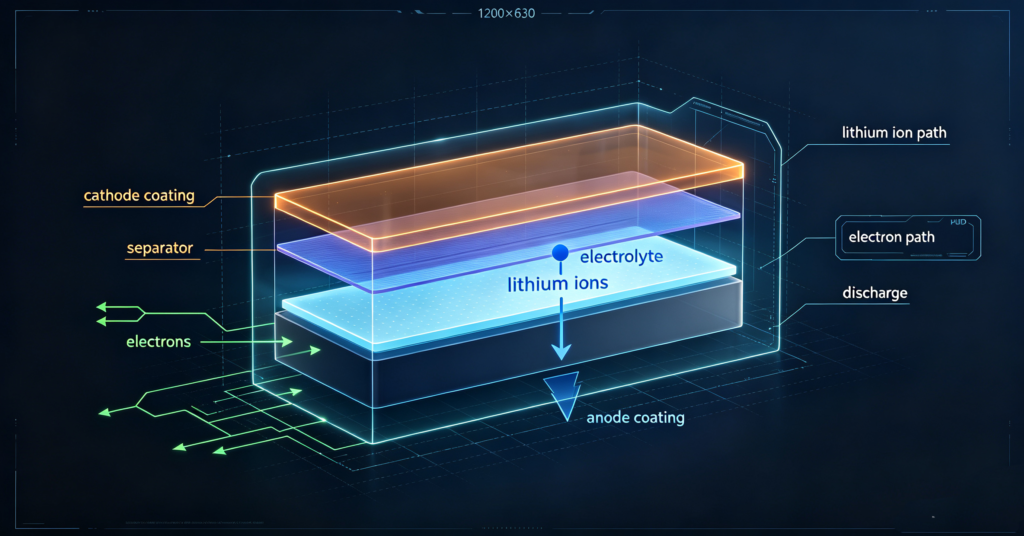
Between the two electrodes sits the separator — a membrane so thin that a single cell contains many metres of it folded into a small space, and so important that its failure is the usual starting point of a fire. A good separator is porous enough to let ions pass freely, strong enough to survive winding and swelling, and designed to shut down when the cell overheats: its pores close at high temperature, cutting ionic flow before thermal runaway can accelerate. When you see a safety claim on a cell datasheet, much of it is really a claim about the separator and the cell design around it.
The electrolyte is the medium the ions travel through: a lithium salt dissolved in organic solvents, held inside the separator and the pores of the electrode coatings. It is an excellent ion conductor and a flammable liquid, which is why cells are sealed and why mechanical damage or overcharge — both of which can heat the electrolyte past its limits — is dangerous. Because the electrolyte participates in ageing, cells kept hot or cycled hard degrade faster, and the gases a failing cell generates are what a swelling or venting pack is releasing. The system-level thermal and fire protections that surround the cells are described in #44 BESS fire safety, and how cells are graded and assembled into saleable packs is the subject of #48 cell wholesale and assembly.
Cylindrical, prismatic and pouch: the same parts, packed differently
All three common cell formats contain the same six layers; they differ in how the sandwich is folded and housed. Cylindrical cells (18650, 21700, 46135 and similar) wind the layers into a tight spiral inside a steel can — cheap, robust and easy to cool, but with more inactive space between cylinders in a pack. Prismatic cells wind or stack the layers into a flat aluminium box, which packs more active material per volume and is the format most common in rack and cabinet storage products. Pouch cells stack the layers in a sealed foil bag, giving the lightest and thinnest format but requiring the most careful handling and swelling management. The format choice shapes the pack’s energy density, cooling and cost; it does not change the chemistry, which is why LFP cells of all three formats share the same safety character.
How to read a teardown before you buy
For a buyer, the inside of a cell is where grade and quality become visible. When a supplier shows a teardown or you inspect a cut cell, check five things. First, coating uniformity: the grey or dark coating on both foils should be even, with no bare patches, scorch marks or thick edges. Second, winding or stacking alignment: misaligned layers mean the separator is not fully covering an electrode — a latent short risk. Third, tab welds: the metal tags joining the foils to the terminals should be clean and consistent; weak welds raise resistance and heat. Fourth, dryness and odour: a properly sealed cell shows no electrolyte residue on the can interior. Fifth, batch consistency: one perfect cell proves nothing; the question is whether cells across a delivery measure alike in capacity and internal resistance. Grade differences between A and B cells — and how they show up in price — are examined in #46 cycle life vs price.
Understanding the inside also explains why cheap cells are rarely a bargain: the six layers cost what they cost, and a suspiciously low price usually means a thinner separator, a lower-grade cathode, or looser quality control somewhere in the sandwich — all of which surface later as capacity fade or early failure. When the LFP chemistry itself is the question rather than its construction, the full material guide is in #01 the LiFePO4 guide.
Q.What is inside a lithium ion battery?
Six functional layers: cathode, anode, electrolyte, separator, two current collectors and a sealed can with safety fittings. Lithium ions move between the two electrodes through the electrolyte while electrons flow through the external circuit — the layer sandwich is the whole battery.
Q. What is the inside of a lithium ion battery made of?
Coated foils and a membrane: metal-oxide or phosphate powder bound to aluminium foil (cathode), graphite on copper foil (anode), a lithium-salt electrolyte, and a microporous polymer separator. The can is aluminium or steel with a vent and a current-interrupt device.
Q. Is there liquid inside a lithium ion battery?
Yes — the electrolyte is a liquid containing a lithium salt, held inside the separator and the pores of the electrode coatings. It is sealed inside the cell and is flammable, which is why cells must never be punctured and why thermal runaway is a real risk after damage.
Q. Why does the separator matter so much?
It physically separates the two electrodes so electrons cannot short-circuit inside the cell, while letting lithium ions pass. A separator that shrinks, punctures or fails to shut down at high temperature is the usual starting point of an internal short and overheating.
Q. Do all lithium ion batteries have the same parts inside?
Yes, the six layers are the same across cylindrical, prismatic and pouch cells and across chemistries such as LFP and NMC. What changes is the cathode material (which names the chemistry), the format (how the sandwich is folded and housed) and the manufacturing quality of each layer.
Next step: from the layers to a battery you can rely on
Knowing what is inside a lithium ion battery is the foundation; choosing a supplier whose layers are consistent is the actual purchase decision.
- See the chemistry and selection view in #59 the lithium ion battery guide
- Compare LFP against NMC on the points that matter in #33 LFP vs NMC
- Learn how cells become packs with a BMS in #48 cell wholesale and assembly
- Ask leekooenergy for cell-level specifications — cathode type, separator class and batch consistency data are standard items its engineers provide before quotation