The shortest answer: the cell + BMS + assembly model lets a wholesale buyer own the value and the flexibility of a battery brand without owning a cell factory. One supplier delivers matched lithium cells, the battery management system and the assembly work — as finished packs, or as semi-finished kits assembled in the buyer’s own market — so the buyer controls branding, local inventory and duty treatment while the factory carries the cell quality and process risk. Lithium cell wholesale purchasing suits buyers with real volume and a long-term brand plan; buyers testing the market or needing small mixed orders are usually better served by finished packs from stock.
The question behind most B2B battery enquiries is not “which battery” but “where in the value chain should I buy”. A distributor can import finished packs and compete on logistics and service. A brand owner can commission a full OEM/ODM programme, which is covered in #20 custom battery pack OEM/ODM. Between those two sits a third model: buying the three core elements — cells, BMS and assembly — as one programme from one factory. This guide explains how that model works, when it wins, and what a serious RFQ for it must contain.
What the model actually is
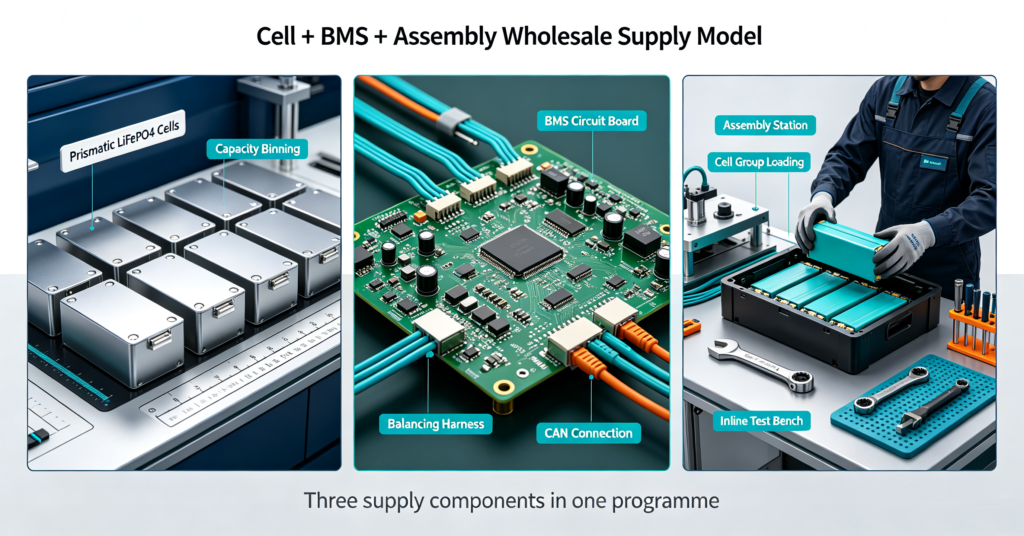
Every lithium battery pack is built from the same three layers. Cells store the energy; their grade, matching and consistency decide the pack’s real cycle life and safety margin. The BMS protects and manages the cells; its protection thresholds, balancing quality and communication protocol decide whether the pack behaves in the field. Assembly is everything that turns cells and a BMS into a product: mechanical design, busbars and welding, enclosure, wiring, testing and certification paperwork.
In the cell + BMS + assembly model, one factory supplies all three layers as a coordinated programme, with several delivery shapes. The factory can deliver fully assembled packs under the buyer’s brand. It can deliver semi-knocked-down kits — matched cell groups, BMS, enclosure and hardware — for final assembly in the buyer’s market, which is where local labour, duty structures or “assembled locally” claims matter commercially. Or it can supply cells plus BMS for buyers who run their own assembly line already. The common thread is that the factory takes responsibility for cell matching and BMS integration, which are the two layers hardest to retrofit if they are done wrong.
Why wholesale buyers choose it
Four commercial reasons come up again and again. Cost structure: buying at the lithium cell wholesale layer and paying assembly separately strips out layers of margin that finished-goods trading adds, and at genuine volumes the difference compounds. Brand ownership: the buyer’s label, warranty and customer relationship sit on the product, not on a supplier’s catalogue brand — the same logic that drives the wider OEM/ODM trend. Market flexibility: one cell platform supports several pack formats, capacities and cabinet styles, so a distributor can cover a whole catalogue from one supply base and adjust the mix as demand shifts. Logistics and duty treatment: in some markets, importing cells or kits lands in a different tariff and regulatory category than importing finished lithium packs, and local assembly can also support domestic-content requirements — the exact treatment is jurisdiction-specific and belongs in the buyer’s own customs review, not in a supplier’s marketing claim.
There is also a risk-management reason that experienced buyers lead with: supply concentration. A buyer whose entire catalogue is one factory’s finished SKU is exposed to that factory’s pricing and priorities. A buyer who owns the pack design, the BMS specification and the cell-matching standard can move the assembly between qualified lines — including their own — without redesigning the product.
What to specify: cells
The cell specification is where a lithium cell wholesale programme succeeds or fails, because everything downstream inherits the cell grade. A serious RFQ states the chemistry and format (prismatic LiFePO4 dominates stationary storage), the capacity grade accepted, and — critically — the matching standard: how cells are binned for capacity and internal resistance, and what spread is acceptable within one pack. The large-format cells common in stationary storage have their own platform trade-offs, compared in #25 280 Ah vs 314 Ah cells. The RFQ should also demand cell-level documentation: the manufacturer’s datasheet, UN38.3 transport test summary, and the grading criteria the factory applies before a cell enters the programme.
Two cell-level traps deserve naming. First, “grade A” is a marketing term unless the factory defines it — ask for the binning criteria and the rejection criteria instead. Second, spot-market cells bought by traders are frequently mixed lots; a programme buyer should insist on lot-traceable supply where every pack maps to identifiable cell batches, because that traceability is what a field investigation needs if a problem appears years later.
What to specify: BMS
The BMS specification decides field behaviour, and it is the layer where under-specification hides best. The RFQ should state the series configuration, the voltage and current ratings with margin for the real load profile, the balancing approach, the communication protocol required by the target inverters, and the protection thresholds for overcharge, overdischarge, overcurrent and temperature. Because the BMS is the component that talks to the rest of the system, protocol compatibility is a hard gate — the handshake rules between batteries and inverters are covered in #18 battery-inverter compatibility, and the selection logic for LiFePO4 systems in #32 how to choose a LiFePO4 BMS.
Programme buyers should also ask who owns the BMS firmware configuration. A BMS tuned for the factory’s demonstration rack is not automatically tuned for the buyer’s enclosure, cooling arrangement and inverter fleet; the acceptance tests should run on the buyer’s configuration, not the factory’s.
What to specify: assembly and quality control
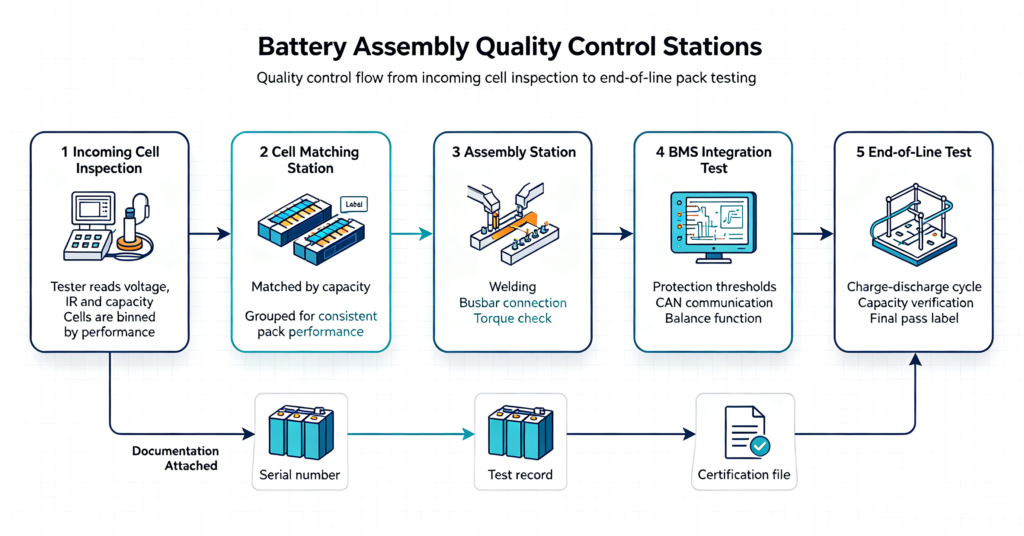
| Control point | What to require | Why it matters |
|---|---|---|
| Incoming cell inspection | Capacity and internal-resistance check per lot, with acceptance criteria in the RFQ | Catches mixed-lot and off-grade cells before they enter packs |
| Cell matching within pack | Defined capacity and resistance spread per pack | Uneven packs age unevenly; the weakest cell governs pack life |
| Joint and busbar quality | Process spec for welding or bolting, with pull/shear sampling | Connections are a leading field-failure location |
| BMS integration test | Protection-threshold verification on every pack, not sampling only | Confirms the safety layer works as specified before shipping |
| End-of-line test | Full charge-discharge cycle or defined capacity verification per pack | Separates shipped capacity from nameplate capacity |
| Traceability | Serial numbers mapping each pack to cell lots and test records | Enables targeted recalls and credible warranty handling |
| Certification file | UN38.3, IEC 62619 or market-specific packs of documentation | Required for shipping and market entry; retro-fitting is slow |
Buyers assembling kits locally should add one more line to this table: process documentation for the local team. A semi-knocked-down programme only transfers quality if the receiving line has the torque values, test procedures and acceptance criteria the factory used. The enclosure side of local assembly — mechanical protection, insulation and fire behaviour of the finished box — is the same problem DIY builders face, and the design principles are covered in #29 battery box and enclosure design.
When the model is the wrong choice
Honesty about the boundary saves both sides money. The cell + BMS + assembly model is the wrong choice when volume is small or unpredictable — the engineering and documentation work only amortises across real volume. It is wrong when the buyer has no technical capacity to review specifications and test data, because an unreviewed programme is just a more expensive way to buy a stranger’s product. And it is wrong when speed matters more than differentiation: a distributor who needs stock next month buys finished packs from inventory. The general purchasing framework for making this call — supplier evaluation, factory audit, sample validation — is covered in #21 how to evaluate battery manufacturers, and the finished-pack buyer’s checklist is in #03 the lithium battery pack buyer’s guide.
An RFQ checklist for a cell + BMS + assembly programme
- Volume and mix: annual cell volume, pack formats, capacity variants, and the delivery shape wanted (finished / SKD / cells plus BMS).
- Cell specification: chemistry, format, grade definition, matching standard, lot traceability, and the documentation pack per lot.
- BMS specification: configuration, ratings, protection thresholds, balancing, protocol compatibility with the target inverter list.
- Assembly standard: the seven control points in the table above, with acceptance criteria and who performs each test.
- Certification scope: which market certifications are supplied, which are the buyer’s responsibility, and who holds the test reports.
- Warranty and support: warranty structure on cells and packs, the claims process, and technical support for the local assembly team.
Q.Is buying cells and assembling locally cheaper than importing finished packs?
Often, at genuine volume, because the buyer pays for cells and assembly instead of finished-goods margin, and duty or regulatory treatment can differ between cells and complete packs. Whether the saving survives local labour, testing and compliance costs depends on the market — the comparison belongs in your own landed-cost model, not in a supplier’s claim.
Q.What is the difference between this model and OEM/ODM?
OEM/ODM usually means the factory designs and delivers a finished branded product. The cell + BMS + assembly model is broader: it can include OEM/ODM delivery, but its distinguishing feature is that the buyer specifies and owns the three core layers and can choose how much assembly happens where — including a semi-knocked-down kit assembled in the buyer’s own market.
Q.Can I mix cells from different lots in one programme?
Across packs, yes — that is normal production reality. Within one pack, mixing lots should be avoided or tightly controlled, because capacity and internal-resistance spread between lots accelerates imbalance. State the within-pack matching rule explicitly in the RFQ rather than leaving it to the factory’s default.
Q.What certifications do I need to ship lithium cells internationally?
Cells and packs classified as lithium batteries require UN38.3 transport test documentation for most carriers, and market entry typically adds product safety standards such as IEC 62619 for industrial applications or the market’s own scheme. The exact set depends on chemistry, format and destination — agree the split of responsibility in writing before the first shipment.
Q.How do I verify the cells I receive match the grade I paid for?
Incoming verification on a sampling basis: capacity and internal-resistance measurement against the datasheet, lot-traceability records, and comparison of the delivered bins against the RFQ’s matching standard. Independent third-party inspection before shipment is a standard safeguard for first orders and for any change of cell source within the programme.
Next step: scope your programme
If the volume and the brand plan are real, the next step is a specification conversation, not a price request. Bring the volume, the pack formats and the target markets.
- Structure a full OEM/ODM programme with #20 custom battery pack OEM/ODM
- Audit the factory side with #21 evaluate battery manufacturers
- Compare cell platforms in #25 280 Ah vs 314 Ah
- Review enclosure design for local assembly in #29 battery box design
- Ask leekooenergy for a cell + BMS + assembly proposal matched to your volume, formats and market requirements