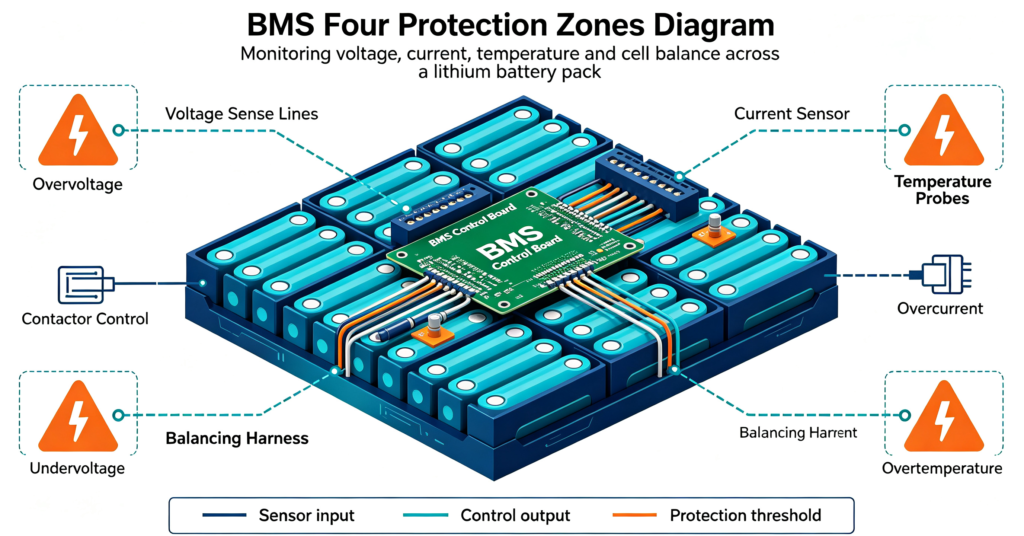
The shortest answer: a battery management system protects a lithium pack by watching voltage, current and temperature at the cell level, and by disconnecting the battery before any of them crosses a limit that causes damage. Overcharge protection stops charging before cell voltages climb into degradation and thermal-runaway territory; overdischarge protection stops the pack draining into copper dissolution and permanent capacity loss; overcurrent protection interrupts shorts and excessive loads; temperature protection blocks charging and discharging outside the safe window. The safety protection of battery management system design is judged by one test: whether the disconnect happens before the damage, every time, on every cell — not just on the pack average.
Lithium batteries are unusual among electrical equipment in that they are destroyed quickly by ordinary electrical mistakes. A lead-acid battery overcharged by a misconfigured charger boils and ages; a lithium battery overcharged the same way can pass the point of no return within a fault cycle. That asymmetry is why lithium packs are never sold without a management system. What a BMS is in the broader sense — its monitoring, balancing and communication roles — is covered in #28 BMS 101 and, for readers meeting the term for the first time, in #31 what does BMS mean. This guide stays on the protection function itself: what each protection defends against, how the intervention actually happens, and how a buyer verifies that the protection is real rather than decorative.
Overcharge protection
Overcharge is the classic lithium failure initiator. When a cell is charged past its maximum voltage, excess lithium plates onto the anode and the cell enters a degradation regime that releases heat; if charging continues, the heat can escalate toward thermal runaway. The BMS defends against this with per-cell or per-group voltage sensing: when any cell in the pack reaches the charge limit — not the pack total, the highest single cell — the BMS signals the charger or inverter to stop, and if the signal is ignored, opens the charge path itself.
The detail that separates good design from weak design is the word “any”. A pack of one hundred cells in series has one hundred individual voltages, and they drift apart as the pack ages. A BMS that protects on pack-average voltage can allow the weakest, highest-voltage cell to exceed its limit while the average still looks healthy. When you read a datasheet, look for cell-level sense lines and a per-cell overcharge threshold — the specification habit that makes the safety protection of battery management system hardware meaningful at scale.
Overdischarge protection
The damage at the other end of the range is quieter but equally permanent. A lithium cell discharged below its minimum voltage dissolves copper from the current collector into the electrolyte. The cell may recover enough voltage after resting to look usable, but the deposited copper creates internal short-circuit paths — a hidden defect that can fail the cell weeks or months later, sometimes energetically. This is why overdischarged cells are treated as suspect even when they “come back”.
BMS overdischarge protection cuts the discharge path when the lowest cell reaches the discharge limit. Because the damage mechanism is slow, the intervention does not need millisecond speed — it needs to be wired so that the pack’s own protection circuit, and not only the load’s behaviour, ends the discharge. That matters most in storage: a battery left connected to parasitic loads in a warehouse discharges itself over months, which is why packs ship with a protected storage mode that disconnects everything but the BMS’s own low-power monitoring.
Overcurrent and short-circuit protection
Overcurrent protection addresses the fastest failure mode: a short circuit or a load far beyond the pack’s rating drives large currents through cells and connections, heating them within seconds. The BMS enforces current limits with switching devices — MOSFETs in smaller packs, contactors in larger systems — backed by fuses or pyrofuses for faults that exceed what electronics can interrupt. The layering matters: the BMS handles overload and moderate faults gracefully and reversibly; the fuse handles the catastrophic case irreversibly. A design with only one of the two layers has a gap.
Buyers evaluating protection design should check two numbers against their application: the continuous current rating, which the pack must carry indefinitely within its thermal limits, and the peak or pulse rating with its duration, which covers motor start-ups and inverter surges. A protection threshold set too close to the application’s real peak current produces nuisance trips and stressed switches; set too far above, it stops being protection. The rating-matching logic is part of the wider selection process covered in #32 how to choose a LiFePO4 BMS.
Temperature protection
Temperature protection is bidirectional in a way the other three are not: lithium cells are damaged by heat, but they are also damaged by charging in the cold. Plating on the anode during sub-zero charging creates internal short paths — the same failure class as deep overdischarge. A complete thermal protection scheme therefore blocks or limits charging below the charge temperature floor, derates current as cells heat toward their ceiling, and disconnects entirely at the hard limit. Probes belong where the hottest and coldest cells actually are, not on the BMS board alone, because the board reports its own temperature most accurately.
Thermal protection also closes the loop with the fire-safety stack. A BMS that disconnects early is the cheapest fire suppression system a BESS will ever have: most thermal events in installed systems trace back to a condition a correctly specified BMS would have interrupted. The relationship between BMS behaviour and the wider fire-code and containment picture is covered in #44 BESS fires and safety codes.
How the interventions escalate
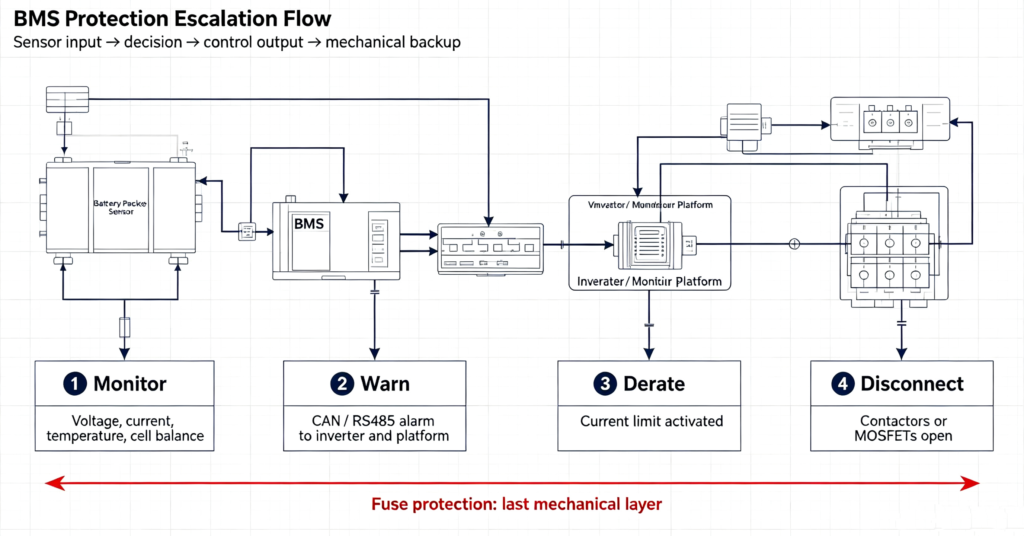
Good protection design does not jump straight to disconnection, because disconnecting a battery is itself an operational cost. The typical ladder runs: monitor continuously; warn when a value approaches its limit, by reporting to the inverter and the monitoring platform; derate by reducing current to pull the value back into range; disconnect only when the hard limit is reached. This escalation is why communication is a safety feature, not a convenience — the warning and derating steps require the BMS and the inverter to speak the same protocol. The handshake standards and compatibility questions behind that requirement are covered in #18 battery-inverter compatibility.
One further protection belongs on the list even though it is rarely labelled as one: cell balancing. In a series string, the cells with the highest charge determine when charging must stop and the cells with the lowest charge determine when discharge must stop — so imbalance shrinks usable capacity and pushes individual cells toward both limits faster. Balancing keeps the string aligned, which keeps every other protection operating in a healthy range rather than a defensive one. Balancing is a capacity feature sold as one, but it functions as the quiet enabler of the whole protection stack.
What a buyer should verify
- Sensing granularity: are voltages sensed per cell or per group, and are temperatures sensed at the cells as well as on the board?
- Threshold visibility: are the overcharge, overdischarge, current and temperature limits published in the datasheet, or only described as “comprehensive protection”?
- Escalation behaviour: does the BMS warn and derate before disconnecting, and does it report events in a log the installer can read afterwards?
- Independent layering: is there a fuse or equivalent mechanical protection beyond the electronics for faults the electronics cannot interrupt?
- Verification evidence: does the supplier demonstrate threshold tests on a sample unit — charging into an overcharge condition and observing the cutoff — as part of acceptance?
- Storage behaviour: what does the pack do over months of shelf time with only parasitic loads connected?
Treating the safety protection of battery management system units as an acceptance test rather than a datasheet claim is the single habit that most improves field outcomes. The questions above can be asked in a thirty-minute call and answered from documentation a serious supplier already has; the ones that cannot be answered are the answer.
Q.Can a BMS prevent every battery failure?
No. A BMS interrupts electrical and thermal abuse before it causes damage, which covers the most common failure initiators in installed systems. It cannot repair manufacturing defects inside a cell, undo mechanical damage from mishandling, or protect a pack that is operated outside its certification limits. Protection reduces the probability of a failure becoming an event; it does not make the battery indestructible.
Q.What is the difference between the BMS and the fuse?
The BMS is electronic, reversible and graduated — it warns, derates and disconnects, and reconnects when conditions recover. The fuse is mechanical, irreversible and blunt — it breaks the circuit once, at a set current, and must be replaced. The BMS handles the routine; the fuse handles faults too fast or too large for electronics. A safe design carries both layers.
Q.Why does charging a cold lithium battery cause damage?
Below the charging temperature floor, lithium deposits as metal on the anode surface instead of intercalating into it. That plated lithium creates internal short paths and permanently reduces capacity, and the damage occurs while everything looks normal on the outside. This is why temperature protection blocks charging in the cold even though the battery can still discharge usefully at reduced rates.
Q.Do all cells in a pack need individual voltage monitoring?
Individual or small-group sensing is what makes the protections effective, because protection limits belong to each cell, not to the average. Systems that sense only the pack total can allow a single cell to exceed its limits while the sum looks acceptable. The sensing granularity is one of the first specification points to check.
Q.Is balancing a safety feature or a performance feature?
Both. Balancing is sold as a capacity feature because it recovers usable energy in an imbalanced string, but its safety role is larger: imbalance drives individual cells toward both the overcharge and overdischarge limits, so balancing keeps every other protection operating in a normal range rather than a defensive one. A pack without functional balancing leans on its protections permanently.
Next step: check the protections on your next datasheet
Protection is verifiable. Take the six questions above into your next supplier call and ask for threshold tests on a sample unit.
- Start with the fundamentals in #28 BMS 101
- Define the term for your team via #31 what does BMS mean
- Match ratings to your pack with #32 choosing a LiFePO4 BMS
- Connect the safety stack to codes via #44 BESS fires and safety codes
- Ask leekooenergy for BMS protection-threshold documentation and sample test reports for your platform