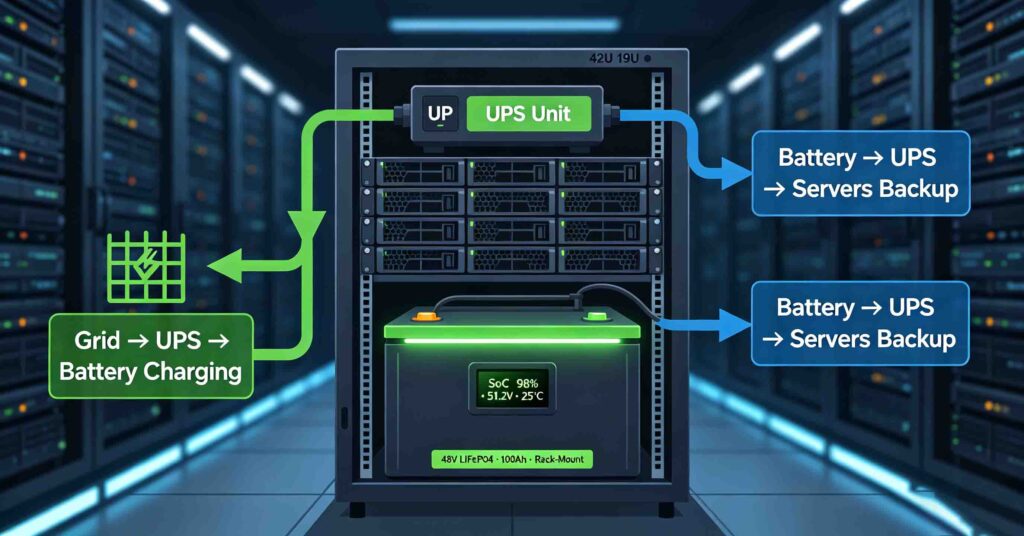
Battery storage for data centers provides uninterruptible power supply (UPS) backup during grid outages and can also deliver peak-shaving and demand-charge reduction when the grid is healthy. The industry is transitioning from valve-regulated lead-acid (VRLA) batteries — which have dominated data center UPS for decades — to lithium iron phosphate (LiFePO4) batteries, which offer 10–15× longer cycle life, 60–70% weight reduction, one-third the footprint, and the ability to discharge more deeply without damage. A rack-mounted 48V/51.2V LiFePO4 battery can be installed directly in a standard 19-inch server rack, eliminating the dedicated battery room that lead-acid systems require. The decision to adopt lithium depends on the required backup runtime, the existing UPS compatibility, the facility’s demand-charge profile, and the total cost of ownership over a 10–15 year horizon.
A data center without reliable backup power is not a data center — it is a room full of expensive servers that become expensive doorstops the moment the grid flickers. For decades, the backup battery of choice has been the valve-regulated lead-acid (VRLA) battery, deployed in dedicated battery rooms containing hundreds or thousands of kilograms of lead and sulfuric acid. These systems work, but they come with costs that are often underestimated: the floor space for the battery room, the structural reinforcement for the weight, the ventilation for hydrogen gas, the regular replacement every 3–5 years, and the inability to use the batteries for anything other than backup. Lithium iron phosphate batteries address all of these limitations, and their declining cost has made them a serious alternative for new data center builds and UPS battery replacements. This guide explains how lithium battery storage works in data center applications, how it compares to lead-acid, how to calculate the required runtime and capacity, and how to evaluate the total cost of ownership.
Lithium vs lead-acid for data center UPS: the practical differences
The choice between lithium (specifically LiFePO4) and lead-acid (VRLA, typically AGM or gel) for data center UPS is not a simple “lithium is better” conclusion. It depends on the runtime requirement, the existing UPS infrastructure, the facility’s space and weight constraints, and the budget horizon. The table below summarises the practical differences that matter for data center operators.
| Parameter | VRLA lead-acid (AGM/gel) | LiFePO4 lithium | Data center implication |
|---|---|---|---|
| Typical service life | 3–5 years (float service) | 10–15 years | Lithium reduces replacement frequency and labour |
| Cycle life (80% DoD) | 200–500 cycles | 6,000–10,000+ cycles | Lithium enables daily peak-shaving without degradation |
| Usable capacity | 50–60% of rated (do not deep-cycle) | 80–90% of rated | Need ~1.6× the lead-acid rated capacity to match lithium usable |
| Weight (per kWh usable) | ~80–100 kg | ~25–35 kg | Lithium eliminates structural floor reinforcement needs |
| Footprint (per kWh usable) | ~0.08–0.12 m² | ~0.03–0.05 m² | Lithium frees floor space for revenue-generating servers |
| Float current / self-discharge | Higher float current; ~3–5%/month self-discharge | Negligible float; ~1–2%/month self-discharge | Lithium reduces standby energy consumption |
| Gas emission | Hydrogen off-gassing under fault/overcharge | No off-gassing in normal operation | Lithium eliminates battery room ventilation requirement |
| Temperature sensitivity | Optimal 20–25°C; degraded above 30°C | Optimal 15–30°C; more tolerant of variation | Lithium reduces cooling load for battery space |
| Capital cost (per kWh usable) | ~$150–$250 | ~$300–$500 | Lithium costs 2× upfront but lasts 3× longer |
| Monitoring capability | Limited (voltage, temperature at string level) | Cell-level monitoring via BMS (voltage, temp, SoC, SoH) | Lithium enables predictive maintenance and early fault detection |
The total-cost-of-ownership case for lithium in data centers is strongest when the batteries can do double duty: provide UPS backup during outages AND perform daily peak-shaving or demand-charge management when the grid is healthy. A lead-acid UPS battery cannot be cycled daily without rapid degradation — it is a standby-only device. A LiFePO4 battery can be cycled daily for 10+ years, which means the same capital investment delivers both backup power and electricity cost savings. In facilities with high demand charges (common in commercial electricity tariffs), the peak-shaving revenue alone can pay for the battery system within 3–5 years, after which the backup power is effectively free.
How to calculate data center battery runtime and capacity
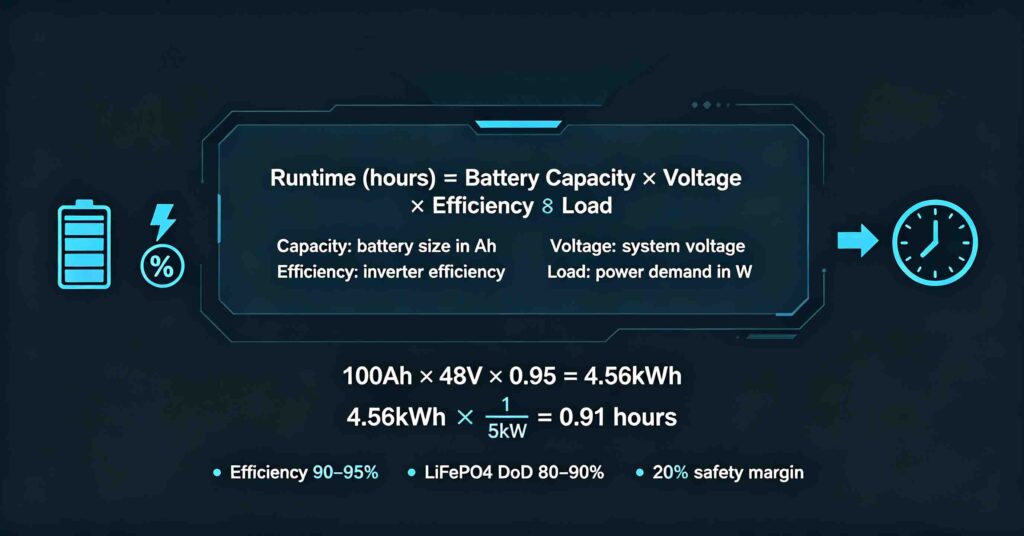
The most common mistake in data center battery sizing is confusing rated capacity with usable capacity, and ignoring the inverter efficiency. The correct formula for calculating the required battery energy capacity is:
Required battery capacity (kWh) = (Load power in kW × Required runtime in hours) ÷ (Inverter efficiency × Usable capacity fraction)
For example, a 50 kW IT load requiring 15 minutes (0.25 hours) of backup runtime, with a UPS/inverter efficiency of 95% and a LiFePO4 usable capacity fraction of 90%:
Required capacity = (50 kW × 0.25 h) ÷ (0.95 × 0.90) = 12.5 ÷ 0.855 = 14.6 kWh
For a lead-acid battery with a usable capacity fraction of 50%, the same load and runtime would require: (50 × 0.25) ÷ (0.95 × 0.50) = 12.5 ÷ 0.475 = 26.3 kWh — nearly double the rated capacity, and at 3–4× the weight and footprint.
Three additional factors should be included in the sizing calculation: (1) growth margin — add 20–30% to account for future IT load growth; (2) temperature derating — if the battery space is not air-conditioned to 20–25°C, derate the capacity (lead-acid loses capacity more rapidly at high temperatures than LiFePO4); (3) end-of-life derating — at end of life (typically 80% of original capacity), the battery must still deliver the required runtime, so size for the end-of-life capacity, not the new capacity.
Data center battery architecture: UPS, energy storage and the hybrid approach
Data center battery systems can be deployed in three architectural patterns, each with different benefits and complexity: For rack-mounted battery form factors, see #81 server rack battery.
1. UPS-only (traditional). The battery is connected exclusively to the UPS and provides backup power only during grid outages. This is the traditional lead-acid architecture and works with both lead-acid and lithium batteries. The battery is idle (float charge) 99%+ of the time, which means the capital investment is rarely utilised. For lithium batteries, this is the simplest deployment but the lowest-ROI option because the peak-shaving capability is not used.
2. Energy storage system (ESS) with UPS bypass. A grid-tied battery energy storage system is installed alongside the existing UPS. The ESS performs peak-shaving, demand-charge management and energy arbitrage when the grid is healthy; during a grid outage, the UPS (with its own battery) provides the instant bridge power while the ESS transitions to backup mode, or a static transfer switch connects the ESS to the critical load. This architecture maximises the battery’s revenue-generating potential but requires coordination between the ESS controller and the UPS, and may require additional switchgear.
3. Hybrid lithium UPS (integrated). The latest generation of lithium UPS systems integrate the battery, BMS, inverter/charger and energy management system into a single unit that provides both UPS backup and grid-tied energy services (peak-shaving, demand management). These systems are designed for lithium from the ground up, with cell-level monitoring, integrated fire suppression, and software that optimises between backup readiness and revenue generation. For new data center builds or full UPS replacements, this is often the most cost-effective and simplest-to-operate architecture.
The choice of architecture depends on whether the facility already has a functioning UPS (in which case option 2 adds an ESS alongside it) or is building new / replacing the UPS (in which case option 3 provides an integrated solution). Option 1 (UPS-only lithium) is appropriate when the facility has no demand-charge incentive and wants only the weight, space and maintenance benefits of lithium over lead-acid.
What to specify when procuring battery storage for data centers
When writing a specification or RFQ for data center battery storage, include the following items to ensure that the proposed system meets the facility’s requirements and that proposals can be compared on an apples-to-apples basis:
- Chemistry and cell format. Specify LiFePO4 (lithium iron phosphate) chemistry — not generic “lithium-ion,” which could include NMC or NCA chemistries with lower thermal stability. Specify the cell format (prismatic, cylindrical, pouch) if relevant.
- Rated capacity and voltage. Specify the rated energy capacity (kWh) and the nominal DC voltage (48V/51.2V for rack-mounted, 400V+ for containerised). Require that the usable capacity (at end of life, at 25°C) meets the runtime requirement.
- Backup runtime. Specify the required runtime at the defined load (e.g., “15 minutes at 50 kW continuous load, at end of life, at 25°C ambient”).
- UPS compatibility. Specify the make and model of the existing UPS (if applicable) and require the battery supplier to confirm compatibility, including charge voltage, communication protocol (CAN, RS485, Modbus), and any required interface cards.
- BMS capabilities. Require cell-level voltage and temperature monitoring, state-of-charge (SoC) and state-of-health (SoH) reporting, overcharge/over-discharge/over-current/over-temperature protection, and a communication interface to the UPS/BMS/EMS.
- Form factor and mounting. Specify the required form factor (19-inch rack-mount, floor-standing, containerised) and dimensions. For rack-mount, specify the rack unit (U) height and depth.
- Safety and certifications. Require UL 9540 (system safety), UL 9540A (thermal runaway propagation testing), IEC 62619 (industrial lithium battery safety), and UN 38.3 (transport safety). Require documentation of the test reports.
- Thermal management. Specify the operating temperature range and the cooling method (passive, forced air, liquid). Require that the battery can deliver rated capacity within the specified temperature range.
- Warranty and service life. Require a minimum 10-year warranty or 6,000 cycles (whichever comes first), with a guaranteed end-of-life capacity of ≥80% of rated. Require a defined maintenance and inspection schedule.
- Energy services capability. If peak-shaving or demand-charge management is required, specify the energy management system (EMS) capabilities, including the control modes, data logging, and integration with the facility’s building management system (BMS) or SCADA.
Q. Can lithium batteries replace lead-acid in an existing data center UPS?
Yes, but it requires careful planning. Lithium batteries (especially LiFePO4) can replace lead-acid in UPS systems, but the UPS charger must support lithium charge profiles, and the battery management system (BMS) must communicate with the UPS. Many modern UPS have lithium-compatible models or retrofit kits. You also need to update fire suppression and ventilation per NFPA 855, and verify the UPS can handle lithium’s higher discharge rates. A direct swap without these modifications risks overcharging or fire.
Q. How long does a data center UPS battery need to last?
Most data center UPS batteries provide 5–15 minutes of runtime, which is enough to start and transfer load to backup generators. Tier III/IV data centers typically require 10–15 minutes of battery runtime to cover generator start-up and paralleling time. Some facilities use 30-minute batteries for extra margin. The runtime requirement is determined by generator start time, transfer switch delay, and desired safety margin — not by how long the facility expects to run on batteries alone.
Q. Is LiFePO4 safe for data center battery rooms?
Yes, when properly installed. LiFePO4 has a high thermal runaway threshold (~270°C), does not release oxygen, and has lower fire risk than NMC. However, data center battery rooms still require: proper spacing between racks, thermal monitoring via BMS, fire suppression (per NFPA 855 and local AHJ requirements), ventilation, and spill containment. Many data centers choose LiFePO4 specifically because it is safer than lead-acid (no hydrogen gas, no acid leakage) and NMC. Always ensure UL 9540 and UL 9540A certification.
Q. What is the total cost of ownership difference between lithium and lead-acid for data center UPS?
Lithium has 2–3× higher upfront cost but 40–60% lower TCO over 10 years. Key savings: longer life (10–15 years vs 3–5 for lead-acid, reducing replacements), higher usable capacity (80–90% DoD vs 50%, fewer batteries for same runtime), smaller footprint, no maintenance, and higher efficiency (95%+ vs 80–85%). For a 1MW UPS, lithium typically pays back in 3–5 years.
Q. Can a data center battery system provide both UPS backup and peak shaving?
Yes, this is called dual-use or multi-use battery storage, and it is increasingly common. The same LiFePO4 battery system can provide UPS backup (instantaneous discharge on grid failure) and peak shaving (discharging during high-demand periods to reduce demand charges). The BMS and energy management system (EMS) prioritize UPS backup — peak shaving only occurs when the battery is at sufficient state of charge and no grid disturbance is detected. This dual-use model improves ROI by monetizing the battery during normal operation while maintaining backup capability.
Next step: specify the data center battery system for your actual load and tariff
The right data center battery system is the one that delivers the required backup runtime, fits the available space and weight budget, is compatible with your existing UPS (or replaces it with an integrated lithium UPS), and — where demand charges are significant — generates peak-shaving revenue that offsets the capital cost. Specifying “a lithium battery” without defining the runtime, the usable capacity, the UPS compatibility, the safety certifications and the energy services capability is an invitation for inconsistent proposals and unexpected costs.
- See the rack-mounted battery form factor in #81 server rack battery
- Review industrial storage applications in #15 industrial battery storage
- Understand peak-shaving economics in #57 peak shaving & demand charges
- Compare battery vs generator backup in #47 battery vs generator
- Review BESS safety and fire codes in #44 BESS fires & energy storage safety codes
- Ask leekooenergy for a data center battery storage specification that includes: your IT load profile (kW, with growth projection), required backup runtime (minutes), existing UPS make/model (for compatibility check), available space and floor load capacity, your electricity tariff structure (demand charges, time-of-use rates), the required safety certifications (UL 9540 / UL 9540A / IEC 62619), the preferred form factor (rack-mount / floor-standing / containerised), and the energy services required (backup-only / peak-shaving / demand-charge management / energy arbitrage) — so your battery system is sized and specified for your actual facility requirements, not a generic default