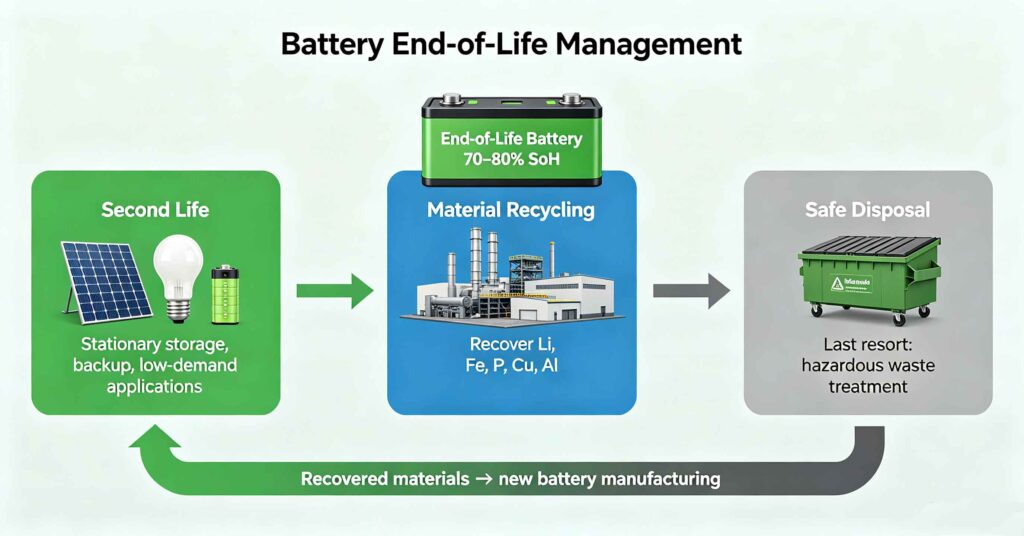
When a LiFePO4 battery reaches the end of its useful life in its original application — typically defined as 70–80% of its original capacity, or 6,000–10,000 cycles — it has three end-of-life paths: second-life reuse (redeploying the battery in a less demanding application where reduced capacity is acceptable), material recycling (processing the battery to recover lithium, iron, phosphorus, copper, aluminium and other materials for use in new batteries or other products), and safe disposal (treating the battery as hazardous waste and disposing of it in a permitted facility, which is the last resort). For B2B buyers, battery second life recycling is no longer an afterthought — it is a procurement consideration that affects total cost of ownership, regulatory compliance, ESG reporting, and corporate sustainability commitments. Buyers who plan for end-of-life at the time of purchase — by selecting suppliers with take-back programmes, understanding local recycling regulations, and budgeting for disposal costs — avoid the situation in which a retired battery bank becomes an expensive liability with no clear disposal path.
Second-life reuse: extending battery life in less demanding applications
Second-life (or “second-use”) batteries are batteries that have reached end of life in their original application — typically electric vehicle batteries or high-demand stationary storage batteries — but still retain 70–80% of their original capacity and can be redeployed in less demanding applications where the reduced capacity is acceptable. For stationary storage batteries that were originally deployed in high-cycle applications (frequency regulation, peak shaving), second-life reuse in low-cycle applications (backup power, low-demand solar self-consumption, off-grid systems) can extend the battery’s useful life by 5–10 additional years, delaying the need for recycling and improving the overall lifecycle economics. For cycle life and degradation economics, see #46 cycle life vs price.
The advantages of second-life reuse include: lower cost per kWh than new batteries (second-life batteries typically cost 30–60% less than new batteries), reduced environmental impact (delaying recycling and the associated energy use and emissions), and improved resource efficiency (extracting more value from the materials and energy invested in manufacturing the battery). The challenges include: variable battery condition (different batteries from different sources may have different capacities, internal resistances and degradation histories, making it difficult to build a uniform battery bank), limited availability of tested and certified second-life batteries, safety concerns (batteries that have been in service for many years may have hidden defects or degradation that increase safety risk), and the lack of standardised testing and certification protocols for second-life batteries. For B2B buyers considering second-life batteries, the key is to source from reputable suppliers that provide tested, graded and warrantied batteries, and to use them in applications where the reduced capacity and potentially higher variability are acceptable.
Material recycling: recovering valuable materials from retired batteries
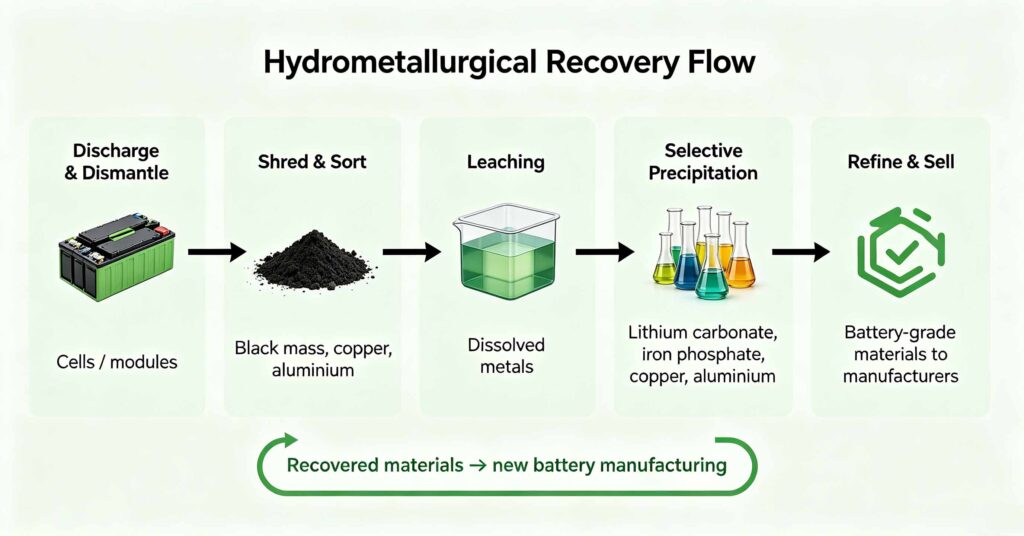
When a battery can no longer be used in any application — either because its capacity has declined below a usable threshold, or because it has safety or performance issues that make second-life use impractical — material recycling is the preferred end-of-life path. Recycling processes break down the battery into its constituent materials and recover those that have economic value, which can then be used to manufacture new batteries or other products. There are three primary recycling technologies in commercial use or development:
| Technology | Process | Materials recovered | Advantages | Limitations |
|---|---|---|---|---|
| Pyrometallurgical (smelting) | Batteries are shredded and smelted in a high-temperature furnace to recover metals as an alloy | Copper, nickel, cobalt, iron (as alloy); lithium and aluminium are typically lost in slag | Mature technology, high throughput, can handle mixed battery chemistries | High energy use, high emissions, does not recover lithium or phosphorus (important for LiFePO4), requires gas treatment |
| Hydrometallurgical (leaching) | Batteries are shredded, and metals are dissolved in acid or other solvents, then selectively precipitated and purified | High-purity lithium, nickel, cobalt, copper, aluminium, iron, phosphorus | High material recovery rate, high-purity products, lower energy use than pyrometallurgy, can recover lithium and phosphorus | Complex process, uses chemicals that require treatment, lower throughput than pyrometallurgy, requires pre-processing (dismantling, sorting) |
| Direct recycling (in development) | Battery materials are recovered without breaking down the crystal structure, preserving the cathode material for direct reuse | Intact cathode material (LiFePO4), anode material, current collectors | Lowest energy use, highest value recovery (preserves manufactured material), lowest emissions | Still in development/early commercialisation, requires careful sorting by chemistry and manufacturer, limited throughput |
For LiFePO4 batteries specifically, hydrometallurgical recycling is generally preferred over pyrometallurgical because it can recover lithium and phosphorus — materials that are lost in the smelting process and that have value for new battery manufacturing. Direct recycling is particularly promising for LiFePO4 because the LiFePO4 cathode material has a stable crystal structure that can be recovered and refurbished for direct reuse, potentially offering the highest value recovery and lowest environmental impact. However, direct recycling is still in the early stages of commercial deployment and is not yet widely available at scale. For most LiFePO4 batteries today, hydrometallurgical recycling is the most practical and environmentally sound option, provided that a qualified recycling facility is accessible.
Regulatory landscape: what buyers need to know
The regulatory landscape for battery end-of-life management is evolving rapidly, driven by the growing volume of retired batteries and increasing concern about environmental impact and resource security. Key regulatory developments include:
- European Union Battery Regulation. The EU’s updated Battery Regulation (effective from 2024–2027 in phases) introduces extended producer responsibility (EPR) for batteries, mandatory recycled content requirements for new batteries, carbon footprint declarations, battery passports (digital records of a battery’s origin, composition and history), and collection and recycling targets. The regulation applies to all batteries placed on the EU market, including industrial and stationary storage batteries, and requires producers to finance the collection and recycling of their batteries at end of life.
- United States. In the US, battery end-of-life management is primarily regulated at the state level, with California leading the way through its Battery Stewardship Act (AB 2440), which requires battery producers to establish and fund stewardship programmes for the collection and recycling of lithium-ion batteries. Other states are considering similar legislation. At the federal level, the Environmental Protection Agency (EPA) regulates hazardous waste disposal under the Resource Conservation and Recovery Act (RCRA), and the Department of Transportation (DOT) regulates the transport of lithium batteries (including retired batteries) under UN 38.3 and 49 CFR regulations.
- China. China has implemented a New Energy Vehicle Battery Traceability Management System and extended producer responsibility requirements for battery manufacturers, requiring them to establish recycling networks and take back retired batteries. China also has policies promoting the梯次利用 (cascade utilisation / second-life use) of retired EV batteries in stationary storage applications.
- Other markets. Other markets, including Japan, South Korea, Australia and Canada, are developing or have implemented battery recycling regulations and extended producer responsibility requirements. The specific requirements vary by market, and buyers should consult local regulations or a qualified environmental consultant to determine the applicable requirements for their location.
Battery second life recycling is becoming a regulated responsibility, not an optional choice. Buyers who purchase battery systems in regulated markets may be required to ensure that the batteries are properly collected and recycled at end of life, and may be held responsible for the cost of compliance. The most effective way to manage this risk is to select suppliers that offer take-back or recycling programmes, to include end-of-life provisions in the purchase contract, and to budget for the cost of recycling or disposal as part of the total cost of ownership.
Battery second life recycling: an end-of-life planning checklist for buyers
- Ask suppliers about their take-back and recycling programmes. Before purchasing, ask each supplier whether they offer a battery take-back programme, whether they partner with certified recycling facilities, and what the cost and process are for end-of-life disposal. Prefer suppliers that offer free or low-cost take-back as part of the product warranty or service agreement.
- Include end-of-life provisions in the purchase contract. The contract should specify who is responsible for end-of-life collection and recycling, what the cost is (or how it will be determined), what documentation will be provided (certificate of recycling, waste manifest), and what happens if the supplier goes out of business (e.g., a third-party recycling arrangement or an escrow account).
- Budget for end-of-life costs. Include the estimated cost of battery recycling or disposal in the total cost of ownership calculation. Typical costs for LiFePO4 battery recycling range from $50–$200 per kWh (depending on location, battery type, and recycling facility availability), though costs are declining as recycling capacity increases and regulations create economies of scale. For large systems, the end-of-life cost can be significant and should not be overlooked.
- Understand local regulations. Consult local environmental regulations or a qualified consultant to determine the applicable requirements for battery storage, collection, transport and recycling in your jurisdiction. This includes hazardous waste classification, transport regulations (UN 38.3, DOT), and any extended producer responsibility or battery stewardship requirements.
- Plan for second-life opportunities. If your batteries are likely to have 70–80% capacity remaining at end of life in their original application, evaluate whether they can be redeployed in a less demanding second-life application (backup power, off-grid storage, low-demand solar self-consumption). This can extend the battery’s useful life and delay recycling costs, improving the overall lifecycle economics.
- Maintain battery documentation. Keep records of the battery’s make, model, serial number, capacity, chemistry, installation date, maintenance history, and performance data (cycle count, capacity degradation, temperature history). This documentation is essential for determining the battery’s condition at end of life, for evaluating second-life suitability, and for complying with recycling and transport regulations.
- Consider ESG and sustainability reporting. If your organisation publishes ESG or sustainability reports, include information about your battery end-of-life management strategy, including recycling rates, second-life deployments, and any supplier take-back programmes. This demonstrates responsible environmental stewardship and can improve your organisation’s ESG rating.
Q.What happens to LiFePO4 batteries at end of life?
LiFePO4 batteries at end of life (typically 70–80% of original capacity, or 6,000–10,000 cycles) have three paths: (1) Second-life reuse — redeployed in less demanding applications like backup power or low-demand solar storage, extending life by 5–10 years. (2) Material recycling — processed through hydrometallurgical (leaching) or pyrometallurgical (smelting) methods to recover lithium, iron, phosphorus, copper, and aluminum. (3) Safe disposal — treated as hazardous waste in a permitted facility, used only as a last resort. The preferred path depends on battery condition, available facilities, and local regulations.
Q.Is LiFePO4 battery recycling economically viable?
It depends on scale, regulation, and technology. Unlike NMC batteries (which contain high-value cobalt and nickel), LiFePO4 contains lower-value materials (iron, phosphorus), making the recycling business case thinner. LiFePO4 recycling is more dependent on economies of scale, extended producer responsibility (EPR) fees, and policy support. However, as the volume of retired LiFePO4 batteries grows (driven by stationary storage growth), costs are falling, and new technologies like direct recycling (which preserves the LiFePO4 cathode for reuse) offer higher-value recovery. For buyers, plan for recycling costs at purchase — don’t assume it will be free.
Q.Can I throw away or landfill a retired LiFePO4 battery?
No. Lithium-ion batteries (including LiFePO4) must never go in general waste or landfills. They contain hazardous materials (electrolyte, reactive chemicals) and can cause fires if damaged during waste collection. In most jurisdictions, lithium-ion batteries are classified as hazardous or universal waste, and landfill disposal is illegal. Retired batteries must be collected, transported under UN 38.3 and applicable regulations, and processed by a permitted recycling or hazardous waste facility. Improper disposal can cause waste facility fires, environmental contamination, and legal penalties. For large systems, engage a qualified battery recycling company and retain waste manifests and certificates of recycling.
Q.What is a battery take-back programme and should I require one from my supplier?
A take-back programme is a service where the supplier agrees to collect and recycle their batteries at end of life, typically at no extra cost. It is a form of extended producer responsibility. Requiring one offers benefits: it eliminates the need to find a recycler at end of life, provides cost certainty, ensures proper recycling by a facility that knows the product, and provides documentation (certificate of recycling) for ESG reporting. In regulated markets, take-back may be legally required. Even where not required, it is a best practice that reduces end-of-life risk.
Q.How much does it cost to recycle a LiFePO4 battery?
Recycling costs vary by location, battery size, facility availability, and transport distance. As a rough estimate, LiFePO4 stationary storage recycling costs $50–$200 per kWh — $500–$2,000 for a 10 kWh battery, or $50,000–$200,000 for a 1 MWh system. These include collection, transport, and processing, but may not include deinstallation. Costs are declining as capacity grows and EPR programmes spread. Obtain a specific quote at purchase time and include it in TCO. Do not assume recycling will be free or that the battery will have positive scrap value.
Next step: plan for end of life before you sign the purchase order
Battery second life recycling is no longer an afterthought — it is a procurement, regulatory and ESG consideration that affects the total cost of ownership and the environmental profile of your energy storage project. Buyers who plan for end of life at the time of purchase — by selecting suppliers with take-back programmes, understanding local regulations, budgeting for recycling costs, and maintaining battery documentation — avoid the situation in which a retired battery bank becomes an expensive liability with no clear disposal path. The battery you buy today is the battery you will need to dispose of in 10–15 years; plan for it now.
- Read the complete LiFePO4 guide in #1 LiFePO4 batteries complete guide
- Review cycle life and price economics in #46 cycle life vs price
- Understand battery replacement timing in #51 when to replace a solar battery
- See battery maintenance best practices in #84 solar battery maintenance
- Ask leekooenergy for an end-of-life management plan that includes: our battery take-back programme terms (coverage, cost, process), our recycling partner certifications and facilities, the estimated recycling cost per kWh for your specific system, the documentation provided at end of life (certificate of recycling, waste manifest), second-life evaluation criteria and process, and ESG reporting support (recycling rates, carbon footprint, lifecycle analysis) — so your battery procurement includes a clear, costed end-of-life plan from day one