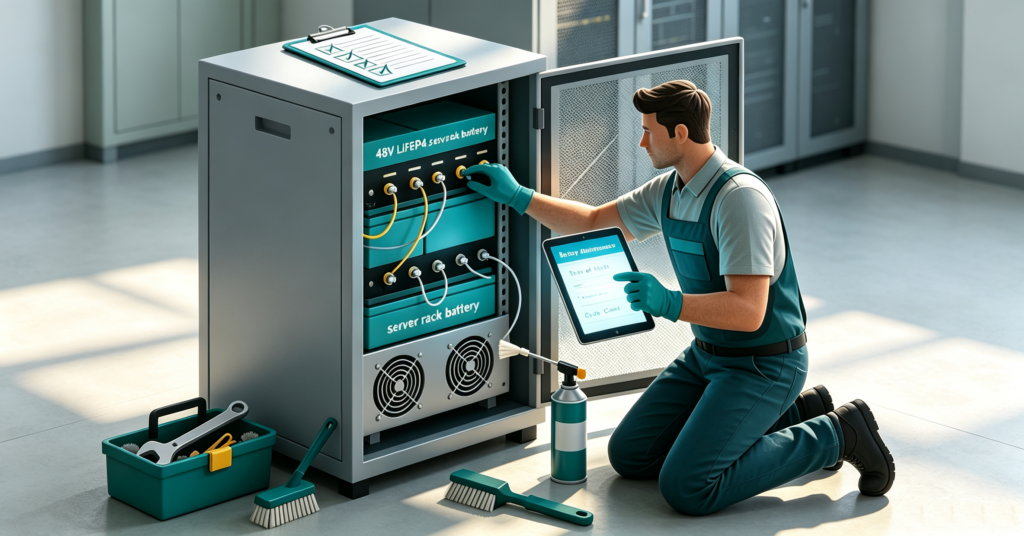
Solar battery maintenance is the set of routine inspections, cleaning, electrical checks and software updates that keep a solar battery bank healthy and extend its service life. The routine looks very different depending on the chemistry: a flooded lead-acid bank needs water top-ups, terminal cleaning and equalisation charges; a LiFePO4 bank needs almost none of those, but it does need BMS firmware updates, state-of-health trend tracking and thermal management. The one-line version worth quoting: most of the lead-acid maintenance checklist is obsolete for lithium; the items that are not obsolete are the items that decide whether the battery reaches its rated cycle life or fails early.
This guide is for the buyer or operations manager who owns the bank after install — a residential solar owner, a commercial facility manager, a fleet operator with hundreds of packs, or a service company writing the maintenance contract. It covers the four decisions that decide whether a maintenance programme actually delivers value: which chemistry-specific tasks to keep, how often to inspect, what software-side tasks to run, and what to budget for the parts of the work that require a technician. The replacement-timing side is in #51 when to replace a solar battery; the cycling-economics side is in #46 cycle life vs price; this article stays on the maintenance programme itself.
What “solar battery maintenance” actually means
Three pieces of information sit inside the phrase. Solar battery is the storage bank on the DC side of a photovoltaic system — typically 12V, 24V or 48V, sized in kWh for the daily load. Maintenance is the routine work that keeps the bank healthy: visual inspection, cleaning, electrical checks, software updates and periodic capacity tests. The maintenance depends on chemistry: a flooded lead-acid battery is essentially a wet chemical system that needs water and ventilation; a sealed lead-acid battery (AGM or gel) is sealed but still has terminal and equalisation needs; a LiFePO4 battery is sealed, has no liquid electrolyte, and its “maintenance” is mostly software and thermal management.
What separates a maintenance programme from a one-off inspection is the cadence and the record. A maintenance programme defines what to inspect at each interval (monthly, quarterly, annually), what to record (voltage, temperature, SoH, alarm history), and what triggers a service intervention. Without the record, the same technician visits the same site every year and notices nothing because nothing is measured against last year.
LiFePO4 vs lead-acid maintenance: what changes and what doesn’t
The maintenance tables in legacy solar textbooks were written for flooded lead-acid and were adapted for AGM with small adjustments. They are wrong for LiFePO4 in three important places and right in five others.
| Task | Flooded lead-acid | AGM / gel lead-acid | LiFePO4 |
|---|---|---|---|
| Water top-up (distilled) | monthly to quarterly | not required (sealed) | not applicable (sealed, no liquid) |
| Terminal cleaning and torque check | quarterly | quarterly | annually (low corrosion risk) |
| Equalisation charge | monthly to quarterly (15.5–16V) | occasional (gel: never) | not applicable (damages cells) |
| Specific gravity test (electrolyte) | quarterly | not applicable (sealed) | not applicable (no liquid electrolyte) |
| Ventilation check | monthly (hydrogen off-gassing) | quarterly (sealed, low gas) | annually (thermal management) |
| Capacity / load test | annually | annually | annually (SoH trend) |
| BMS firmware update | n/a (no BMS) | n/a (no BMS) | per vendor release (1–2× per year) |
| Cell voltage drift inspection | n/a | n/a | monthly (read from BMS log) |
| Thermal imaging scan | annually (terminal hot spots) | annually | annually (cell-level hot spots) |
| Cable and connector inspection | annually | annually | annually |
Three rows deserve attention. Water top-up is the headline change: a LiFePO4 bank eliminates this entirely, which is the single largest labour saving in the maintenance contract. Equalisation charge is the dangerous one to skip correctly — applying a 15.5V equalisation charge designed for lead-acid to a LiFePO4 bank will push cells past their upper voltage limit and damage the pack; the BMS may save the pack, but the cells will have lost cycle life. BMS firmware updates are the new line item: a LiFePO4 pack’s protection logic lives in the BMS firmware, and missing a critical update can leave the bank exposed to a known protection bug.
The maintenance checklist that works for both chemistries
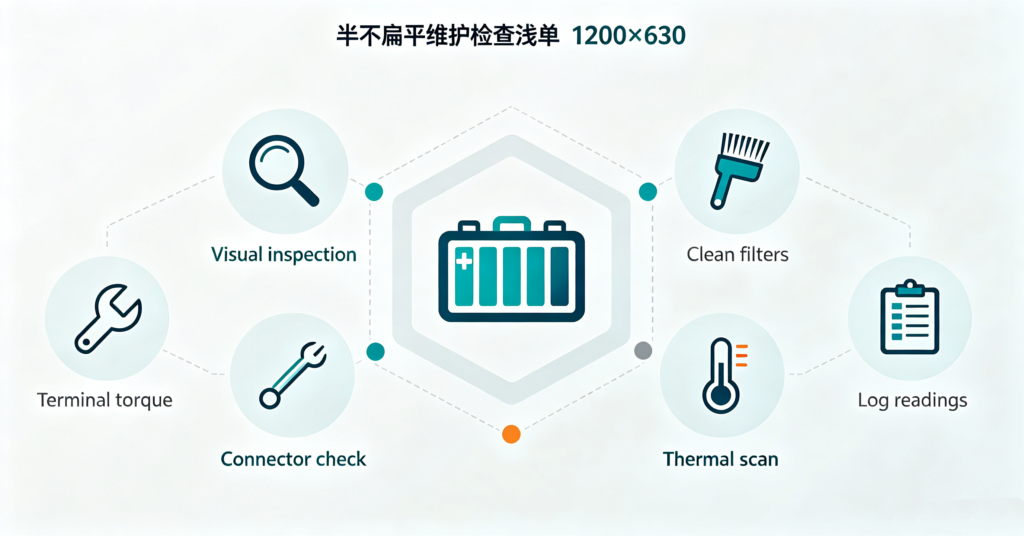
Five items belong on every solar battery maintenance checklist regardless of chemistry.
- Visual inspection: case for cracks, swelling, leaks, corrosion on terminals, rodent damage to cables, indicator lights on the BMS.
- Cleaning: dust on heat sinks and fan grilles (blocks thermal management), debris in cabinet vents, salt or pollen deposits on outdoor enclosures.
- Terminal torque: check that connections are still at the manufacturer’s specified torque (typically 4–8 Nm for M6/M8 studs on lithium packs). Loose terminals are the leading cause of voltage-drop incidents and the second leading cause of thermal events.
- Cable and connector inspection: insulation for cracking or UV damage, Anderson connectors for contact wear, strain reliefs for tightness.
- Record keeping: capture every reading (voltage, temperature, SoH, alarm history) into a maintenance log that lets the next visit be compared against the last.
The single highest-value item is the maintenance log. A bank that has been visited monthly for three years with voltage and temperature recorded each time will tell you when something starts to drift long before it becomes a service event. A bank that has been visited annually with nothing recorded will fail the same way, just with no warning.
Software-side maintenance: BMS firmware, SoH trends and alarms
For a LiFePO4 bank, half the maintenance work is software.
- BMS firmware updates: the BMS vendor releases firmware updates that fix protection bugs, add new cell chemistries, or improve the state-of-charge algorithm. A fleet of packs that has missed three firmware updates may be running protection logic that the manufacturer no longer supports.
- State-of-health trend: the BMS reports SoH over time. A healthy pack holds 95–100% SoH in year one and gradually declines; a pack that drops 5% in a quarter has a problem (cell imbalance, abuse, or firmware bug). Reading the SoH trend every quarter catches the slow drift before it becomes a sudden failure.
- Alarm history review: a quality BMS logs every protection event (over-voltage, under-voltage, over-current, over-temperature). Reviewing the alarm history at every maintenance visit catches the “the BMS saved the pack last Tuesday” events that would otherwise go unnoticed.
- Data export and backup: a periodic export of the BMS log to a maintenance archive (CSV, Parquet, or vendor cloud) protects against loss of the on-pack memory and supports warranty claims.
The monitoring side of this work — what to do when the BMS is part of a fleet and the data flows to a cloud platform — is in #83 battery monitoring system manufacturers; the BMS-side protection logic is in #49 BMS protection.
Common failures and how maintenance prevents them
Five failure modes account for most of the service events on solar battery banks. Each one has a maintenance task that would have caught it.
- Loose terminal: voltage drop under load, intermittent BMS low-voltage alarms. Prevented by quarterly torque checks.
- Blocked fan or vent: thermal runaway risk during summer, capacity derating in spring. Prevented by quarterly cleaning.
- Cell imbalance: one cell drifts low, the pack reaches its low-voltage cutoff earlier than it should, the bank loses capacity. Prevented by monthly cell-voltage trend review from the BMS log.
- Stale BMS firmware: a known bug triggers a false over-voltage event, the BMS disconnects, the system shuts down. Prevented by an annual firmware update cadence.
- Cabinet corrosion: outdoor enclosures rust at the seams, water enters, terminal corrosion accelerates. Prevented by annual seal and paint inspection.
The economics of catching these early are large. A loose terminal caught at quarterly maintenance is a five-minute torque fix; the same loose terminal caught when it has melted a connector is a service visit plus parts. A blocked fan caught at quarterly cleaning is a five-minute brush and compressed air; the same blocked fan caught when it has cooked a cell is a pack replacement.
Annual maintenance plan: a B2B template
A working maintenance plan defines cadence by task, not by visit. The plan below is the one most B2B service contracts adapt from.
| Cadence | Tasks | Typical duration (per pack) |
|---|---|---|
| Monthly | visual inspection, BMS log review, alarm history check | 5–10 minutes (remote or on-site) |
| Quarterly | cleaning, terminal torque, fan / vent check, BMS data export | 20–30 minutes on-site |
| Annually | capacity / load test, thermal imaging scan, firmware update, cable and connector inspection, cabinet seal check, SoH trend review | 1–2 hours on-site per cabinet |
| Every 3–5 years | capacity test under load, deep SoH review, replacement scheduling decision | half-day per site |
For a residential 5–15 kWh bank, the monthly and quarterly tasks are a 30-minute visit once or twice a year; the annual visit absorbs the rest. For a commercial 100 kWh+ bank, the monthly task can be remote (BMS dashboard review) but the quarterly visit is still on-site. For a fleet of 100+ packs across multiple sites, the cadence above scales by adding a remote-monitoring layer that does the monthly review across all sites and dispatches a technician only when an alarm fires. The fleet-monitoring angle is in #83 battery monitoring system manufacturers.
Q. How often should a solar battery be maintained?
Visual inspection and BMS log review monthly, terminal torque and cleaning quarterly, capacity test and firmware update annually. A LiFePO4 bank needs less frequent physical maintenance than a flooded lead-acid bank because it has no water to top up, but the software-side tasks (firmware, SoH trend, alarm history) become more important.
Q. Can you equalise a LiFePO4 battery?
No. Equalisation charges push voltage up to 15.5–16V to desulfate lead-acid plates; a LiFePO4 cell above 14.6V is being damaged. The BMS high-voltage cutoff will normally save the pack, but the cells will have lost cycle life. If your charger is configurable, set the absorption voltage to the LiFePO4 value (typically 14.4–14.6V) and disable equalisation entirely.
Q. Does a LiFePO4 battery need ventilation?
LiFePO4 chemistry is thermally stable and does not off-gas in normal operation, so the explosive-gas ventilation requirements that apply to flooded lead-acid do not apply. What does apply is thermal management: the cells need to stay within their operating temperature range (typically 0–45 °C for charge, –20–60 °C for discharge), which means the cabinet needs airflow or air-conditioning for outdoor and indoor installations alike.
Q. What is the most common cause of solar battery failure?
For flooded lead-acid: sulfation from chronic under-charging and plate damage from chronic over-charging. For AGM: terminal corrosion and thermal runaway from blocked vents. For LiFePO4: cell imbalance from missed BMS firmware updates and capacity fade from chronic high-temperature operation. All of these have maintenance tasks that catch them early.
Q. How do I track state of health (SoH) for a solar battery fleet?
Read the SoH reported by each BMS quarterly and plot it over time. A healthy pack loses 1–2% SoH per year; a pack losing 5% per quarter has a problem. For a fleet, push the SoH data from each BMS to a cloud monitoring platform and let the platform generate the trend chart and the alarm when a pack drifts off the curve. The data-export format and the alarm thresholds are part of the monitoring platform selection.
Next step: a maintenance plan that fits the chemistry and the budget
The right solar battery maintenance programme is the one that fits the chemistry (LiFePO4 vs lead-acid), the cadence (monthly, quarterly, annually), and the asset structure (single pack vs fleet) — and that produces the record the warranty auditor will eventually ask for.
- Confirm the cycling economics in #46 cycle life vs price
- Plan the replacement timing in #51 when to replace a solar battery
- Switch from lead-acid to lithium in #24 lithium vs lead-acid deep cycle
- See the BMS protection side in #49 BMS protection
- Run the monitoring layer in #83 battery monitoring system manufacturers
- Ask leekooenergy for a solar battery maintenance specification that defines the chemistry-specific checklist (LiFePO4 vs lead-acid), the cadence per task, the BMS firmware update cadence, the SoH tracking template, the alarm thresholds and the service contract terms — a maintenance programme that fits residential, commercial and fleet deployments from a single document set