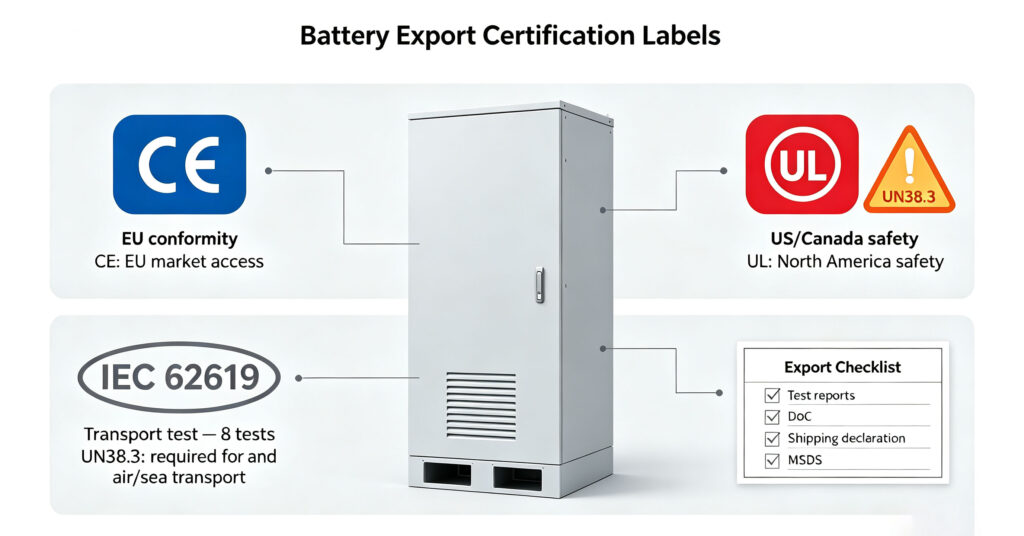
Battery export certification is the set of documents, test reports and conformity marks a lithium battery must carry to be legally sold, transported and installed in a target market. For most LiFePO4 battery exports the core certifications are: CE marking (mandatory for EU market access under the Low Voltage and EMC Directives), UL certification (required or strongly expected in the US/Canada, notably UL 1973 for battery packs and UL 9540/UL 9540A for energy storage systems), UN38.3 (a transport test report required for shipping lithium batteries by air or sea, covering eight tests including altitude, thermal and impact), and IEC standards (such as IEC 62619 for the safety of secondary lithium cells and batteries, and IEC 62133 for portable cells). These certifications are not interchangeable: CE is about EU regulatory compliance, UL is about North American safety listing, UN38.3 is a transport requirement, and IEC is an international safety standard. A compliant supplier should be able to provide the test reports and certificates for the exact model you buy, not just for a similar model. Failing to verify battery export certification can cause customs delays, shipment rejection, liability in an incident, or installation that does not meet local code — so certification verification belongs in every battery procurement decision. For a broader supplier evaluation checklist, see #21 how to evaluate battery manufacturers.
When you import, source or specify a lithium battery, “certified” is one of the first words you hear and one of the least precise. Battery export certification covers several distinct requirements, and mixing them up leads to costly mistakes at customs or during installation. This guide explains the four main certification types, what each actually covers, and exactly what to verify before you buy. For the full custom-battery procurement picture, see #98 OEM/ODM custom battery pack design guide.
CE marking: EU market access
CE marking is the conformity mark required for products sold in the European Economic Area. For battery systems, CE typically covers the Low Voltage Directive (LVD, 2014/35/EU) and the Electromagnetic Compatibility Directive (EMC, 2014/30/EU). Newer EU rules, such as the Battery Regulation (EU) 2023/1542, add requirements on sustainability, carbon footprint and due diligence that are being phased in over the coming years.
CE is a declaration of conformity by the manufacturer, supported by test reports against harmonised standards. For batteries, relevant standards include EN 62619 (safety) and EN 61000 (EMC). The mark must be accompanied by a Declaration of Conformity (DoC) listing the standards applied. A CE-marked battery should have the full technical file behind it. As of the transition to the Battery Regulation, buyers should confirm not just the CE mark but also the model’s registration status under the new rules.
UL certification: North America safety listing
UL certification is a third-party safety listing widely required or expected in the United States and Canada. For stationary batteries and energy storage, the key standards are UL 1973 (batteries for use in stationary and vehicle auxiliary power applications), UL 9540 (safety of energy storage systems), and UL 9540A (test method for evaluating thermal runaway fire propagation). For smaller or consumer batteries, UL 2054 or UL 62133 apply.
UL certification involves the manufacturer submitting samples for testing by an accredited lab (UL or an accredited lab issuing UL-recognised marks), followed by factory inspection. Unlike CE, UL is a genuine third-party listing with follow-up factory audits. For grid-tied or building-integrated storage, local codes (such as the International Fire Code and NFPA 855) often require UL 9540/UL 9540A. Buyers should ask for the UL listing for the exact model, check the file number on the UL website, and confirm the scope covers the full system, not only the cells. See #87 battery thermal runaway and NFPA 855 for how these safety standards tie together.
UN38.3: transport test for lithium batteries
UN38.3 is not a product safety standard; it is a transport test required for shipping lithium cells and batteries by air, sea or road. It is defined in the UN Manual of Tests and Criteria, Part III, Subsection 38.3, and covers eight tests: altitude simulation, thermal test, vibration, shock, external short circuit, impact/crush, overcharge, and forced discharge. A battery must pass UN38.3 to be carried on an aircraft (including in devices or as cargo) and is a precondition for the transport declaration.
The UN38.3 report is issued for a specific battery design and is part of the shipper’s declaration, along with the MSDS and, for air, the lithium battery handling label. Because it is per-design and per-capacity, a new battery size or chemistry needs its own test. Buyers should confirm the UN38.3 report matches the exact model and cell configuration, and that the report is current. Without a valid UN38.3 report, lithium batteries can be refused for air shipment or cause customs delays.
IEC standards and other regional marks
Beyond CE, UL and UN38.3, international IEC standards provide a common safety framework. IEC 62619 covers the safety requirements for secondary lithium cells and batteries used in industrial applications, including stationary energy storage; IEC 62133 covers portable sealed cells; IEC 62620 covers industrial cells. Many regional certifications are built on these IEC standards — for example, some markets accept IEC-based test reports, and EU harmonised standards reference them.
Other regional marks to be aware of include: UKCA (United Kingdom), PSE (Japan), KC (South Korea), RCM (Australia), and the CB scheme (an international mutual-recognition system based on IEC standards). Which ones apply depends on your target market. A useful practice is to define the target market first, then list the mandatory certifications, then ask the supplier for the corresponding reports.
| Certification | Region/Scope | What it covers | Type |
|---|---|---|---|
| CE | EU/EEA | Low voltage, EMC; EU Battery Regulation phased in | Self-declaration + test reports |
| UL 1973/9540 | US/Canada | Battery safety; ESS system safety and thermal runaway | Third-party listing + factory audit |
| UN38.3 | International transport | Eight transport safety tests (air/sea/road) | Test report per design |
| IEC 62619/62133 | International | Safety of lithium cells and batteries | Standard / basis for regional marks |
What to verify before importing or sourcing batteries
Verifying battery export certification is a checklist, not a leap of faith. The following steps reduce the risk of a shipment problem or a compliance gap.
- Match the certificate to the exact model: certification is per-design. Confirm the certificate number and file name match the exact model, cell chemistry, capacity and pack configuration you are buying, not a similar one.
- Check the issuing body and validity: confirm UL listings on the UL online directory, and check that CE reports are from an accredited lab. Ask for the DoC and test report dates; recent and current is better than old.
- Define target-market requirements first: the certification set differs by market. Make a list for your target market (e.g. EU: CE + Battery Regulation; US: UL 1973/9540; transport: UN38.3), then verify each.
- Confirm system vs component coverage: for an energy storage system, UL 9540 covers the whole system, not just the cells. Ask whether the listed unit is the full system or only a sub-component.
- Ask for reports, not just marks: a mark on a label is weak evidence. Ask the supplier to send the test report and certificate PDF for the exact model, and keep them on file for customs and AHJ review.
For the sourcing and factory-side aspects of battery procurement, including cleanroom and quality questions, see #41 battery cleanroom manufacturers and China lithium supplier guide.
Q. What certifications does a lithium battery need for export?
It depends on the target market, but the core set is: CE for EU access, UL (1973/9540) for the US and Canada, UN38.3 for transporting lithium batteries by air or sea, and IEC standards such as 62619 as a safety baseline. For a home battery, EU buyers need CE plus the EU Battery Regulation; US buyers need UL 9540 for a listed energy storage system. Always confirm the exact model has each required certificate.
Q. Is CE the same as UL certification?
No. CE is a self-declared conformity mark for EU market access, covering directives like Low Voltage and EMC, backed by test reports the manufacturer issues. UL is a third-party safety listing for North America, where an accredited lab tests samples and audits the factory. CE is about regulatory compliance; UL is an independent safety certification. They are not interchangeable, and many products carry both for different markets.
Q. Do I need UN38.3 for a home battery?
Yes, if it is shipped as lithium batteries. UN38.3 is a transport requirement for lithium cells and batteries carried by air, sea or road, regardless of final use. A home battery reaching a customer by sea or air freight must have a valid UN38.3 test report for its exact model. It covers eight tests including altitude, thermal, vibration, shock, short circuit, and overcharge. Without it, the battery can be refused for air shipment.
Q. How do I verify a battery has valid certification?
Ask the supplier for the certificate and test report PDFs for the exact model, then cross-check: for UL, search the UL online directory for the file number; for CE, confirm the DoC lists the correct directives and standards from an accredited lab; for UN38.3, verify the report matches the model and cell configuration. Check dates and issuing bodies, and confirm the listed unit is the full system you are buying, not just the cells.
Q. What happens if I import a battery without the right certification?
You risk customs delays or rejection, returned or destroyed shipments, and liability if a non-compliant battery causes an incident. Without UN38.3, air shipment is refused; without CE, EU sale is non-compliant and can face enforcement; without UL, US installations may not pass inspection or insurance review. Verification before purchase is far cheaper than resolving a blocked shipment or a compliance failure after the fact.
Next step: verify the certification before you commit
Understanding battery export certification protects you from customs delays, non-compliant installations and liability. The right certification set depends on your target market: CE for the EU, UL for North America, UN38.3 for transport, and IEC standards as the safety baseline. Before you source or import, ask the supplier for the exact-model test reports and certificates and verify them.
- Use the manufacturer evaluation checklist in #21
- Review OEM/ODM design requirements in #98
- Understand UL 9540A and NFPA 855 in #87
- Ask leekooenergy for a battery export certification package that includes: the CE declaration and test reports for the exact model, UL 1973/9540 listing for the US/Canada market (where applicable), the UN38.3 test report matching your model and cell configuration, IEC 62619 or relevant standard compliance, and any regional marks needed for your target market — so your battery arrives compliant, clears customs smoothly, and passes local installation and insurance review