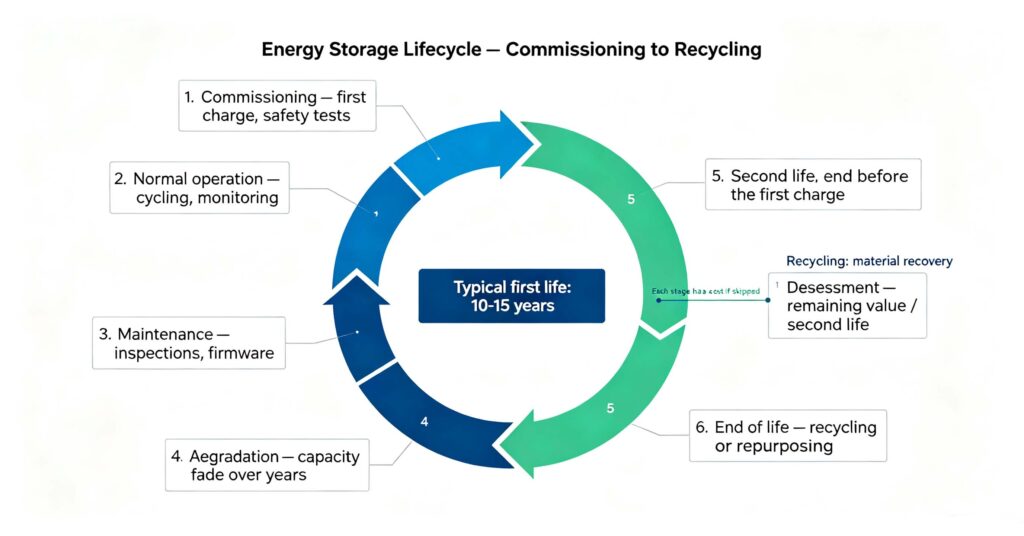
Energy storage lifecycle is the full sequence a storage system passes through — commissioning, normal operation, maintenance, degradation, end-of-life assessment, and retirement or second life — and each stage has a cost if it is skipped. The lifecycle typically spans 10–15 years of first-life operation for a lithium system, during which capacity fades gradually (calendar aging plus cycle aging), then the system is either repurposed for a second life or recycled for material recovery. The stages are: commissioning (first charge, safety tests, grid connection checks), operation (cycling to the dispatch schedule, monitoring SOC, temperature and fault flags), maintenance (inspections, cleaning, connection retorque, firmware updates), degradation (capacity and efficiency fade that must be modelled from year one, not discovered at year ten), end-of-life assessment (measured remaining capacity determines whether second life or recycling makes sense), and retirement (safe decommissioning, transport and disposal). The lifecycle mindset changes buying decisions: a system chosen for its 10-year degradation curve and service plan is worth more than one chosen on first price, because energy storage value is delivered over the whole lifecycle, not at the point of purchase.
Battery storage is an asset that lives for a decade or more, and planning the energy storage lifecycle from the start is what protects that value., and the way it is operated in year three decides how much value it delivers in year ten. This guide walks through the energy storage lifecycle stage by stage. For the system anatomy behind it, see #52 BESS components: battery, PCS, BMS and EMS.
The six stages of an energy storage lifecycle
Every storage system moves through the same six stages, and each one has specific requirements. The table below summarises them.
| Stage | What happens | What it protects |
|---|---|---|
| 1. Commissioning | First charge, safety tests, grid checks | Correct initial state, safe operation |
| 2. Operation | Cycling to schedule, monitoring | Revenue model, early fault detection |
| 3. Maintenance | Inspections, cleaning, retorque, firmware | Reliability, warranty validity |
| 4. Degradation | Capacity and efficiency fade over years | Modelled performance, honest forecasts |
| 5. End-of-life assessment | Measured capacity, remaining value | Second life vs recycling decision |
| 6. Retirement | Safe decommissioning, disposal | Safety, compliance, material value |
The pattern to notice: most of the lifecycle cost is decided early — the commissioning quality, the operating regime, the maintenance discipline — while the consequences show up late. That is why lifecycle planning belongs before the purchase, not at year nine.
What drives degradation over the lifecycle
Degradation is not random; it follows the operating conditions, and understanding this is the core of managing the energy storage lifecycle. The main drivers are well understood, and managing them is the core of lifecycle value.
Temperature: sustained high temperature accelerates both calendar and cycle aging. Keeping cells in their operating window — which is what thermal management exists to do — is the single biggest controllable factor.
Depth of discharge: deeper cycles wear the battery faster. A system cycled to 80% DoD ages faster than one kept to 50%, which is why the dispatch schedule matters as much as the chemistry.
High-rate cycling: charging and discharging at high C-rates raises temperature and stresses cells. Matching the duty to the design C-rate protects life.
Time at high SOC: sitting at full charge for long periods accelerates calendar aging. For systems that do not need daily full cycles, the operating strategy should avoid unnecessary top-ups.
These drivers are why two identical systems can have different lifetimes: the lifecycle is decided by operation, not just by chemistry. For the maintenance that manages these factors, see #84 solar battery maintenance.
How to plan a lifecycle before you buy
The lifecycle view turns procurement into a plan. Five planning steps make the difference:
- Model degradation from year one: the dispatch schedule, temperature profile and DoD assumptions should feed a degradation model at the design stage, not after installation.
- Buy the service plan, not just the hardware: warranty throughput and years, spares availability, monitoring access and response times are lifecycle assets.
- Set the operating rules: the dispatch strategy, SOC limits and temperature protections that the system will run under.
- Plan the measurement: how capacity will be tested over the years, so the degradation curve is measured, not assumed.
- Decide the end before the beginning: the second-life or recycling route, the decommissioning obligation, and the residual value assumption.
For the commissioning that starts the lifecycle correctly, see #111 BESS commissioning.
Common lifecycle mistakes and how to avoid them
Three mistakes recur across storage projects, and each one is avoidable with a lifecycle view.
Buying on first price, ignoring degradation: a system that fades 2% a year and one that fades 3% a year look identical in the quote and very different in year ten. Compare the modelled curve, not the sticker.
Operating to the maximum without limits: dispatching the battery to full DoD every day because the revenue model rewards it, while the warranty and the asset both erode faster than planned. The operating rules should be set deliberately.
Discovering end-of-life at end-of-life: no measured capacity data, no second-life plan, no decommissioning budget. The retirement decision is better made with three years of measured data than with none. For the end-of-life options, see #94 battery second life and recycling.
Q. What is the lifecycle of a battery storage system?
It is the full sequence from commissioning, normal operation and maintenance, through degradation, to end-of-life assessment and retirement or second life. A lithium storage system typically runs 10-15 years of first-life operation, then is repurposed for a second life or recycled. Each stage has a cost if skipped.
Q. How long does an energy storage system last?
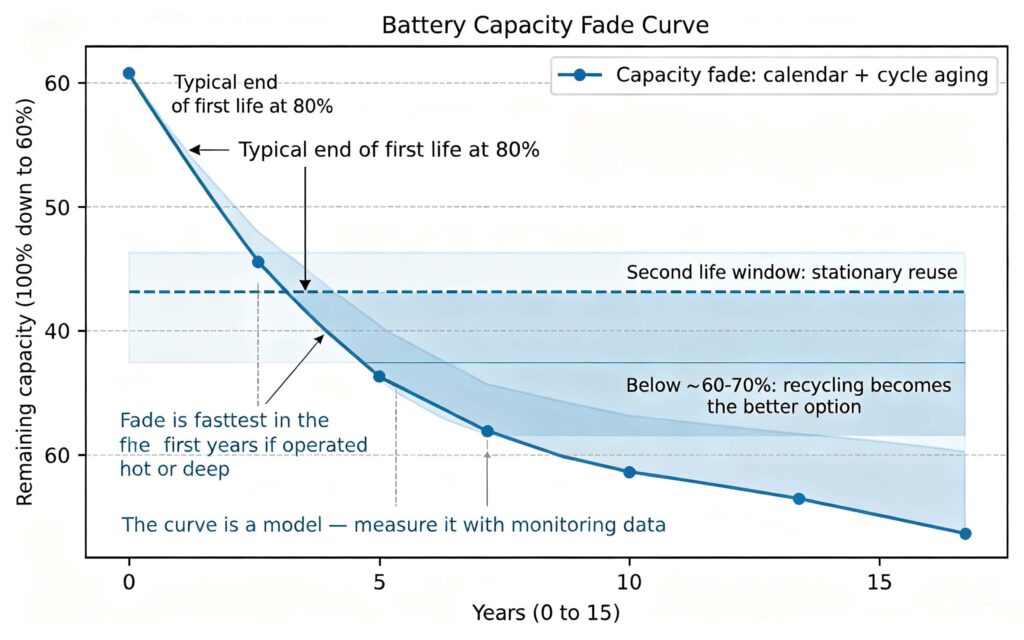
For lithium systems, the common planning horizon is 10-15 years of first life, defined by capacity fading to around 80% of initial under stated conditions. Calendar aging, temperature, depth of discharge and cycling rate all affect the actual life, so the number depends on operation, not just chemistry.
Q. What causes battery degradation over time?
Temperature, depth of discharge, high-rate cycling and time at high state of charge are the main drivers. Sustained heat and deep cycles accelerate both calendar and cycle aging; sitting at full charge for long periods also wears the battery. Managing these factors is the core of lifecycle value.
Q. When should a battery be retired or given a second life?
When measured capacity falls to around 80% of initial, the battery may no longer suit its first-life duty; between roughly 60-80% it can serve a second life in less demanding stationary roles, and below that recycling becomes the better option. The decision should be based on measured capacity data, not a calendar guess.
Q. How do I extend the lifecycle of my storage system?
Keep cells in their temperature window, avoid unnecessary deep cycles, match the duty to the design C-rate, avoid prolonged sitting at full charge, and follow the maintenance schedule — inspections, cleaning, retorque and firmware updates. Model degradation from year one and measure capacity over time so you manage the curve, not discover it.
Next step: plan the end before the first charge
Energy storage value is delivered over a 10-15 year lifecycle, and the decisions that protect it — degradation model, operating rules, service plan, measurement and end-of-life route — are made before installation, not after. Plan the lifecycle and the system pays for itself twice.
- Know the components with #52
- Start the lifecycle right with #111
- Plan the end of life with #94
- Ask leekooenergy for a lifecycle plan with your system: modelled degradation curve from your operating assumptions, warranty throughput and service terms, capacity testing schedule, and the second-life or recycling route — so the energy storage lifecycle is planned before the first charge, not discovered after the tenth year