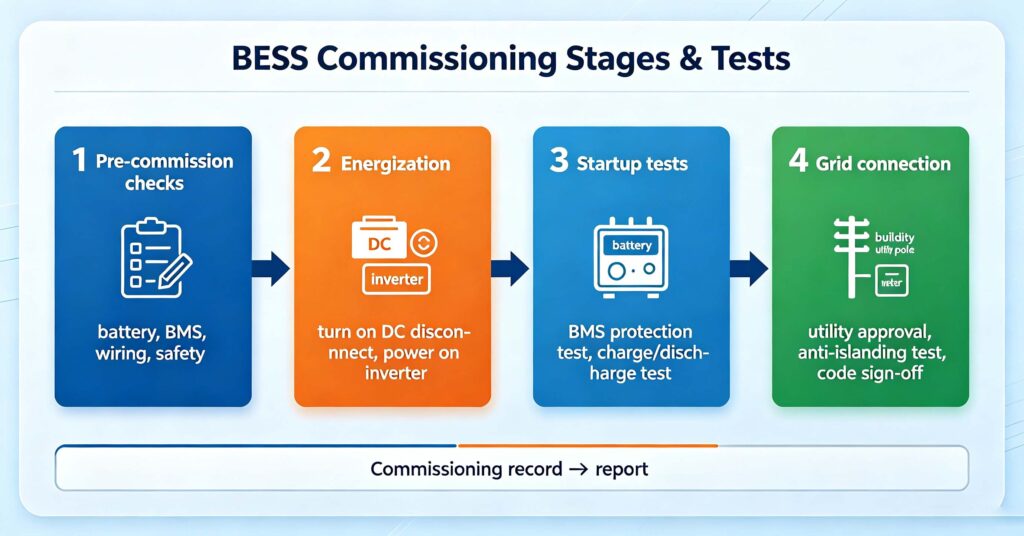
BESS commissioning is the formal process of verifying that a battery energy storage system is correctly installed, safe to operate, and ready for grid connection, carried out in four stages: pre-commission checks (confirming the physical installation, wiring, torque, grounding and settings against the design), energization (powering up the DC battery side and the AC inverter side in a controlled sequence), startup and performance tests (checking the BMS protection functions, charge/discharge operation, communication, and rated power), and grid connection (with utility approval, anti-islanding and protection tests, and final code sign-off). Commissioning is different from simply turning the system on: it is a recorded, test-by-test verification that the system behaves as designed and fails safely. The key tests are: continuity and insulation of the DC and AC wiring, correct polarity and voltage at each node, BMS communication and protection response (overvoltage, overdischarge, overcurrent, temperature), a controlled charge and discharge at rated power, and, for grid-tied systems, anti-islanding and grid protection settings confirmed with the utility. A complete BESS commissioning produces a signed record with all test results, which is required for warranty validity, insurance and local code sign-off. Skipping or rushing commissioning risks undetected wiring errors, protection misconfiguration, or a grid-connection rejection. For the pre-install assessment that comes before commissioning, see #110 battery installation site assessment.
Turning on a battery storage system is the end of installation, not the end of the job. BESS commissioning is the disciplined verification that the system is safe, works as designed, and satisfies the utility and the code before it enters daily operation. This guide walks through the four commissioning stages, the key tests, and the grid connection requirements. For the installation process that precedes it, see #13 home battery installation: process and cost.
Stage 1: Pre-commission checks
Before any power is applied, the system must be verified against the design. This stage catches physical and wiring errors while they are still cheap to fix.
Key checks: the battery, BMS and inverter are the models and ratings specified; all connections are torqued to spec and correctly polarized; DC and AC wiring continuity and insulation are verified; grounding and bonding are correct; the enclosure and clearances match the design; and all safety devices (disconnects, breakers, fuses) are present and rated correctly. Also confirm firmware versions and that the BMS and inverter settings (voltage, current, capacity, protocol) match the system. The result is a signed pre-commission checklist.
Stage 2: Energization
Energization powers the system up in a controlled sequence so that any fault appears at the lowest-risk point, not during full operation.
The sequence typically starts with the DC side: close the battery disconnect, confirm the BMS wakes up, reads cell voltages, and reports healthy status. Then energize the AC side through the inverter, confirming the input voltage and the inverter’s startup. On hybrid or grid-tied systems, the inverter then synchronizes with the grid before closing its connection. During energization, watch for voltage drops, alarms, or a BMS protection trip — any of these stops the sequence for investigation. The sequence is documented stage by stage.
Stage 3: Startup and performance tests
With the system energized, the commissioning tests verify that the BMS, inverter and battery work together and that the system delivers its rated power.
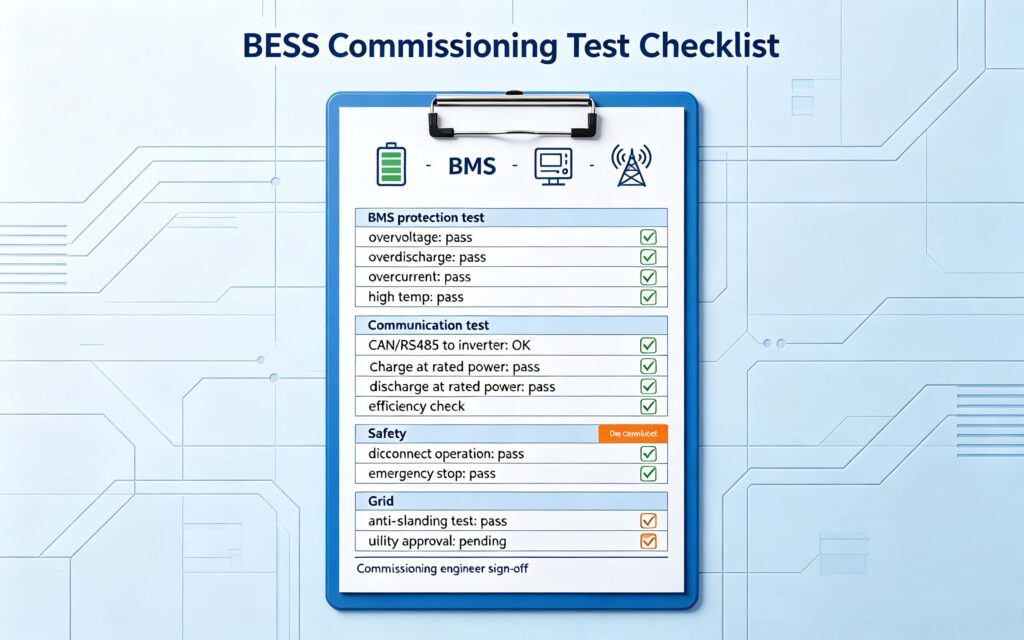
The core tests: BMS protection response (temporarily or by simulation verify overvoltage, overdischarge, overcurrent and temperature protection each open the circuit as designed); communication (confirm the BMS and inverter exchange state-of-charge and status correctly over CAN or RS485); and a charge/discharge test (charge the battery at rated power, confirm the pack reaches the target state of charge without a protection trip, then discharge at rated power and confirm the delivered energy and efficiency meet spec). If any test fails, the cause is corrected and the test rerun. The tests are recorded with values.
Stage 4: Grid connection and final sign-off
The last stage connects the commissioned system to the grid and completes the paperwork for code and warranty.
Grid connection: the utility reviews the interconnection application and may witness the connection; the system passes anti-islanding and grid protection tests (the inverter must disconnect when the grid drops); the metering and export settings are confirmed; and the system receives permission to operate. Final sign-off: the commissioning record, test results, and the signed checklist are kept for warranty, insurance and the Authority Having Jurisdiction. For the design and sizing that feed into commissioning, see #61 battery energy storage system design.
What to confirm in the commissioning record
A proper BESS commissioning leaves a record that proves the system is safe and works. Confirm it captures the following before the job is closed.
- Identification: system model, serial numbers, firmware versions, and the commissioning date and engineer.
- Pre-commission results: continuity, insulation, polarity, torque, grounding and safety-device checks.
- Energization log: the sequence performed and any alarms or trips during startup.
- Test results: BMS protection, communication, and charge/discharge at rated power with measured values.
- Grid documents: utility approval, anti-islanding and protection test results, and code sign-off.
For maintaining the system after commissioning, and for understanding the components being tested, see #84 solar battery maintenance and #52 BESS components: battery, PCS, BMS and EMS.
Q. What is BESS commissioning?
It is the formal process of verifying that a battery energy storage system is correctly installed, safe and ready for grid connection, done in four stages: pre-commission checks, energization, startup and performance tests, and grid connection. Commissioning produces a signed record with test results, required for warranty, insurance and code sign-off. It differs from just turning the system on because it verifies each function test-by-test.
Q. What tests are done during BESS commissioning?
The core tests are: continuity and insulation of the DC and AC wiring, polarity and voltage at each node, BMS protection response (overvoltage, overdischarge, overcurrent, temperature), BMS-inverter communication, and a charge/discharge test at rated power checking delivered energy and efficiency. For grid-tied systems, anti-islanding and grid protection tests are also run with the utility. Each test is recorded with its measured value.
Q. How long does BESS commissioning take?
It depends on system size and complexity. A residential system often takes a few hours to a day for pre-checks, energization and basic tests. A commercial or utility system can take several days to weeks, including performance tests, utility witnessing and anti-islanding verification. The schedule depends on the number of tests, system size and whether the utility witnesses the connection. Plan for it rather than rushing startup.
Q. Why is anti-islanding testing required?
Anti-islanding is a safety function that makes the inverter disconnect from the grid when the grid goes down, preventing it from back-feeding an apparently “dead” line and endangering utility workers. Testing verifies the inverter detects a grid loss and disconnects within the required time. It is a grid connection requirement for all grid-tied storage and is verified during commissioning, often with the utility present.
Q. Can a BESS run without formal commissioning?
It can physically start, but it should not be operated without commissioning. Running a system that has not passed its protection and safety tests risks undetected wiring errors, misconfigured protection, or a grid connection that fails inspection. Most manufacturers require commissioning for the warranty, insurers and authorities need the record, and the performance tests confirm the system actually delivers its rated power. Commissioning is the safety and warranty gate.
Next step: commission your system with a complete test record
BESS commissioning is the gate that turns an installed system into a safe, warranty-valid, grid-approved one. Pre-checks, energization, startup tests and grid connection each verify a specific part, and the signed record protects your warranty, insurance and code compliance. Commission properly and document every test.
- Run the pre-install site assessment in #110
- Follow the installation process in #13
- Know the components being tested in #52
- Ask leekooenergy for a BESS commissioning package that includes: a commissioning checklist for your system model, the correct energization sequence for your battery and inverter, the BMS protection and communication test procedure, charge/discharge test guidance at rated power, grid connection and anti-islanding requirements, and a commissioning record template — so your system is verified safe, warranty-valid and grid-approved before it enters daily operation