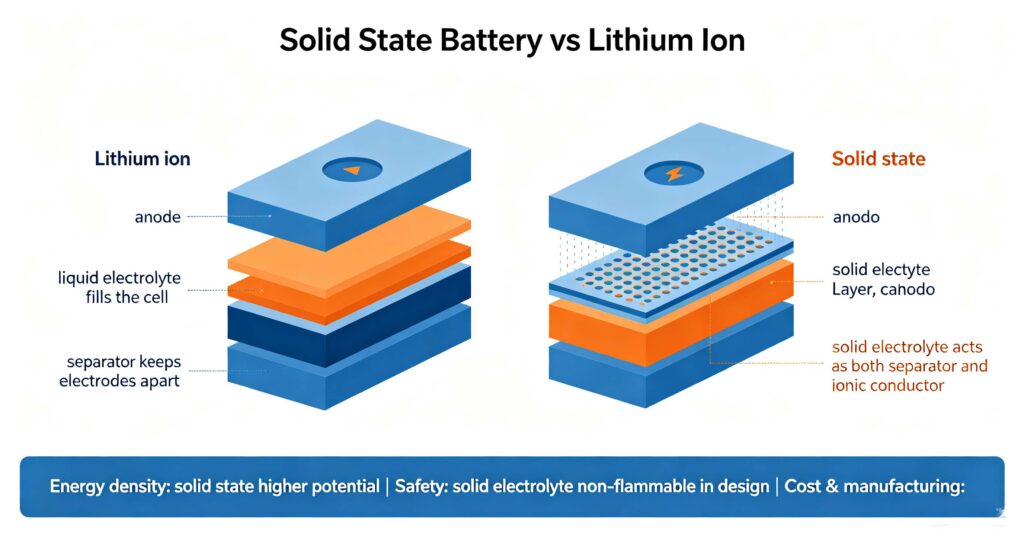
The core difference between a solid state battery vs lithium ion battery is the electrolyte: lithium-ion cells use a liquid or gel electrolyte that fills the cell and is held apart by a separator, while solid-state cells replace that with a solid electrolyte layer that both separates the electrodes and conducts ions. In theory that design promises higher energy density, better safety (a solid electrolyte does not burn or leak the way liquid does) and longer cycle life; in practice, solid-state cells are still more expensive to produce, harder to scale, and mostly limited to small-format and demonstration products rather than commercial energy storage. For storage buyers, the practical answer today is that lithium-ion — and specifically LiFePO4 for stationary storage — remains the commercially mature choice, while solid-state is a technology to track rather than to spec into a project yet. The comparison is real, but the timeline matters more than the chemistry.
Anyone reading about the next generation of batteries meets the same claim: solid-state will replace lithium-ion. The honest version is more useful. This guide compares the two at the chemistry level, then at the level that matters for buyers — cost, manufacturing maturity and what it means for energy storage. For the basics of how lithium-ion works, see #59 what is a lithium ion battery first.
How the two chemistries actually differ
Both families are lithium batteries, and the solid state battery vs lithium ion difference is the medium the lithium ions travel through.
Lithium-ion: a liquid electrolyte carries ions between the anode and cathode, and a porous separator prevents physical contact while letting ions pass. The liquid is what makes the cell manufacturable at scale, and also what makes it flammable if damaged or overcharged.
Solid-state: a solid electrolyte — ceramic, sulfide or polymer based — performs both roles: it separates the electrodes and conducts ions. Removing the liquid removes the fire and leakage path in design, and allows the cell to use higher-energy electrode materials that liquid electrolytes could not tolerate.
The solid state battery vs lithium ion gap is not “better vs worse” in every dimension; it is a set of trade-offs that are still being resolved in manufacturing. For how the existing lithium-ion types compare with each other, see #67 types of lithium ion batteries.
Solid state battery vs lithium ion: head-to-head
The comparison changes depending on whether you are reading a research paper or a purchase order. This table separates potential from present state.
| Dimension | Lithium-ion (current) | Solid-state (potential) |
|---|---|---|
| Energy density | Mature, well characterized | Higher on paper, partially demonstrated |
| Safety profile | Liquid electrolyte can burn; managed by BMS and design | Solid electrolyte non-flammable in design; interfaces still being proven |
| Cycle life | Proven across chemistries, LiFePO4 strongest | Promising in lab, long-term field data limited |
| Manufacturing maturity | Gigafactory scale, low cost | Small scale, higher cost, yield challenges |
| Cost | Falling, commodity-level for common formats | Still significantly higher per kWh |
For stationary storage specifically, the comparison favors the mature chemistry today: storage values cycle life and cost over raw energy density, which is exactly where liquid LiFePO4 is strongest. See #33 LiFePO4 vs lithium-ion (NMC) for why that chemistry wins in storage.
What the safety advantage really means
The safety claim is the most repeated argument for solid state, and it deserves precision.
A solid electrolyte removes the flammable liquid, which removes one major failure path in the solid state battery vs lithium ion comparison — thermal runaway fed by the electrolyte. That is a genuine design advantage. What it does not mean is that solid-state cells are immune to failure: interfaces between solid materials degrade, internal shorts are still possible, and the thermal management story is different, not absent.
For stationary systems, the practical safety work is already being done with liquid chemistry through BMS design, enclosure, fire suppression and installation requirements — the topics covered in #87 battery thermal runaway and fire safety. The safety comparison that matters for a storage buyer is the system-level one, not the cell-level one.
When solid state makes sense for energy storage
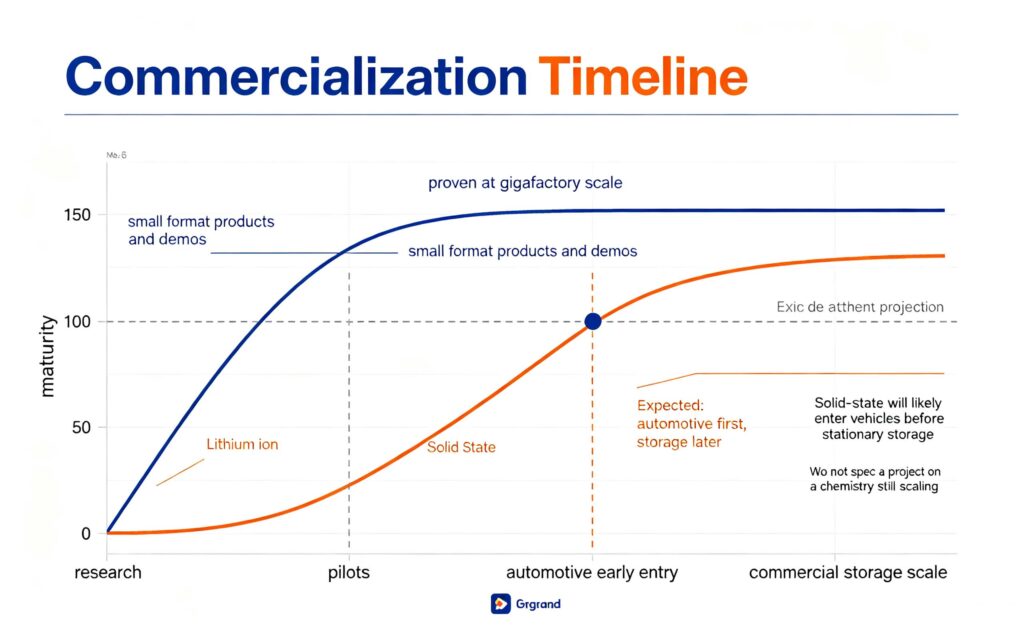
The honest timeline for storage buyers: solid-state cells will likely reach commercial vehicles first, because the energy density premium is worth more per kilogram there, and stationary storage second, because storage values cost and cycle life over density.
Watch, do not spec: track production announcements, yield improvements and field data. The moment solid-state pricing approaches liquid chemistries with comparable cycle life, the storage case reopens.
Today’s purchase decision: for a project you are buying now, the commercially proven chemistry with documented cycle life and field performance is the defensible choice. For how that choice lands in practice across chemistries, see #24 lithium vs lead-acid switching decisions for the other side of the battery chemistry landscape.
Q. Is a solid state battery better than lithium ion?
It depends on the metric and the timeline. In design, solid-state offers higher potential energy density and a non-flammable electrolyte, which are real advantages. In practice, lithium-ion is cheaper, manufactured at scale, and proven across years of field use, which is why it still wins commercial decisions. Solid-state is better in specific future scenarios, not better in every way today.
Q. What is the difference between solid state and lithium ion batteries?
The difference is the electrolyte: lithium-ion uses a liquid or gel electrolyte with a separate separator, while solid-state uses a solid electrolyte layer that both separates the electrodes and conducts ions. That change removes the flammable liquid and enables higher-energy electrode materials in design, but it also creates new manufacturing and interface challenges. Both are lithium batteries; the chemistry medium is what differs.
Q. Why are solid state batteries not widely used yet?
Production cost and manufacturing yield are the main barriers. Solid electrolytes are harder to process at scale than liquid filling, and the interfaces between solid materials are harder to control, which limits yield and raises cost per cell. Scale-up is progressing, but commercial volumes remain small and are expected to reach vehicles before stationary storage.
Q. Are solid state batteries safer than lithium ion?
In design, yes: a solid electrolyte removes the flammable liquid electrolyte that feeds thermal runaway in liquid cells. In practice, solid-state cells still face interface degradation, internal short risks and their own thermal management needs. For storage buyers, system-level safety — BMS, enclosure, fire suppression and installation — matters more than the cell-level chemistry comparison.
Q. When will solid state batteries be used in energy storage?
The likely sequence is commercial vehicles first, then stationary storage, because vehicles pay a premium for energy density while storage values cost and cycle life. There is no fixed date; it depends on yield improvement and cost reduction at scale. Storage buyers should track production announcements and field data, and continue specifying proven chemistries for projects being built now.
Next step: build on chemistry that is proven
Solid state battery vs lithium ion is a real comparison with a real timeline — and for storage projects being bought today, the proven chemistry still wins on cost, cycle life and field data. Track the technology, but spec the project on what is commercially mature.
- Compare storage chemistries in #33
- Understand the baseline in #59
- Review system safety in #87
- Ask leekooenergy for the chemistry data behind its storage products: cycle life tests, safety documentation and field performance — so your project decision rests on evidence, not headlines