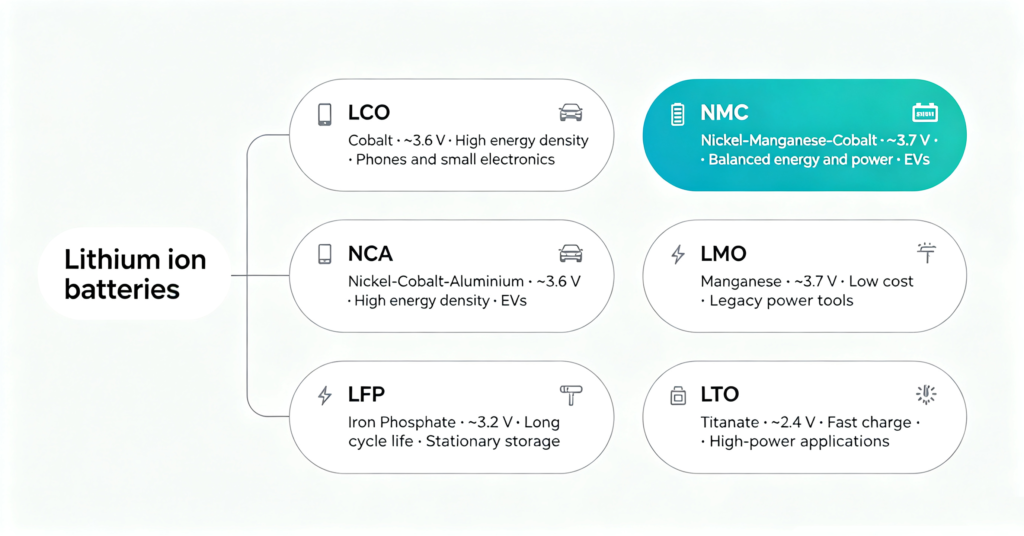
There are six commercial types of lithium ion batteries, and they are named after the cathode chemistry that stores the energy: lithium cobalt oxide (LCO), lithium manganese oxide (LMO), nickel manganese cobalt (NMC), nickel cobalt aluminium (NCA), lithium iron phosphate (LFP) and lithium titanate (LTO). The type decides the trade-off between energy density, cycle life, cost, safety and charge speed. The one-line version worth quoting: for stationary energy storage, LFP is today’s default choice because it trades a little energy density for long cycle life, thermal stability and a supply chain free of cobalt, while NMC and NCA dominate electric vehicles where light weight matters more.
Most buyers never compare chemistry families directly; they compare two product names, such as LFP versus NMC, and miss the wider picture. That is a mistake, because the same lithium-ion umbrella covers chemistries that behave very differently under a storage duty cycle. If you understand how the families are defined, you can read any datasheet, spot which chemistry you are actually being offered, and argue with a supplier about whether it fits your use case. This guide lays out all six families, explains why cathode chemistry is the dividing line, and finishes with a clear answer on what to choose for solar and commercial storage. For the basic operating principle behind all of them, start with #59 what is a lithium ion battery.
The six types of lithium ion batteries at a glance
Every lithium-ion cell has the same skeleton — two electrodes and an electrolyte that shuttles lithium ions — and the personality of the cell comes almost entirely from the positive electrode material. The table below compresses the differences that matter to a buyer.
| Type | Full name | Nominal cell voltage | Key strength | Typical home |
|---|---|---|---|---|
| LCO | Lithium cobalt oxide | 3.6–3.7 V | Highest energy density | Smartphones, laptops |
| LMO | Lithium manganese oxide | 3.7 V | High power, low cost | Legacy power tools, early EVs |
| NMC | Nickel manganese cobalt | 3.6–3.7 V | Balanced energy and power | EVs, some grid storage |
| NCA | Nickel cobalt aluminium | 3.6 V | High energy, EV-tuned | EVs (pioneered for long range) |
| LFP | Lithium iron phosphate | 3.2 V | Cycle life and safety | Solar storage, ESS, some EVs |
| LTO | Lithium titanate | 2.3–2.4 V | Extreme cycle life and fast charge | High-power grid services, cold sites |
Note the voltage column: LFP sits at 3.2 V and LTO at around 2.3 V, while the cobalt and nickel families sit near 3.6–3.7 V. That is why a “48 V” LFP pack is usually built from 15 or 16 cells and a “48 V” NMC pack from only 13 — the chemistry changes the count. Understanding this helps you compare capacity numbers across suppliers instead of assuming equal packs. The wider system picture — where these chemistries appear inside a storage installation — is covered in #11 types of energy storage systems.
Why the cathode defines the type
A lithium ion battery stores energy by moving lithium ions between two electrodes. On discharge, ions leave the negative electrode (usually graphite) and travel through the electrolyte into the positive electrode; charge reverses the journey. The positive electrode material is what chemists call the cathode, and swapping that one material is enough to change voltage, energy density, safety margin and price. The anode and electrolyte matter too — LTO, unusually, replaces the graphite anode with lithium titanate — but the shorthand industry uses is to name the whole battery after the cathode. That naming is why “lithium ion” alone tells you very little until you know the type. The physical layout and components inside a cell are described in #63 what is inside a lithium ion battery.
LCO and the cobalt-family cathodes
Lithium cobalt oxide is the original commercial lithium-ion chemistry, and it still wins wherever volume matters more than anything else — phones and laptops. Its energy density is excellent, but cobalt is expensive, its thermal runaway threshold is the lowest of the family, and cycle life is modest, so LCO never became a storage chemistry. NMC was developed to reduce cobalt and raise stability by blending nickel (energy) and manganese (stability). Modern NMC variants such as NMC 622 and NMC 811 shifted the balance toward nickel, giving EVs long range at acceptable cost. NCA is the same family idea tuned by a different blend and is strongly associated with EV manufacturers that pioneered long-range packs. For a storage buyer, the relevant question is not whether NMC is good — it is — but whether its energy-density advantage is worth the shorter cycle life and higher cell cost once the battery stops moving and sits on a rack. That trade-off is examined head-to-head in #33 LFP vs NMC.
LFP: the chemistry that took over stationary storage
Lithium iron phosphate trades energy density for the three things a fixed installation actually needs. First, cycle life: LFP cells are routinely rated for thousands of cycles at deep discharge, which is what a daily-cycling storage system demands. Second, thermal stability: the olivine crystal structure releases oxygen far less readily than nickel-rich cathodes, giving a higher thermal runaway threshold and a wider safety margin inside a rack. Third, materials: no cobalt and no nickel, which stabilises cost and supply chains. The price for these advantages is a lower nominal voltage (3.2 V per cell) and lower energy density, so an LFP pack of the same kWh weighs more and needs more cells than an NMC pack. For stationary storage, that penalty is usually irrelevant — the battery does not carry itself. The full buyer-oriented treatment of LFP, including quality checks and sourcing, is in #01 lithium iron phosphate batteries guide, and the cell-level choice between LFP sizes is in #25 LFP cells 280Ah vs 314Ah.
LTO and the niche chemistries worth knowing
Lithium titanate replaces the graphite anode, which changes the battery’s character more than most cathode swaps: it tolerates very high charge rates, survives far more cycles, works in deep cold and is extremely safe, but it delivers low voltage and low energy density at a high cost. You meet LTO in grid services that need fast response, in some commercial peak-shaving applications where power matters more than energy, and in cold-climate sites. LMO is largely a legacy chemistry — high power but short life — and appears in older power tools and early electric vehicles rather than new storage designs. Two final points keep this complete without drifting off-topic: first, iron-air and other non-lithium chemistries are being developed for multi-day storage and are worth watching, as explained in #60 iron air battery explained; second, a supplier quoting “lithium battery” without a type name on the datasheet is a red flag, because the chemistry is the single biggest driver of price and lifetime.
Which types of lithium ion batteries fit energy storage?
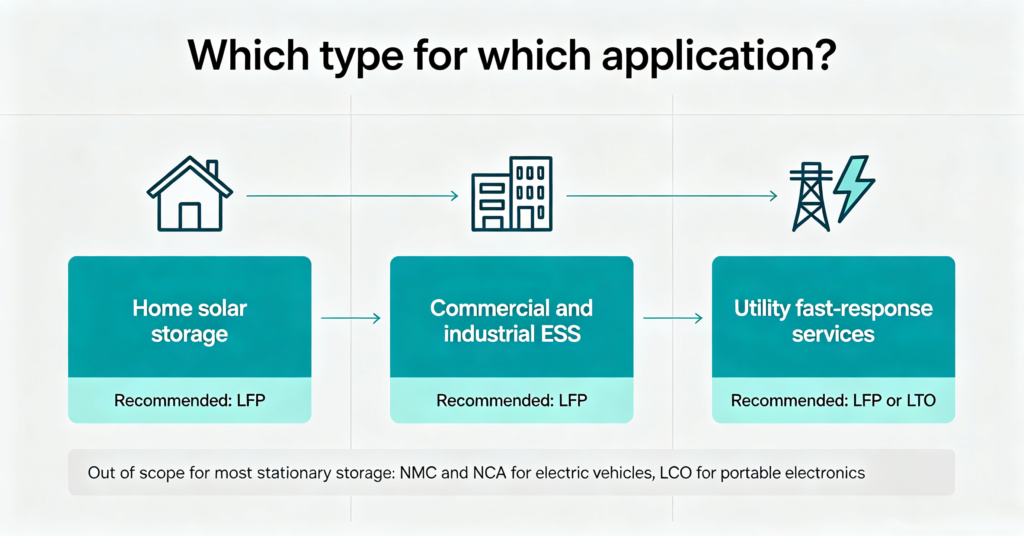
For solar home storage, commercial and industrial ESS, and most utility-scale projects, the practical ranking is short: LFP first, NMC a distant second for niche weight-sensitive or space-constrained sites, LTO for specialised high-power applications, and the rest effectively out of contention. The reasoning is that a storage battery is discharged and recharged far more often than an EV battery, so cycle life and safety dominate the economics; energy density, the EV priority, barely matters for a cabinet bolted to a floor. What you should actually compare when a supplier quotes LFP versus NMC is cycle life at your depth of discharge, the usable energy warranty, operating temperature range and price per kilowatt-hour over the warranty period — not the headline capacity. The decision framework by application — how many cycles different duty cycles demand and what that does to cost — is developed in #46 cycle life vs price. If your requirement is a single integrated storage product rather than a raw chemistry debate, the component map in #52 BESS components shows where the chemistry sits inside the complete system.
How to identify the chemistry before you buy
Three signals reveal the type of lithium ion battery you are being offered. The first is the datasheet voltage: a nominal cell voltage near 3.2 V points to LFP, near 3.6–3.7 V to a cobalt or nickel chemistry, and near 2.3 V to LTO; multiply by the cell count and you can reverse-engineer the pack. The second is the cycle-life claim: if a supplier promises several thousand cycles at 80% depth of discharge, the product is almost certainly LFP or LTO, because NMC warranties rarely reach those numbers. The third is certification documentation, where the cell model and chemistry are stated for transport and safety approvals — UN38.3 and the battery test summary name the cell and its chemistry. If a quotation refuses to name the cell type, treat it as a warning rather than a detail. The habit of verifying supplier claims with documents instead of brochures is exactly what #21 how to evaluate battery manufacturers is built around.
Q.What are the different types of lithium ion batteries?
The six commercial types are LCO, LMO, NMC, NCA, LFP and LTO, named after their cathode chemistry. LCO powers portable electronics, NMC and NCA power most EVs, LFP dominates stationary energy storage, and LTO serves specialised high-power, fast-charge and cold-climate applications.
Q.Which type of lithium ion battery is best for solar storage?
LFP is the default choice for solar and other stationary storage because it combines long cycle life, high thermal stability and a cobalt-free supply chain. Energy density, the main weakness of LFP, does not matter much when the battery is installed in a fixed cabinet.
Q.Is LFP safer than NMC?
Generally yes. LFP releases oxygen less readily at high temperature and has a higher thermal runaway threshold, which gives more time for a BMS and fire system to respond. Safety still depends on cell quality, the BMS and system design — chemistry alone is not a guarantee.
Q.What is an LTO battery used for?
Lithium titanate batteries are used where fast charging, very long cycle life or cold-weather operation matters more than cost or energy density, such as grid frequency-response services and high-power commercial applications. They are expensive per kilowatt-hour.
Q.Why do EVs use NMC while storage uses LFP?
An EV carries its battery, so energy density and weight decide range; NMC and NCA win there. A storage battery sits in a cabinet, so cycle life, safety and cost dominate the economics, which is why LFP wins stationary projects despite lower energy density.
Next step: check the chemistry before you check the price
A lithium ion battery quote without a named chemistry is incomplete. Learn to read the type first, then compare what the cycle life actually costs.
- Start with the operating principle in #59 what is a lithium ion battery
- See the storage decision framework in #46 cycle life vs price
- Compare LFP with NMC directly in #33 LFP vs NMC
- Ask leekooenergy for LFP cell and pack datasheets with the cell model, chemistry and cycle data stated — specifications you can verify instead of promises you cannot