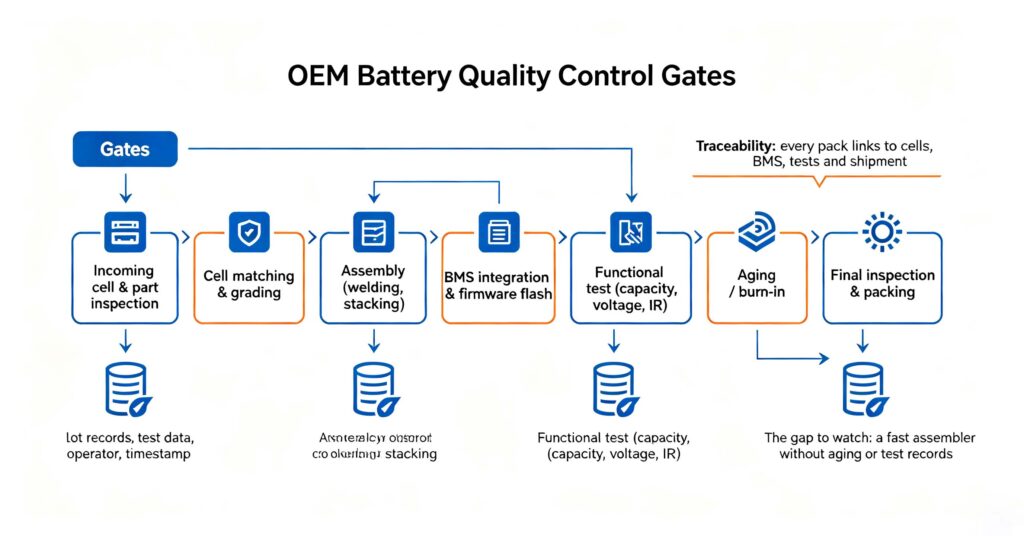
OEM battery quality control is the set of production gates — incoming inspection, cell matching, assembly checks, functional test, aging and final inspection — that catch defects before a pack ships, and it is only as good as the records behind it. The buyer-side question is not whether the factory says it does QC, but which gates run on every pack, what data each gate records, and whether the records link each pack to its cells, BMS, test results, operator and shipment. That link is traceability, and it is what turns a quality claim into something you can verify after a failure. The professional expectation for an OEM battery partner: batch-level incoming data, 100% functional testing with records you can sample, defined aging time, and a traceability code on every pack. The gap to watch is the fast assembler that can build packs but cannot produce the records that prove how they were built.
For an OEM buyer, the difference between a manufacturer and an assembler shows up in the quality records, not in the brochure. This guide walks through the QC gates that matter, the traceability structure that survives recalls, and the acceptance tests to witness before volume. For the broader manufacturer evaluation, see #21 how to evaluate battery manufacturers first.
OEM battery quality control: the QC gates that define a real production line
Each gate exists to catch a specific class of defect, and each one should have a defined pass/fail criterion and a record.
Incoming inspection: cells and BMS units arrive from suppliers with their own quality spread. Incoming checks — capacity, voltage, internal resistance, appearance — decide which cells enter production and how they are matched.
Cell matching and grading: cells grouped by capacity and internal resistance produce packs that stay balanced longer. The matching record is part of traceability and predicts pack life.
Assembly checks: welding quality, busbar torque, insulation and mechanical assembly. These are the gates that catch the workmanship defects that electrical tests may not reveal.
BMS integration and firmware: the BMS is configured and flashed to the pack’s parameters. The record shows which firmware version went into which pack — critical for later field updates.
For how the BMS role connects to pack safety, see #49 how a BMS protects batteries.
Functional testing, aging and the records that prove them
The tests that every pack must pass are the core of OEM battery quality control, and the records are the deliverable the buyer should actually receive.
| Test | What it verifies | What the record shows |
|---|---|---|
| Capacity test | Actual delivered capacity vs rating | Capacity value, test current, temperature |
| Voltage / IR check | Cell and pack integrity after assembly | Voltage balance, internal resistance spread |
| Functional / BMS test | Protection triggers, communication, charge-discharge behavior | Test log, firmware version, pass result |
| Aging / burn-in | Early failures surface before shipment | Aging time, temperature, cycle data |
| Final inspection | Cosmetic, label, packaging and documentation | Inspection sheet, photos, pack ID |
Ask which of these run on every pack and which run on samples only; the honest answer defines the batch risk. For the certification documents that should accompany the records, see #107 battery export certification explained.
Traceability: what to ask for and how to verify it
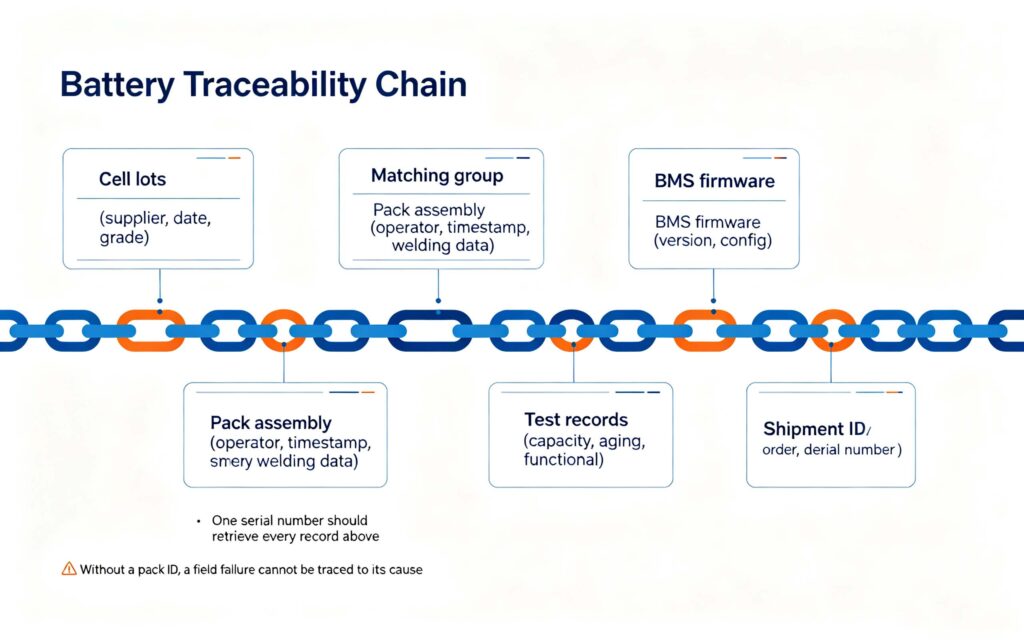
Traceability is the buyer’s insurance against a silent quality problem. The request is simple: prove that any pack can be traced to its build data.
- Pack ID: every pack carries a serial number or QR code that exists in the factory system, not just on a label.
- Cell lot linkage: the pack record includes the cell lots used — supplier, date, grade and matching group.
- Test record linkage: capacity, functional and aging results are attached to the pack ID, not kept in a folder somewhere.
- Sample verification: ask the factory to pull one pack’s full record from its serial number during an audit, and watch them do it live.
A factory that cannot retrieve a pack’s record in front of you does not have traceability; it has paperwork. For the OEM/ODM workflow that produces these records, see #98 custom battery packs: OEM ODM design guide.
Acceptance testing the buyer should witness
Before volume ships, the buyer should witness the acceptance tests defined in the contract — not accept a summary report.
Sample selection: agree how samples are drawn (random, from different production days) and how many are tested. Random sampling across batches reveals process drift that first-day samples hide.
Test witnessing: watch capacity and functional tests on the agreed samples, and compare the results to the datasheet tolerances in the contract.
Documentation check: verify that the shipped batch’s records — test logs, traceability files, certificates — match the agreed format before payment milestones.
The acceptance test list should be written into the contract before production, because it defines both the quality bar and the remedy if the batch fails. For the supplier-audit context around this, see #21 how to evaluate battery manufacturers again.
Common quality gaps in OEM battery projects
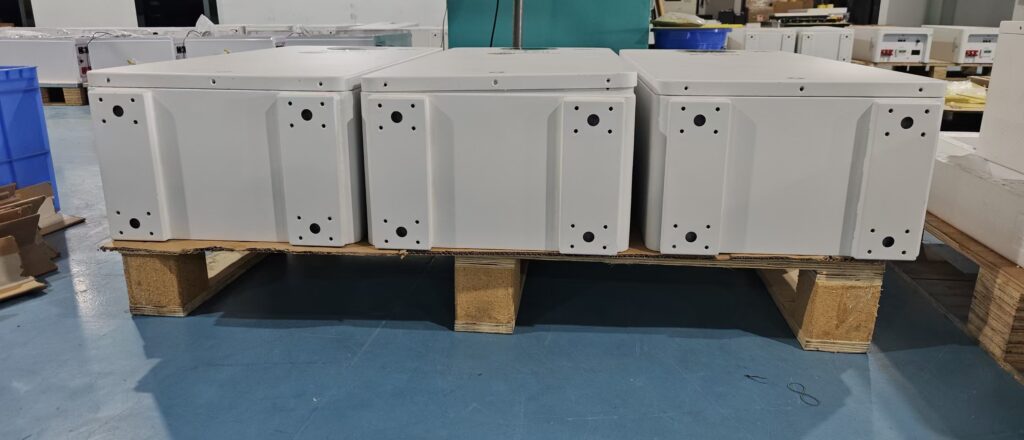
Most OEM quality problems share a small set of root causes that are visible at audit time.
Sample-only testing: a factory that tests capacity only on samples ships untested packs with a tested reputation.
No aging: skipping burn-in saves days and ships early failures to the buyer. Aging is where infant mortality shows up.
Paper traceability: records exist in folders but cannot be retrieved by pack ID. That is not traceability.
Firmware drift: BMS firmware versions change between orders; without version records, field behavior changes are untraceable. For related pack-design quality decisions, see #20 custom battery pack OEM/ODM from spec to mass production.
Q. What is OEM battery quality control?
OEM battery quality control is the system of production gates — incoming inspection, cell matching, assembly checks, functional test, aging and final inspection — that catch defects before shipment, plus the records that prove each gate ran. The buyer-side measure is not the factory’s claim but whether every pack carries test data and a traceability link. Sample-only testing and missing aging are the common gaps.
Q. Why is traceability important for battery OEM projects?
Traceability links every pack to its cells, BMS firmware, test results, operator and shipment, which is what makes a field failure diagnosable and a recall manageable. Without it, a quality problem can affect thousands of packs with no way to identify the cause or the affected batch. Buyers should verify traceability live by asking the factory to retrieve one pack’s full record from its serial number.
Q. What tests should an OEM battery factory run on every pack?
Every pack should pass functional testing (protection triggers, communication, charge-discharge behavior), a voltage and internal resistance check, and ideally an aging or burn-in run that surfaces early failures. Capacity testing should follow a defined sampling plan. The distinction that matters is which tests run on every pack versus on samples only, and the records should reflect that difference.
Q. How do I verify a battery factory’s quality control?
Audit the gates and the records together: confirm which tests run on every pack, watch the factory retrieve a pack’s traceability record live, and witness the acceptance tests on randomly drawn samples. Compare the results against the contract tolerances. A factory that can demonstrate records on demand has quality control; one that only describes it does not.
Q. What should be in an OEM battery acceptance test?
An acceptance test defines sample selection (random, across production days), the tests witnessed (capacity, functional, voltage and IR), and the documentation checked (test logs, traceability files, certificates). It should be written into the contract before production with a defined remedy if the batch fails. The test is the buyer’s last verification gate before payment milestones.
Next step: buy the records, not the claim
OEM battery quality control is verifiable: gates that run on every pack, tests you can witness, and traceability that survives a field failure. Audit the gates, watch the retrieval, and write the acceptance test into the contract before production starts. The factory that proves its records is the factory you can scale with.
- Run the full manufacturer audit in #21
- Review the OEM/ODM flow in #98
- Match the certifications in #107
- Ask leekooenergy for its OEM battery quality control package: the gate-by-gate QC flow, a live traceability demonstration from a pack serial number, and the acceptance test protocol it will sign before production