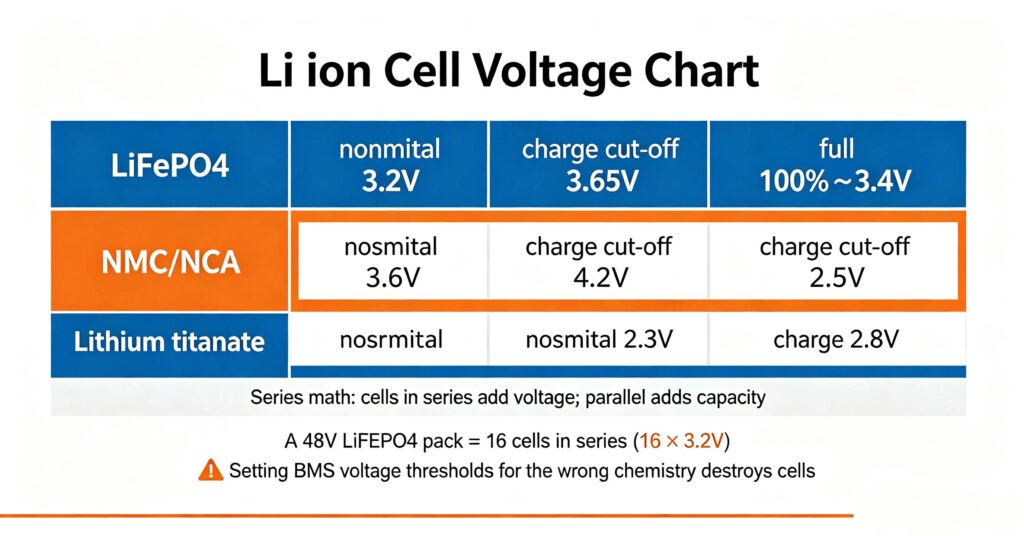
Li ion cell voltage is the single most important parameter in pack design: it determines how many cells in series make a 12V, 24V or 48V system, and it sets the over-voltage and under-voltage thresholds the BMS must enforce. For LiFePO4, the nominal li ion cell voltage is 3.2V, charge cut-off is 3.65V, and discharge cut-off is about 2.5V; for NMC it is 3.6V nominal, 4.2V charge and 2.5V discharge. Cells in series add voltage (16 × 3.2V = 51.2V nominal for a “48V” LiFePO4 pack); cells in parallel add capacity at the same voltage. Getting the BMS thresholds wrong for the chemistry is the fastest way to destroy cells.
For a pack builder, li ion cell voltage is not a label on a datasheet; it is the input that defines the series configuration and the BMS settings. This guide covers the key numbers, the series math and the BMS thresholds that protect the pack. For the BMS role in enforcing these thresholds, see #28 battery management system 101.
The key li ion cell voltage numbers by chemistry
The first thing to know about li ion cell voltage is that it differs by chemistry. Using one chemistry’s thresholds on another is a common and destructive mistake.
| Chemistry | Nominal voltage | Charge cut-off | Discharge cut-off |
|---|---|---|---|
| LiFePO4 | 3.2V | 3.65V | 2.5V |
| NMC / NCA | 3.6V | 4.2V | 2.5V |
| Lithium titanate (LTO) | 2.3V | 2.8V | 1.5V |
The flat voltage curve of LiFePO4 (3.2V across most of the charge range) is why state of charge cannot be read directly from a single voltage reading the way a lead-acid battery can. For how the system voltage choice connects to this, see #35 48V lithium batteries explained.
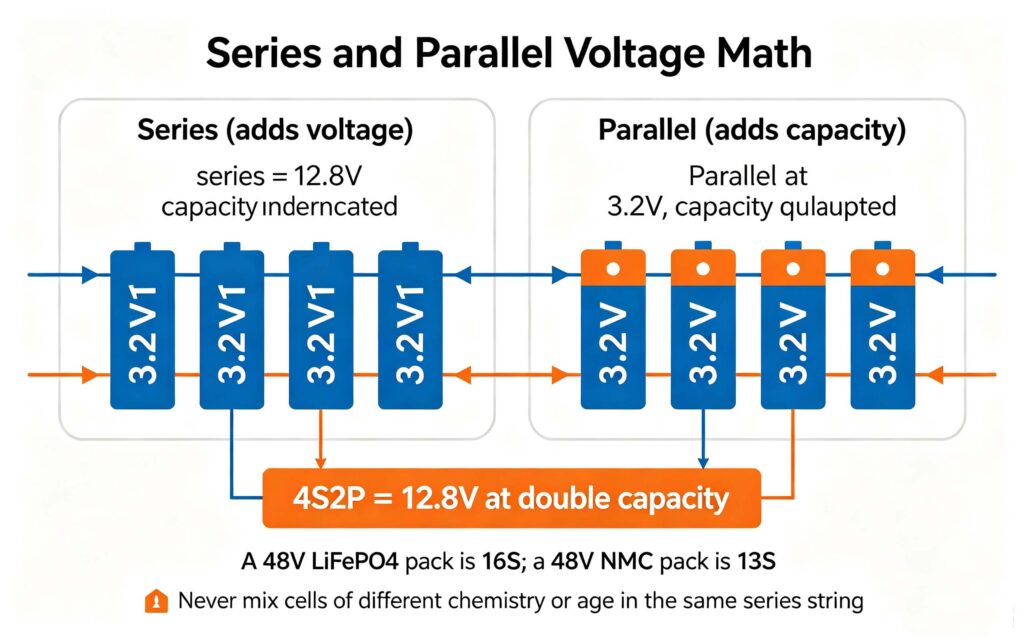
Series and parallel: the li ion cell voltage math
Pack voltage is built by combining cells. The two configurations follow simple rules, and mixing them wrong produces an unsafe pack.
Series (S): cells in series add their voltages. A 12.8V system uses 4 LiFePO4 cells in series (4S); a 24V system uses 8S; a “48V” LiFePO4 system uses 16S (16 × 3.2V = 51.2V nominal). Capacity stays the same as one cell.
Parallel (P): cells in parallel add their capacity at the same voltage. Two cells in parallel double the Ah rating but keep the same voltage. This is how you reach larger pack capacities without changing voltage.
Series-parallel matrix: “16S2P” means 16 cells in series for voltage, 2 in parallel for capacity. The BMS must monitor every series cell’s voltage individually. For how the BMS does this, see #106 active vs passive cell balancing.
BMS voltage thresholds that protect the pack
The BMS enforces the chemistry’s voltage limits. Setting them wrong is a leading cause of cell damage, and it happens more often than hardware failure.
- Over-voltage protection (OVP): charges stop when the highest cell reaches the chemistry’s charge cut-off (3.65V for LiFePO4, 4.2V for NMC).
- Under-voltage protection (UVP): discharge stops when the lowest cell reaches the discharge cut-off (typically 2.5V for both LiFePO4 and NMC).
- Cell balancing: as cells drift apart in voltage over cycles, balancing brings them back toward a common level. Passive balancing bleeds energy; active balancing transfers it.
- Pack voltage vs cell voltage: the pack voltage shown on the inverter is the sum of all series cells; the BMS monitors each one individually, and a single weak cell determines when protection triggers.
For choosing the right BMS for the pack voltage, see #32 how to choose a LiFePO4 BMS.
Q. What is the nominal voltage of a lithium ion cell?
The nominal voltage depends on chemistry: LiFePO4 is 3.2V, NMC/NCA is 3.6V, and lithium titanate is 2.3V. The nominal voltage is the average voltage across the useful charge range, not a single reading. A “48V” LiFePO4 pack uses 16 cells in series (16 × 3.2V = 51.2V nominal), while a 48V NMC pack uses about 13 cells in series.
Q. What voltage should I charge a LiFePO4 cell to?
A LiFePO4 cell should be charged to a cut-off of 3.65V per cell, not 4.2V. Charging to 4.2V — the NMC standard — damages LiFePO4 cells and shortens life. The BMS must be set to the chemistry-specific charge cut-off; setting it to 4.2V for a LiFePO4 pack is a common and destructive configuration error.
Q. How many cells are in a 48V lithium battery?
It depends on chemistry. A 48V LiFePO4 pack uses 16 cells in series (16S, giving 51.2V nominal), while a 48V NMC pack uses about 13 cells in series (13S, giving about 48V nominal). The “48V” label is a system voltage class, not the exact cell count. Always confirm the chemistry before counting series cells.
Q. Why can’t I read state of charge from LiFePO4 voltage?
Because LiFePO4 has a very flat voltage curve: it holds near 3.2V across most of its charge range, then drops sharply at the end. Unlike lead-acid, where voltage correlates roughly with state of charge, a single LiFePO4 voltage reading cannot tell you whether the pack is at 30% or 70%. State of charge in LiFePO4 systems is estimated by the BMS using coulomb counting and other methods, not by voltage alone.
Q. What BMS voltage settings protect a lithium pack?
The BMS must enforce the chemistry-specific over-voltage and under-voltage thresholds: charge stops at the charge cut-off (3.65V for LiFePO4, 4.2V for NMC) on the highest cell, and discharge stops at the discharge cut-off (typically 2.5V) on the lowest cell. It must also monitor every series cell individually, because a single weak cell determines when protection triggers. Setting thresholds for the wrong chemistry is a leading cause of premature cell failure.
Next step: configure voltage before you build
Li ion cell voltage defines the series count, the pack class and the BMS thresholds. Confirm the chemistry, count the series cells, and set the BMS voltage limits before charging the pack for the first time. A correctly configured pack protects cells; a misconfigured one destroys them.
- Understand the BMS in #28
- Choose system voltage in #35
- Select the BMS in #32
- Ask leekooenergy for a pack with the chemistry-matched BMS voltage settings configured and documented, so the protection thresholds match the cells before the system ships