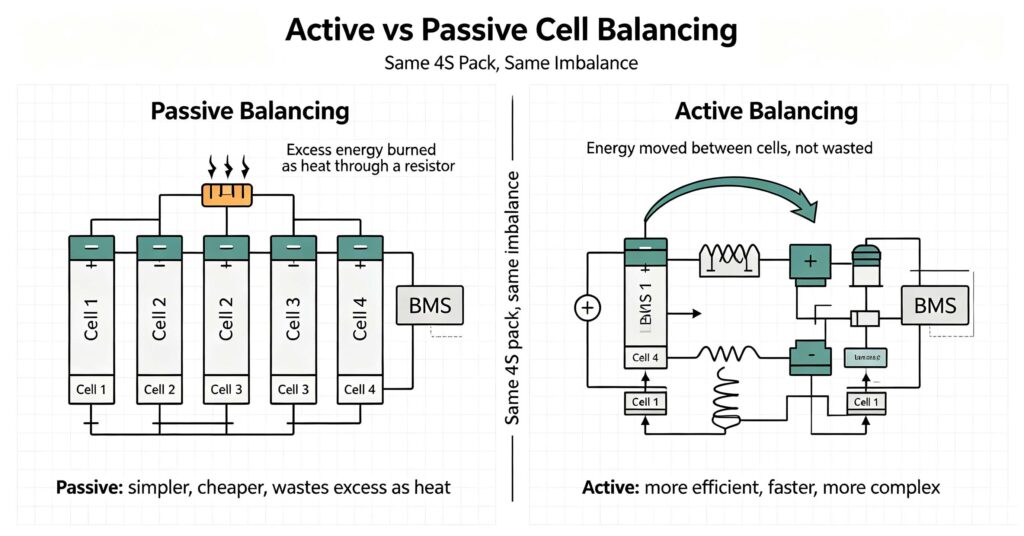
Active vs passive cell balancing describes the two ways a battery management system (BMS) equalises the state of charge of individual cells in a series pack. Passive balancing burns excess energy from the highest-charged cell through a resistor as heat, bleeding it down to match the others; active balancing moves energy from the higher cells to the lower cells using a capacitor, inductor or DC-DC converter, so little energy is wasted. Passive balancing is simpler, cheaper and adequate for most packs where cells start well matched and are charged slowly, so it is the default on most consumer and many commercial BMS units. Active balancing is more efficient (energy is transferred, not burned), balances faster and keeps large packs closer to full usable capacity, which matters for big LiFePO4 packs, high charge rates, and packs with cells that age unevenly. The trade-off is cost and complexity: an active balancing BMS costs more and needs more board space. For most 48V/51.2V LiFePO4 packs used in solar storage, passive balancing is usually sufficient, while active balancing earns its extra cost in large, high-rate or long-lived systems. The practical answer depends on pack size, charge current, cell matching, and how much usable capacity you can afford to lose to imbalance.
Every lithium battery pack is only as good as its weakest cell. Because cells in a series string must charge and discharge as a group, one cell that is slightly ahead or behind limits the whole pack’s usable energy. Cell balancing is the BMS function that corrects this. This guide compares active and passive cell balancing in depth, explains when each is worth it, and gives a decision framework for battery pack designers, integrators and buyers. For a broader look at what a BMS does, see #28 battery management system 101.
Why cell balancing matters in a battery pack
Cell balancing exists because no two cells are identical. Even cells from the same batch have small differences in capacity, internal resistance and self-discharge, and these grow as the battery ages, is charged at different rates, or runs at different temperatures. Without balancing, the pack’s usable capacity is set by the weakest cell, so a pack that is 90% full might only deliver 80% because one cell hits its limit first.
Imbalance shows up in two ways. Charge imbalance: when charging, the highest cell reaches its upper voltage limit first, forcing the BMS to stop the whole pack before the lower cells are full. Discharge imbalance: the lowest cell hits the low cutoff first, ending the discharge early. Both shrink usable energy. Balancing reduces this loss by keeping cells at similar states of charge.
How passive cell balancing works
Passive balancing, also called resistive balancing, bleeds excess energy off the highest-charged cell as heat. During the charging (often the CV stage) or when the pack is idle, the BMS turns on a bypass resistor across the highest cell, drawing current from it until it matches the others. The excess energy is simply dissipated as heat.
The passive balancing current is small — typically 0.03A to 0.2A on most BMS units, up to 1A on a few. Because it is slow and only handles the highest cell, passive balancing works best when cells start well matched and charging is slow enough to give it time. It is the cheapest and most reliable method, with no moving parts beyond the resistor and a switch, and it suits packs where the imbalance is small. Its limitation is that it wastes energy as heat, works slowly on large imbalances, and cannot correct a pack that has drifted far.
How active cell balancing works
Active balancing moves energy from higher cells to lower cells instead of burning it. A capacitor-based (charge shuttling) balancer, an inductor-based (adjacent-cell transfer) balancer, or a DC-DC converter takes charge from the highest cell and transfers it to the lowest. This is far more efficient: instead of wasting the excess as heat, it is reused to fill the lower cell.
Active balancers move more current — typically 0.5A to 5A, sometimes more — so they correct larger imbalances much faster. They are also more efficient (energy is conserved), which can add usable capacity, especially in large packs and at high charge/discharge rates. The costs are higher price, more complex circuitry, larger board footprint, and slightly more components that could fail. Active balancing makes the most sense in large packs (over a few kWh), high-rate systems, and packs where cells age unevenly.
| Factor | Passive balancing | Active balancing |
|---|---|---|
| Principle | Bleeds excess energy as heat through a resistor | Transfers energy between cells via capacitor/inductor/DC-DC |
| Efficiency | Wastes excess energy as heat | Reuses energy, high efficiency (85-95%) |
| Balancing current | 0.03A–0.2A (up to 1A) | 0.5A–5A |
| Speed | Slow, handles small imbalance | Fast, corrects large imbalance |
| Cost | Low, simple | Higher, more complex |
| Best fit | Matched cells, small packs, slow charge | Large packs, high rate, uneven aging |
Choosing between active and passive balancing
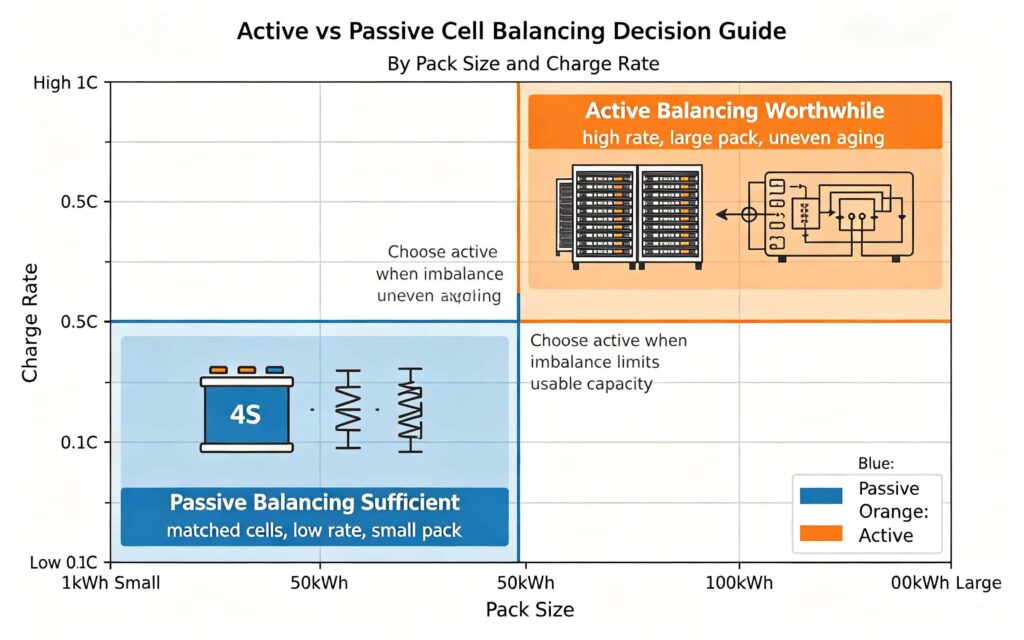
There is no single right answer; the decision depends on pack size, charge rate, cell quality, and duty cycle. For most 48V/51.2V LiFePO4 packs used in home and C&I solar storage, passive balancing is sufficient when cells come well matched and are charged at moderate rates.
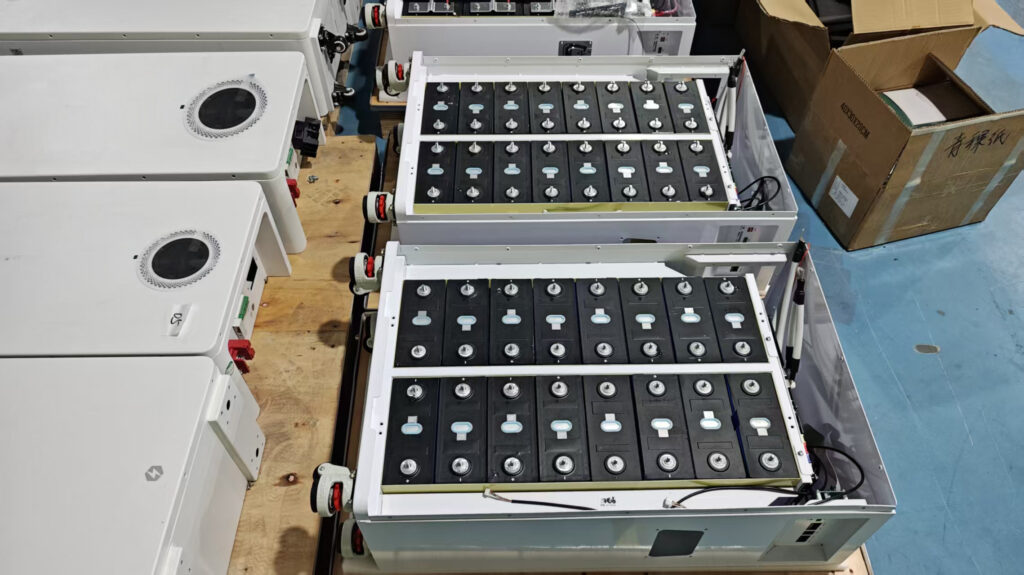
- Pack size: small packs (under 1–2kWh) almost never need active balancing; the imbalance is small and passive handles it. Large packs (tens of kWh, or server-rack/stackable batteries) benefit more from active balancing because the capacity loss from imbalance scales with pack size.
- Charge rate: if you charge at 0.5C or above, passive balancing has little time to work during charging. Active balancing’s higher current corrects imbalance faster, so it matters more in high-rate systems.
- Cell matching and aging: well-matched fresh cells stay balanced longer with passive; packs whose cells age unevenly (temperature differences, repeated high-rate use) drift more and benefit from active.
- Usable capacity target: if you need to extract maximum capacity every cycle and imbalance is limiting it, active balancing’s efficiency is worth the extra cost.
When selecting a BMS, confirm both the balancing method and the balancing current, because these determine how well the pack holds capacity over time. For guidance on matching a BMS to a LiFePO4 pack, see #32 how to choose a LiFePO4 BMS.
Common myths about cell balancing
A few misconceptions can lead to choosing the wrong BMS. First, active balancing does not make a bad pack good — it manages, not repairs, cell-to-cell differences. Second, balancing cannot fix a dead or badly degraded cell; a pack with one failing cell still needs that cell replaced. Third, a higher balancing current is not automatically better; on a pack with matched cells, fast active balancing adds cost with little benefit. Fourth, balancing only helps within the cell voltage window — a pack that is deeply discharged cannot be “balanced up”. Understanding these limits prevents overpaying for balancing you do not need, or under-specifying it for a system that does. For the broader role of the BMS in protecting a battery, see #49 BMS protection: overcharge, overdischarge and thermal.
Q. What is the difference between active and passive cell balancing?
Passive balancing bleeds excess energy off the highest cell through a resistor, wasting it as heat; active balancing moves energy from higher cells to lower cells using a capacitor, inductor or DC-DC converter. Passive is simpler and cheaper but slow and wasteful; active is more efficient and faster but costs more and is more complex. Both aim to keep series cells at similar states of charge so the pack delivers its full usable capacity.
Q. Is active balancing worth the extra cost?
Only in certain cases. Active balancing is worth it for large packs (tens of kWh), systems charged at high rates (0.5C or above), and packs whose cells age unevenly, where the efficiency gain recovers usable capacity that outweighs the higher BMS cost. For small, well-matched packs charged slowly, passive balancing is adequate and active adds cost with little benefit. Estimate the capacity you would lose to imbalance to decide whether active pays off.
Q. Does passive balancing waste energy?
Yes, passive balancing dissipates the excess energy from the highest cell as heat through a resistor. The amount is usually small because balancing current is low (0.03A-0.2A) and only runs when a cell exceeds the pack average. The energy lost is the imbalance itself, so in a pack with tiny imbalance the waste is negligible. In a pack with large imbalance, the waste grows, which is why active balancing, which reuses that energy, becomes attractive.
Q. Can cell balancing fix a damaged cell?
No. Balancing only manages small cell-to-cell state-of-charge differences; it cannot repair a cell that is degraded, has high internal resistance, or is failing. If one cell is far out of line due to damage, balancing will continually try to equalise it but the pack will still be limited by that cell, and the cell should be replaced. Balancing maintains health; it does not restore it.
Q. How much balancing current does a LiFePO4 pack need?
For most 48V/51.2V LiFePO4 packs with matched cells and moderate charging, passive balancing at 0.1A-0.2A is enough. For large packs, high-rate charging, or packs that age unevenly, active balancing at 1A-5A gives faster, more effective correction. A practical guide: choose the smallest balancing capability that keeps the pack balanced over a normal cycle; oversized balancing adds cost without proportional benefit.
Next step: specify the right balancing strategy for your BMS
Choosing between active vs passive cell balancing is a BMS selection decision with real cost and performance consequences. Passive balancing is simple and economical for most well-matched LiFePO4 packs; active balancing earns its higher cost in large, high-rate, or unevenly aging systems where recovering usable capacity matters. Before you buy, confirm the balancing method, the balancing current, and how the BMS applies balancing during charge and idle.
- Read the BMS 101 guide in #28
- Match a BMS to your pack in #32
- Learn BMS protection in #49
- Ask leekooenergy for a BMS and balancing specification that includes: recommended balancing method (active or passive) for your pack size, balancing current suitable for your charge rate, cell voltage and series count of your battery pack, compatibility with your LiFePO4 chemistry and pack configuration, balancing behaviour during charge and idle, and how the choice affects usable capacity and cost — so your battery pack stays balanced, delivers full capacity, and the balancing investment matches your real need