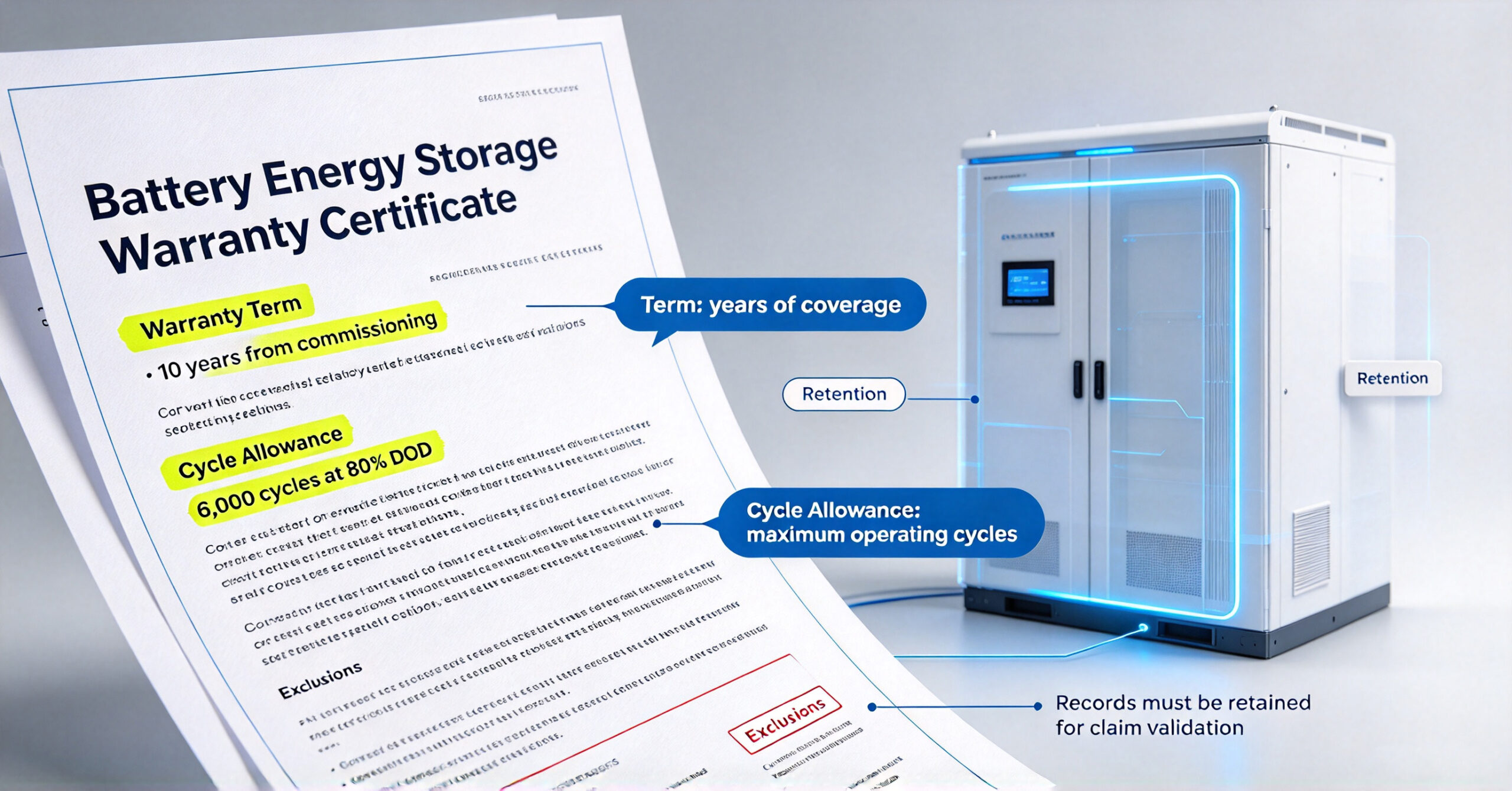
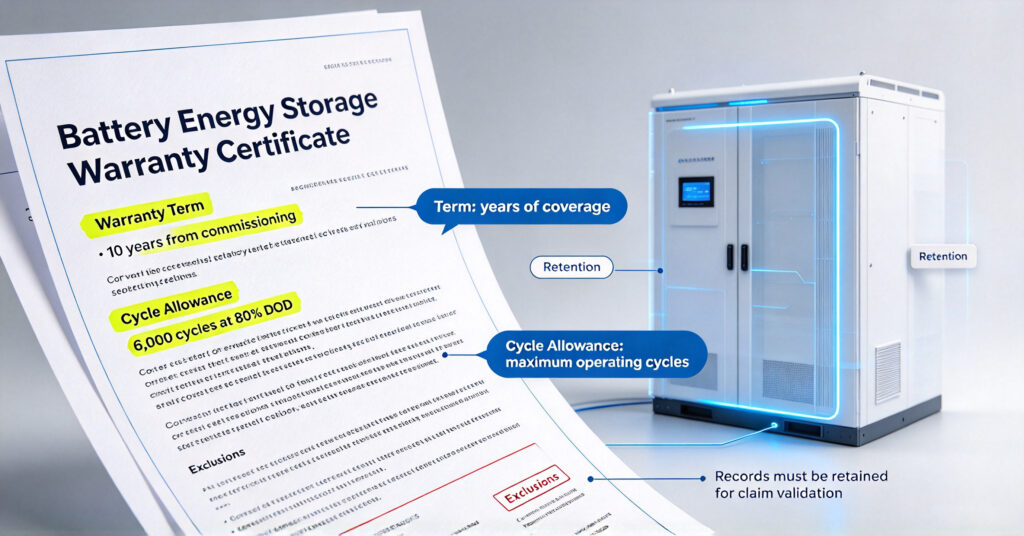
battery warranty cycles vs years describes a dual-limit promise: the cover ends when either the cycle count or the calendar term is reached, whichever arrives first. The year limit protects against age-related failure; the cycle limit protects against wear. Reading both together, plus the retention clause, is the only way to compare two warranties.
Two warranties can quote the same number of years and differ by a factor of two in what they actually deliver. This guide is written for buyers reading the clause rather than the headline, before the contract is signed.
Two clocks: battery warranty cycles vs years explained
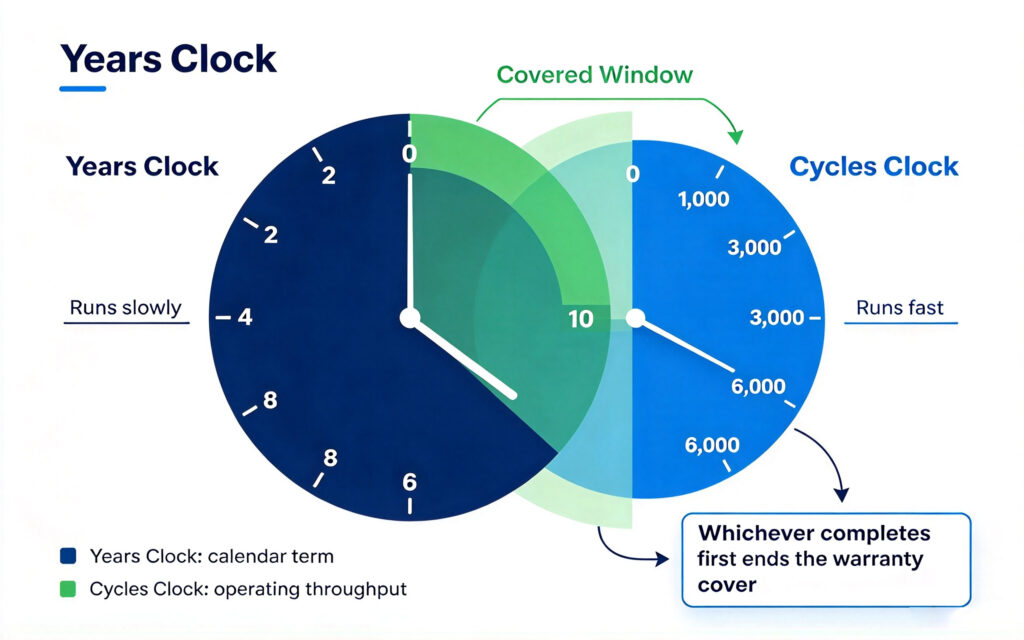
A storage warranty almost always runs two clocks at once, and the cover stops when the first of them runs out. The calendar clock counts years from commissioning or from shipment. The cycle clock counts equivalent full cycles, or sometimes total throughput, accumulated over the life of the unit. Whichever arrives first ends the promise, and the maker chooses the pairing so that neither is generous on its own.
That pairing is the first thing to read in any battery warranty cycles vs years clause, because a warranty is only as good as its binding limit, and which limit binds depends entirely on the duty. A backup unit that cycles a handful of times a year will run out the calendar clock long before the cycle clock. A peak-shaving unit cycling daily will exhaust the cycle allowance in a fraction of the term — which is why the first question to ask of any battery warranty cycles vs years clause is which one actually binds at your duty.
Throughput and the argument over what counts as one cycle
The single largest source of disagreement in the market is the definition of a cycle. The naive reading — one discharge and one recharge — is not what most contracts mean. Most define an equivalent full cycle as the throughput equal to one full discharge of the nameplate capacity, regardless of how it was accumulated: ten discharges to ten percent depth followed by ten recharges count as one equivalent full cycle, not ten.
Two checks settle it. First, ask whether the cycle allowance is stated against a defined depth of discharge, or whether it is an equivalent-full-cycle figure that already normalises for depth. Second, ask how the cycle count is derived — from BMS coulomb counting, from a modelled estimate, or from a fixed assumption — and who has access to the record. A promise the buyer cannot measure is a promise the buyer cannot enforce, and the cycle life versus price comparison shows how much of the price difference between products sits in exactly this clause.
Reading retention clauses in battery warranty cycles vs years
Capacity retention is the third term in almost every storage warranty, and it is the one buyers skip most often. It states what share of the original capacity the unit will still hold at the end of the term — commonly somewhere in the seventy to eighty percent band for stationary lithium — and it converts the warranty from a failure promise into a performance promise.
Without a retention clause, a warranty only covers the unit against outright failure, and a battery that quietly loses a third of its capacity over eight years has not failed by that definition. With one, the buyer has a measurable floor: if the pack tests below the retention figure at the stated conditions before the term ends, there is a claim. That is a materially different promise from the same number of years without it.
Temperature and duty limits written into the terms
Storage warranties are conditioned on how the unit is operated, and temperature is the most common condition by a wide margin. A warranty written for an indoor, conditioned environment can be void, or reduced to a shorter term, if the unit spends its life in an unheated garage or an outdoor cabinet in a hot climate. The operating band is usually printed in the installation manual rather than in the warranty document, which is exactly why it gets missed.
The LiFePO4 battery temperature range guide is the reference for what the operating band means in practice, and it is worth reading alongside the warranty rather than after it. Where the site cannot hold the band the warranty assumes, the honest options are to relocate the unit, to condition its enclosure, or to buy a warranty written for the conditions that actually exist.
Exclusions that quietly remove cover
Exclusions are where warranties differ most and where buyers read least, and the same list appears with disturbing regularity. Improper installation is the broadest: no defined commissioning record, no torque record, no documented protection settings, and the claim is declined on process rather than on product. Unauthorised modification is the second, which usually catches firmware changes, third-party monitoring hardware and any physical alteration to the enclosure.
And the quiet ones: consumables and wear items are excluded, as is any consequential loss — lost revenue, emergency generator fuel, the cost of the visit. A warranty that replaces a module but not the labour to fit it is a materially weaker promise than one that covers both, and this is usually the single most valuable line to negotiate.
Warranty term versus real service life
A warranty term is a commercial promise, not a prediction. It is set by the maker’s risk appetite and by what the market expects, and it is deliberately shorter than the life the product is expected to have. A unit with a ten-year warranty is not expected to fail in year eleven; it is expected to still be working, with less capacity than it had when new.
That gap is the reason the retention clause matters more than the headline term in a long project. What an asset owner needs to model is the capacity available in year ten or fifteen, not the date the cover expires, and the battery warranty cycles vs years pairing only bounds the period in which a claim can be made. Beyond it, the unit keeps working and keeps fading.
A checklist for comparing two warranty documents
Two documents can carry the same headline — ten years, six thousand cycles — and be worth very different amounts. Nine checks separate them once the battery warranty cycles vs years pairing has been read carefully, and they are quick to run.
- Which clock binds at your duty: the year limit or the cycle limit
- Whether cycles are equivalent full cycles, cycles at a stated depth, or throughput in megawatt-hours
- Whether a retention clause exists at all, and what figure it promises
- Whether retention is measured at the system terminals or on the cells, and at what conditions
- Who performs the measurement, with what method, and who pays for it
- The operating temperature band the terms assume, and whether your site holds it
- Whether the duty you intend is named as covered or excluded
- Whether labour, shipping and access are covered or only the replacement part
- Whether the warranty is backed by the maker or by the distributor, and what happens if either disappears
That last line is the one procurement teams forget. A distributor’s own warranty is only as good as the distributor’s balance sheet, and in a market where brands and channels change quickly, the identity of the obligor is part of the value of the clause. The how to evaluate battery manufacturers guide covers how to read that signal during supplier selection.
Clauses to write into the purchase contract
Whatever the maker’s standard document says, the purchase contract is where a buyer can make the promise measurable, and six clauses do most of the work. State the warranty term and the cycle allowance together, with an explicit statement that the earlier of the two governs. Define the cycle in throughput terms, or as equivalent full cycles, and say how it is counted and who can read the record.
Then state the retention figure, the measurement method, the measurement conditions and who bears the cost of the test — because a retention promise without a method is not a promise. State the operating band the warranty is written against, and confirm in writing that the intended duty is covered rather than excluded.
Confirm what a successful claim delivers: the part only, or the part plus labour, access and shipping. Name the obligor and, where the counterparty is a distributor rather than the maker, ask for the maker’s own backing or for a performance bond. And tie the documentation to the export and compliance package, since the certification files required for shipment under the battery export certification are usually the same evidence a claim will later need. Where the clause measures capacity, it should be the same usable figure the spec sheet quotes, and the usable versus nameplate battery capacity comparison explains why those two numbers differ.
Q. battery warranty cycles vs years?
It is a dual-limit promise. The calendar term covers age-related failure and the cycle allowance covers wear, and the cover ends when whichever limit is reached first. A backup unit usually exhausts the years; a daily-cycling unit usually exhausts the cycles.
Q. What counts as one battery cycle?
Most contracts use an equivalent full cycle: throughput equal to one full discharge of the nameplate capacity, however it was accumulated. Ten shallow discharges to ten percent count as one, not ten. Some contracts state total throughput instead.
Q. What is a capacity retention clause?
It promises the unit will still hold a stated share of its original capacity at the end of the term, commonly in the seventy to eighty percent band. Without it, a warranty only covers outright failure and says nothing about gradual fade.
Q. Does temperature affect the warranty?
Yes. Operating outside the stated band, which is usually printed in the installation manual rather than the warranty, can void or shorten the cover. Outdoor cabinets and unheated garages are the common cases that fall outside it.
Q. What exclusions should I look for?
Improper installation with no commissioning record, unauthorised modification, operation outside the voltage or temperature window, long storage at the wrong state of charge, mismatched parallel units, and consequential losses such as lost revenue.
Q. Is the warranty term the same as service life?
No. The term is a commercial promise, deliberately shorter than the life the product is expected to have. Model the capacity at the end of your own project horizon, using the retention figure as a floor, rather than sizing to the warranty date.
Q. Should a claim cover labour as well as parts?
Yes, and it is usually the most valuable line to negotiate. A warranty that replaces a module but not the labour, access and shipping to fit it is materially weaker than one that covers the whole visit.
Next step: make the warranty measurable before signing
A headline term hides more than it reveals. Send both warranty documents for a clause-by-clause comparison.
- Settle the brand-side obligations in the private label storage batteries route
- Weigh the term against the battery energy storage cost and ROI model
- For chisidal, send your usage and site details, and we will come back with product prices, lead time and warranty information.