
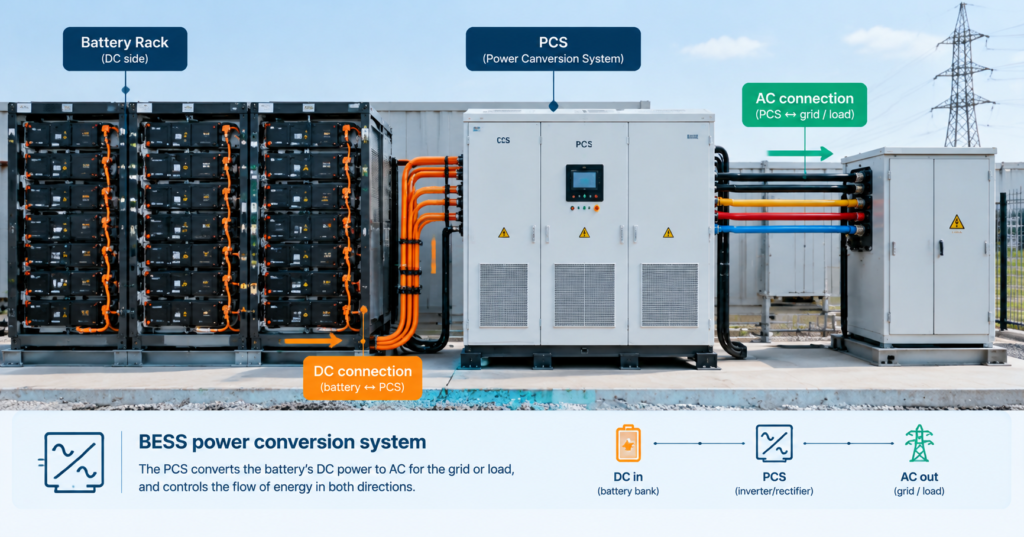
bess power conversion system is the hardware that sits between a battery and everything it serves — the grid, a load, or another source — and converts electrical energy between direct and alternating form in both directions. It charges the battery from AC and returns stored energy as AC, and it carries the controls that keep voltage and frequency inside limits during a disturbance.
A storage battery on its own stores energy as direct current and cannot feed a building or the grid, which run on alternating current. The piece that makes the battery usable is the power conversion system, and projects that size or buy storage often treat it as a secondary item until something misbehaves. That is a mistake, because the converter sets how fast the battery can respond, how much energy is lost on the way in and out, and whether the system stays connected when the grid wobbles. This article explains what the bess power conversion system does in plain terms, how it differs from a plain inverter, and what to look for when you read a specification.
What the bess power conversion system actually is
A bess power conversion system is, at its core, a bidirectional inverter built for stationary storage rather than for a single solar panel or a vehicle. Where a solar inverter only sends power one way — from the panels to the grid — the power conversion system must take alternating current from the grid or a generator and push it into the battery as direct current, then reverse the path when the battery discharges. That two-way path is the single feature that defines it.
The converter is usually a cabinet or a rack of power modules rather than a small wall box. Inside it you find the switching devices, the filters, the controller, and the protective elements that together shape the waveform and guard the battery. For chisidal, the module approach matters because it lets a project scale power by adding units rather than replacing the whole converter, and it keeps a single fault from taking the entire site offline.
What a PCS does when the battery charges and discharges
The simplest description of the job is two conversions. On charge, the converter rectifies grid or generator AC into DC and feeds the battery at a voltage and current the cells will accept. On discharge, it inverts the battery DC back into AC at the voltage and frequency the load or grid expects. Between those two states the converter also holds the battery at rest, supplying the small amount of control power the site needs without cycling the cells.
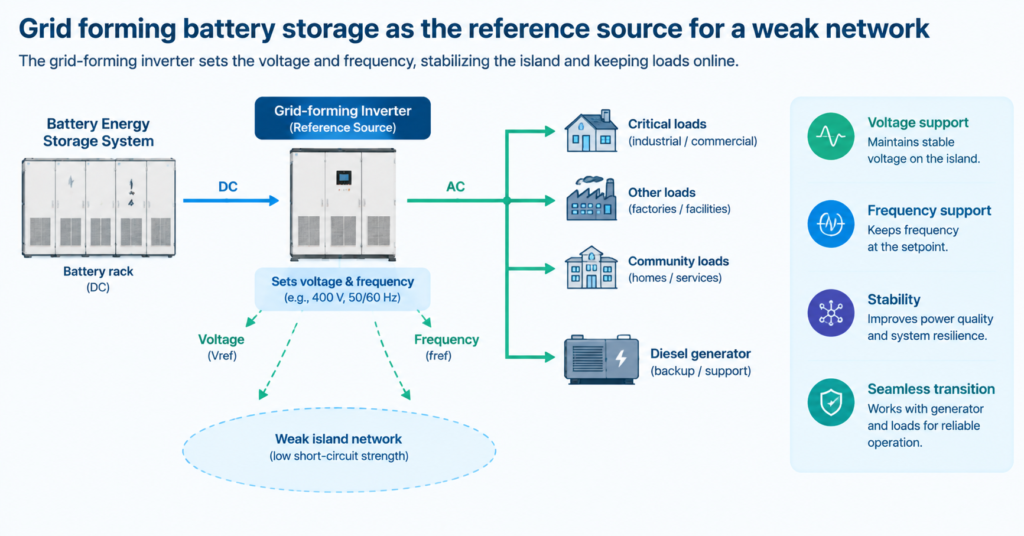
Grid-tied and off-grid duties differ in what the converter must hold steady. Tied to a strong grid, the converter follows the network frequency and voltage and injects or absorbs power on command. Off-grid, the same hardware has to create the frequency and voltage from nothing, because no neighbouring source exists to lean on. A storage hybrid inverter handles the same two jobs on a smaller, house-sized scale, and the design choices scale with the power rather than change in kind.
PCS versus a plain inverter — why storage needs two directions
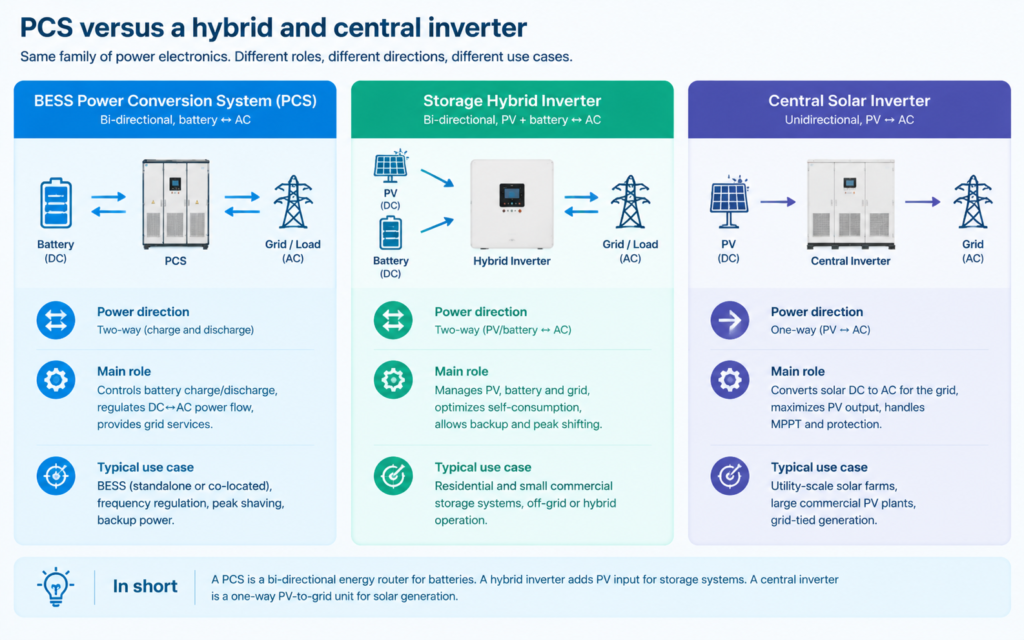
A plain inverter was designed to push power out and stop. The bess power conversion system has to do that and the reverse, which changes the semiconductors, the cooling and the control software. A one-way device can assume a known source on one side; a storage converter must manage a battery whose voltage wanders as it fills and empties, and a grid that may vanish mid-cycle. That management is the reason a storage project cannot simply reuse a solar inverter of equal rating.
| Device | Power direction | Primary role | Best fit |
|---|---|---|---|
| PCS (bess power conversion system) | Both ways, battery-centred | Charge and discharge a storage bank | Utility, C&I and microgrid storage |
| Storage hybrid inverter | Both ways, source-flexible | Pair a small battery with PV at one site | Homes and small commercial buildings |
| Central solar inverter | One way, PV to grid | Convert panel DC for export | Large PV plants with no storage |
The table shows the practical split. A central inverter is the cheapest way to move solar to the grid but cannot store; a hybrid unit adds storage at small scale; the bess power conversion system is the large, battery-first option when the project is about the storage rather than the panels. Choosing among them is a sizing question more than a quality one, and the 48V split-phase inverter guide covers the small end of that range.
Why the PCS power rating is not the same as battery energy
Power and energy are different units and they describe different limits. The battery holds energy, measured in kilowatt-hours, and the converter sets power, measured in kilowatts — how fast that energy can move. A large battery behind a small converter fills and empties slowly; a small battery behind a large converter can move power it does not have. The bess power conversion system rating should match the job the site actually needs, not the biggest number on the battery nameplate.
Most sites do not need the converter to move the full battery in one hour. A four-hour system, for example, pairs a battery of a given capacity with a converter rated at roughly a quarter of that in power terms, and that choice is where much of the project cost sits. Oversizing the converter buys speed the load may never ask for and adds cooling the room must carry.
Efficiency and the losses worth watching
No converter returns all the energy it takes. Round-trip loss splits between the charge conversion and the discharge conversion, and the converter is the larger share of that loss for most systems. The number to watch is the converter efficiency at the power level you actually run, not the peak printed on the datasheet, because efficiency curves dip at low load and at the very top of the range.
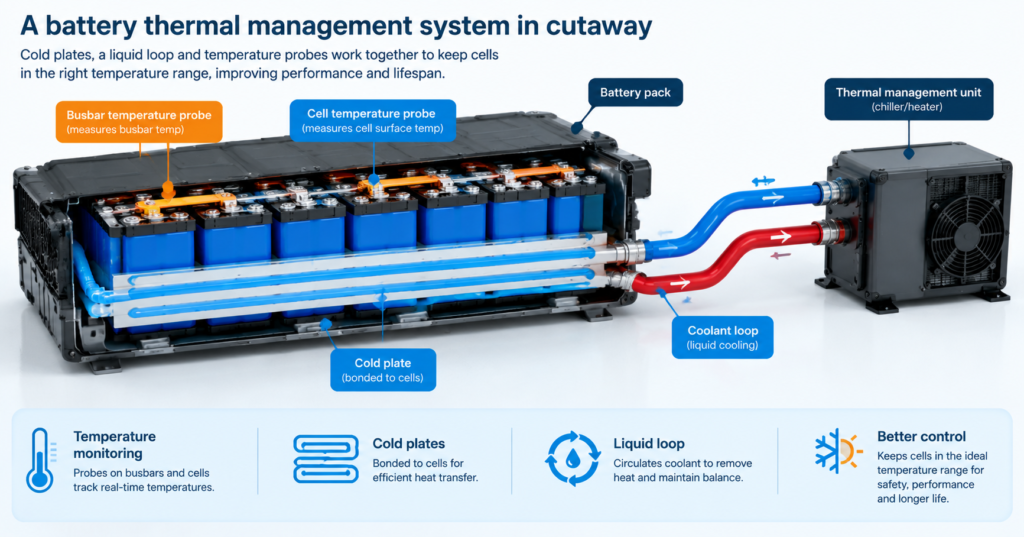
Cooling is the other hidden cost. A converter that runs warm loses more and ages faster, so the enclosure, the fan or liquid loop, and the ambient temperature all feed back into the energy you keep. For chisidal, we rate losses at the expected operating band rather than at the marketing peak, because that is the number that shows up on the meter at the end of the year.
Paralleling units and keeping the site running if one fails
Larger sites rarely run a single converter. Several units work in parallel so that one can be taken out for service while the rest carry the load, and so that power grows in steps as the project expands. The controls have to share current fairly and keep one unit from fighting another, which is a harder problem than running one box and is worth checking in the specification.
Redundancy is a design choice, not a default. A site that cannot tolerate a converter outage sizes for N+1; a site that can ride a short stop may run N and save the cost. The decision belongs with the microgrid storage plan, where the consequence of a blackout is weighed against the price of a spare unit.
What to check in a PCS specification before you sign
A specification sheet hides the details that decide whether the converter fits your site. Read the voltage window against your battery’s working range, the rated current against your charge and discharge plan, and the declared efficiency at your typical load rather than at peak. Confirm the protection marks your market requires and the cooling method the room can support, because both are expensive to fix after installation.
Also check how the converter talks to the rest of the plant. A bess power conversion system is only as useful as its link to the controller and the meters, so the communication protocol and the response time under a grid event belong in the early review, not the commissioning call. The containerized BESS and BESS project delivery guides cover how these pieces come together on site.
bess power conversion system?
A bess power conversion system is the converter that links a battery to the grid, a load or a generator. It turns battery DC into AC on discharge and AC back into DC on charge, and holds voltage and frequency within limits during a disturbance.
Q. What does a PCS do in a battery storage system?
A PCS charges the battery by rectifying AC into DC and discharges it by inverting DC back into AC. It holds it at rest, follows grid commands when tied, and creates voltage and frequency off-grid. The converter is the bridge between stored energy and usable power.
Q. Is a PCS the same as an inverter?
No. A plain inverter sends power one way, say from solar to the grid. A PCS does that and the reverse, because storage must both take in and give back energy. The two-way path and grid-support controls set a PCS apart from a solar inverter.
Q. How do you size a PCS to a battery?
Match the converter power in kilowatts to the site’s needs, not to battery energy in kilowatt-hours. A four-hour system pairs capacity with a converter near a quarter of it. Oversizing buys response the load may never use and adds cooling the room must carry.
Q. What efficiency should a PCS have?
Look at converter efficiency at the load you run, not the peak, because curves dip at low and high power. Round-trip loss splits between charge and discharge, and the converter is usually the larger share. Cooling method and ambient temperature affect energy you keep.
Q. Can PCS units run in parallel for redundancy?
Yes. Units share current so one can be serviced while the rest carry the load, and power grows in steps as the project expands. Redundancy is a choice: N+1 tolerates a failure, while N saves cost where a short stop is acceptable.
Q. What standards apply to a bess power conversion system?
The converter must carry the safety and grid-connection marks your market requires, such as IEC 62619 and UN 38.3, with local grid-code approval. Exact marks vary by country, so confirm the list with the quote rather than assuming one certificate covers every destination.
Request pricing for your project
Send us your usage and site details. For chisidal, we can share product prices, lead time and warranty information. Feel free to contact us for a quote.
- bess energy management system
- grid forming battery storage
- For chisidal, send your usage and site details, and we will come back with product prices, lead time and warranty information.