A buyer once shortlisted three “manufacturers” with identical brochures. Two were traders reselling the same OEM unit; only one owned the line. The difference showed up at the audit, not in the PDF. That is the whole point of this guide.
Evaluate a BESS manufacturer on three things: can they prove the factory (audit), can they prove compliance (certifications), and can they prove consistency (QC). A real manufacturer answers all three with evidence — a trader stalls on the first.
The 10-point evaluation checklist
- Factory ownership. Do they own the production line, or trade? Ask for a live line tour, not just photos.
- Cell sourcing. Which cell grade (A/B) and brand? Grade-B cells are cheap but short-lived.
- BMS capability. In-house BMS or bought? In-house usually means faster support and protocol control.
- Certifications. UN 38.3, IEC 62133 / IEC 62619, and market-specific marks (see table).
- Audit report. Recent third-party audit (ISO 9001 at minimum; ISO 14001 / 45001 a plus).
- QC plan. IPQC/OQC, traceability of cells, and a written sample-acceptance rule.
- Test equipment. Capacity, impedance, and abuse testing on site — not outsourced blindly.
- Reference projects. Similar climate and scale, with a contactable reference.
- Warranty & RMA. Clear terms, local service or swap logistics, and spare-part lead time.
- Engineering response. How fast do they answer a spec or failure-mode question? Slow now means slower later.
Certificates that actually matter
| Certificate | Covers | Why it matters |
|---|---|---|
| UN 38.3 | Transport safety | Required to ship cells/packs |
| IEC 62133 / 62619 | Product safety (portable / stationary) | Market access for most regions |
| ISO 9001 | Quality system | Baseline for a real factory |
| UL 1973 / 9540A | North America stationary | Needed for US/CA projects |
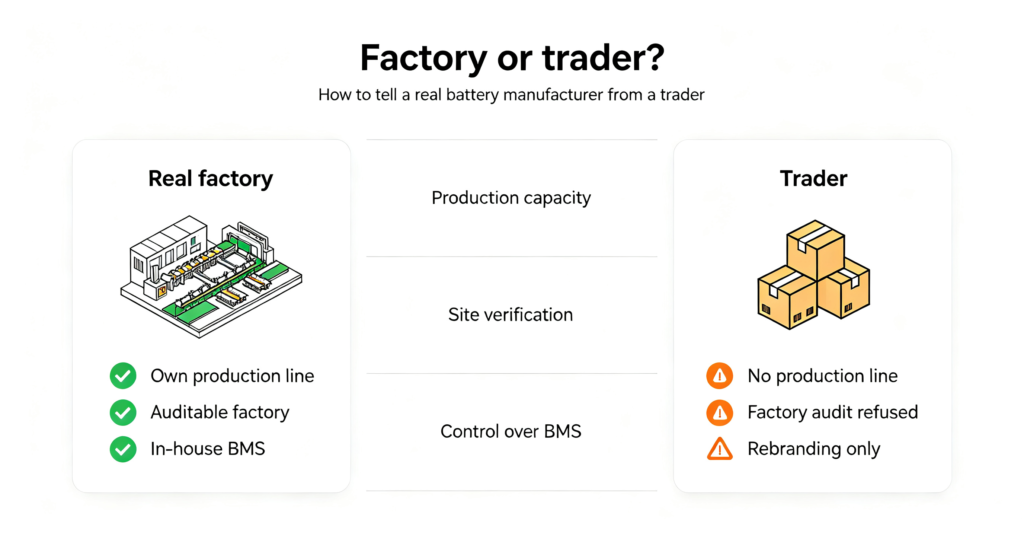
What separates a real factory from a trader
A trader can show you a slick deck and even a certificate borrowed from a partner. The tells are consistent: no live line tour, vague cell grade, outsourced BMS, and slow engineering replies. The audit is where the story either holds or collapses.
Audit checklist, item by item
- Legal entity & track record — years operating, registered address, export license.
- Factory, not just a trading desk — request a live video tour of the line.
- Cell sourcing — grade-A cells with batch traceability; confirm not B-grade or recycled.
- Certifications — UN38.3, IEC 62619 / UL 1973 as your market needs, verified current.
- BMS capability — in-house or sourced; ask for the protocol list.
- QC process — incoming cell test, weld/torque check, outgoing capacity test.
- Capacity & throughput data — real cycle-life curves at your DoD.
- Reference projects — similar scale and market, with contacts if possible.
- Warranty & after-sales — basis (years/throughput), spare parts, response time.
- Financial stability — can they honor a multi-year warranty?
Certification map
| Purpose | Common standard | Why it matters |
|---|---|---|
| Transport | UN38.3 | Ships by air/sea at all |
| Stationary safety | IEC 62619 / UL 1973 | Enclosure-level safety |
| Grid connection | Local grid code | Can connect and bid |
| Quality system | ISO 9001 | Process consistency |
QC verification that actually catches problems
Ask for the test reports, not the certificate image. Incoming cell grading, weld resistance checks, and outgoing capacity testing should be documented per batch. A supplier that tests only at final audit hides line variation. Request a sample of the actual batch records before volume.
Real factory vs trading company
Many “manufacturers” are trading desks reselling another line’s packs. The difference shows in three places: they cannot show the production line live, they are vague on cell grade, and they cannot share batch QC records. A true factory answers all three without hesitation. For a BOFU purchase, that distinction is the whole risk.
Red flags in brochures
- “World-class” or “best” with no test data behind it.
- Cycle-life claims with no depth-of-discharge stated.
- Price far below market with no grade disclosure.
- No reference project in your region or scale.
Running a remote audit
You do not need to fly in first. A live video walk of the line, shared batch QC records, and a reference call cover most risk. Reserve the on-site visit for the final two finalists — it is expensive, so spend it where the quote already fits.
The sample stage is the real test
Order a small paid sample and run it through your duty cycle. A supplier confident in the data welcomes this; one that delays or upsells reveals hesitation. The sample you validate becomes the benchmark for every mass-produced unit.
Negotiating the warranty
Warranty basis matters more than length. Years-only favors light users; throughput (total kWh) favors daily cyclers. Match the basis to your use, and confirm spare-part lead time so a failure is days, not months, of downtime.
Cost vs risk tradeoff
The cheapest quote is rarely the cheapest ownership. A failed pack in the field costs freight, downtime, and reputation far beyond the savings. Weight reliability and traceability above unit price for BOFU volumes.
When a trading company is acceptable
For small or one-off volumes, a trading desk with a strong factory backend can be fine — if it discloses the source and stands behind warranty. The problem is only when it hides the factory while pricing like one.
Documenting the decision
Keep the audit notes, cert copies, sample results, and the signed quote in one file. A defensible record protects you at renewal and if a field issue appears a year later.
Scoring the shortlist
Turn the ten-item checklist into a simple score: give each candidate a point per item backed by evidence, not a promise. A factory with live video, batch QC records, and a reference call scores high; one with only a glossy PDF scores low. Two or three finalists emerge; reserve the costly on-site visit for them.
Reference-check questions
- Did the pack match spec at volume, not just the sample?
- How fast was warranty support when something failed?
- Was documentation (certs, batch records) delivered on time?
- Would you buy from them again at this volume?
Sample contract clauses worth adding
For BOFU volumes, put three things in writing: batch traceability and the right to audit, a defined warranty basis (years or throughput) with spare-part lead time, and a source-disclosure clause if the partner is a trading desk. These clauses are what make a “manufacturer” accountable when a field issue appears a year later.
Evidence to request, not just claims
- Current certificate PDFs with expiry dates, not screenshots.
- One full batch QC record from a real shipment.
- A short video walk of the actual line, not a showroom.
- A reference in your region or at your scale.
Fit to your region
Certification that fits one market may not fit yours; a supplier strong in Region A can be unqualified in Region B. Weight regional cert and reference fit above generic scale. The right partner is the one already shipping compliantly where you sell.
Red flags during the call
If a candidate redirects every technical question to “our sales will follow up,” or quotes a price far below market without explaining grade, slow down. Confidence shows as answers, not delays. The cheapest surprise is the one you didn’t buy.
Audit cadence, not a one-off
Evaluation does not stop at award. Keep a light audit cadence: a batch-record review each shipment, a reference re-check annually, and a certificate renewal check before expiry. Suppliers change ownership and lines; a partner that was solid two years ago can drift. A standing cadence catches that drift before it reaches your customer.
When to walk away
If a candidate cannot show the line, won’t share batch records, or quotes far below market with no grade disclosure, walk away even if the price is tempting. The cost of a wrong manufacturer is a field failure under your brand — far above any unit saving. The discipline to decline is part of the evaluation, not a defeat.
Final word
Evaluating bess manufacturers is less a test and more a habit: evidence over claims, cadence over a one-off check, and the discipline to walk when the evidence fails. That habit is the cheapest insurance on every BOFU volume you ship.
Q. How do I know if a battery manufacturer is real?
Ask for a live line tour and cell-grade proof. A real factory owns production and BMS; a trader resells and stalls on the audit.
Q. Which certificates should a BESS manufacturer have?
At minimum UN 38.3 and IEC 62133/62619; ISO 9001 for the system. Add UL 1973/9540A for North America. Match the list to your market.
Q. What is the most overlooked evaluation point?
QC consistency and traceability. A great sample means little if mass production drifts; lock the IPQC/OQC plan and sample-acceptance rule in the contract.
Q. Should I require an on-site audit?
For volume or BOFU buys, yes — or a third-party audit report. For small trial orders, a strong cert package and reference project may suffice first.
Q. How fast should a manufacturer respond technically?
Quick, specific answers on spec and failure modes signal real engineering. Slow or generic replies now predict worse support after the contract.
Choosing a manufacturer?
See leekooenergy Manufacturer Page and Customization Process Guide,Prepare the 10-point checklist and book a factory audit with the certification pack.