Utility-scale battery storage is grid-connected BESS built at megawatt (MW) and megawatt-hour (MWh) scale — far larger than a home or factory system. A single site packs containers of lithium cells, each with its own cooling, fire safety, and power conversion, to deliver services like frequency response, peak shifting, and capacity to the grid. The buyer is usually a utility, an independent power producer (IPP), or a project developer, not an end consumer.
What “utility-scale” means here
Utility-scale refers to storage sized for the grid rather than a single building. Where residential storage is tens of kWh and C&I storage is up to a few MWh, utility-scale starts around 1 MWh and runs to hundreds of MWh or GWh per site. “Utility scale battery storage” and “grid-scale storage” are used interchangeably; both mean storage that connects at the distribution or transmission level and is dispatched by grid operators or market participants.
MW vs MWh: the two numbers that matter
Two units define every utility-scale project, and mixing them up is the most common buyer error:
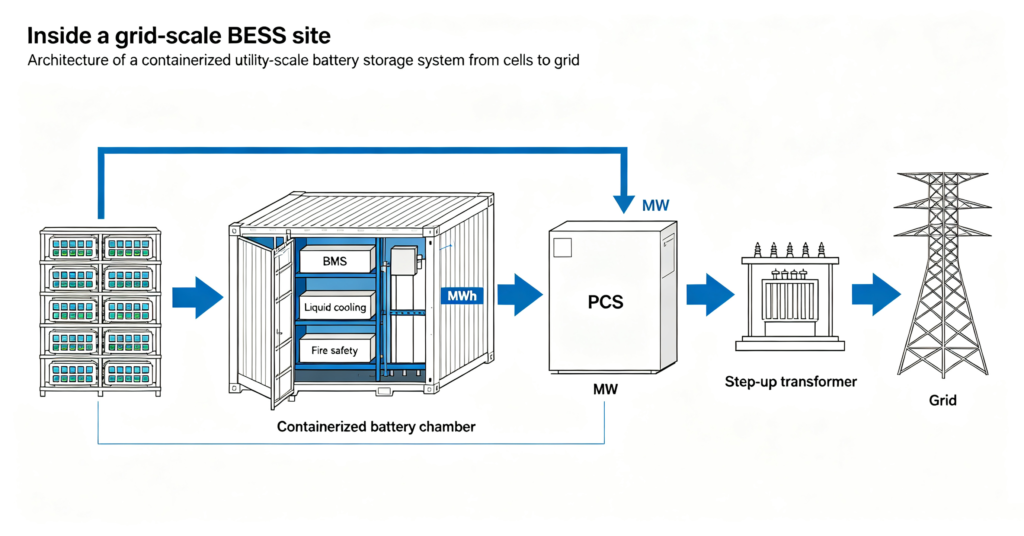
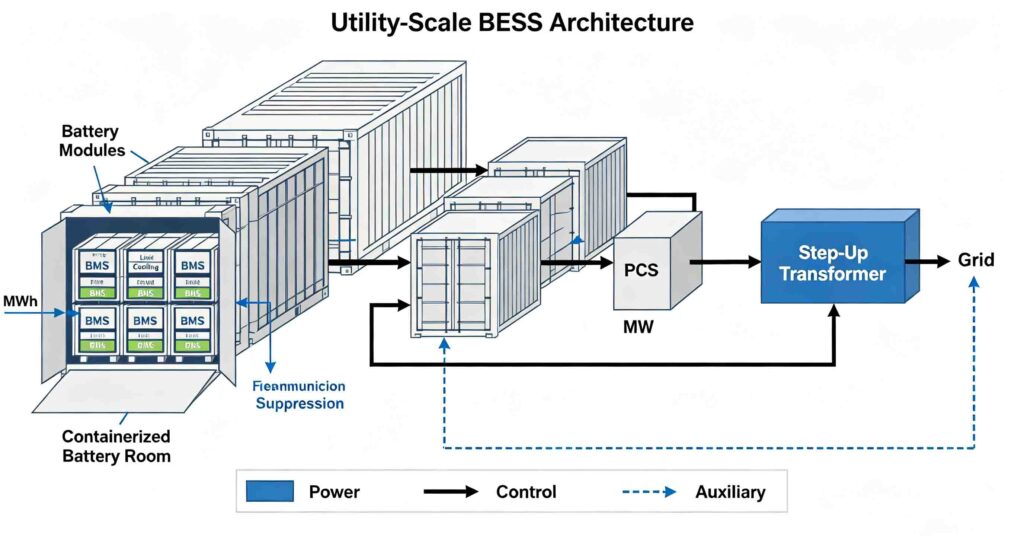
- MW (megawatt) = power, how fast the system can charge or discharge. It sets how big an inverter/PCS you need.
- MWh (megawatt-hour) = energy, how much it can store. It sets how many cells and containers you need.
A “100 MW / 200 MWh” site can deliver 100 MW for about 2 hours. Duration = MWh ÷ MW. Most grid services today run 1–4 h; longer duration is a separate, still-emerging category.
Typical configuration at a glance
| Parameter | Typical range | What it drives |
|---|---|---|
| Site capacity | 1 MWh – 1 GWh+ | Total stored energy |
| Power rating | 0.5–500 MW | PCS / inverter size |
| Discharge duration | 1–4 h (common) | Cell quantity vs PCS ratio |
| Container size | 20 / 40 ft | Land footprint, cooling |
| Chemistry | LFP dominant | Safety, cycle life, cost |
| System round-trip efficiency | 85–90% (typical) | Usable revenue |
Who the players are
Utility-scale projects are delivered by a chain of specialists, and knowing who does what tells you who to talk to:
- Developers / IPPs — own or finance the site and award the battery supply contract.
- Utilities — buy capacity or operate the asset for grid service.
- EPC contractors — engineer, procure, and construct the balance of plant (civil, electrical, commissioning).
- Battery / BESS suppliers — provide the containerized storage, cells, BMS, and PCS integration.
- System integrators — assemble containers and software, sometimes the same company as the supplier.
What a buyer should verify before RFQ
From a procurement standpoint, the spec sheet is only the start. Before issuing a request for quotation, confirm these points so quotes are comparable:
- Usable, not nameplate, capacity. Ask for energy at the agreed depth of discharge and temperature — nameplate MWh overstates what you can actually deliver.
- PCS and duration separately. A 200 MWh site at 2 h and one at 4 h are different products; quote both MW and MWh.
- Cycle life at project conditions. Cells rated for 6,000 cycles in a lab may deliver fewer at your ambient temperature and daily throughput.
- Safety certification of the container. Request the enclosure-level fire and electrical compliance, not just cell-level certificates.
- Software and grid-code compliance. The site must speak the protocol your market operator requires; confirm before, not after, commissioning.
- Delivery and commissioning lead time. Container supply, not cells, is usually the long pole — confirm the critical-path date.
A good RFQ states application, required MW/MWh and duration, site environment, target market certifications, and the commissioning window. Suppliers can only price what you define.
How a utility-scale project is procured
The path is unlike a home or factory buy. A developer or IPP issues a specification for MW/MWh and duration, suppliers bid containerized systems, and an EPC integrates them with civil works and grid connection. Awards are won on levelized cost, delivery certainty, and safety record — not on a brochure. For a non-core buyer, the practical move is to understand the spec language so quotes are comparable, then lean on an EPC for integration. Seplos approaches utility-scale as a capability showcase: containerized systems demonstrate large-project competence, while the core business stays residential and C&I. Buyers evaluating a grid site should weigh the supplier’s delivered track record as heavily as the price per kWh. Beyond the battery, the balance of plant — civil works, transformer, and interconnection — is often the larger schedule risk, so scope it early rather than treating the containers as the whole project.
Q. What is utility scale battery storage?
Grid-connected storage at MW/MWh scale that provides services like frequency response and peak shifting. It is built from containerized battery systems, not single-home units.
Q. How much does utility scale battery storage cost per kWh?
Installed cost varies widely by market, duration, and scope (cells only vs turnkey container). Published industry figures sit in a broad range per usable kWh; treat any single number as a planning estimate and request a project-specific quote.
Q. MW or MWh — which should I size first?
Start from the service: the grid product defines required power (MW) and duration (hours), and MWh = MW × hours. Size the PCS to the power need, then size cells to the energy need.
Q. Is utility-scale storage always lithium?
LFP dominates new builds for safety and cycle life. Some niches still use NMC for energy density, and flow or other chemistries appear in long-duration pilots, but LFP is the default for 1–4 h projects.
Q. How does it connect to the grid?
Containers feed a PCS that converts DC to AC, then a step-up transformer connects to the distribution or transmission network. The plant controller bids the asset into grid markets per local codes.
Evaluating utility-scale solutions or showcasing large-project capability?
start with the fundamentals What Is Battery Storage (BESS)? and the category overview Types of Energy Storage Systems。leekooenergy uses containerised utility-scale systems as a capability showcase; final configuration and certifications depend on the project proposal.