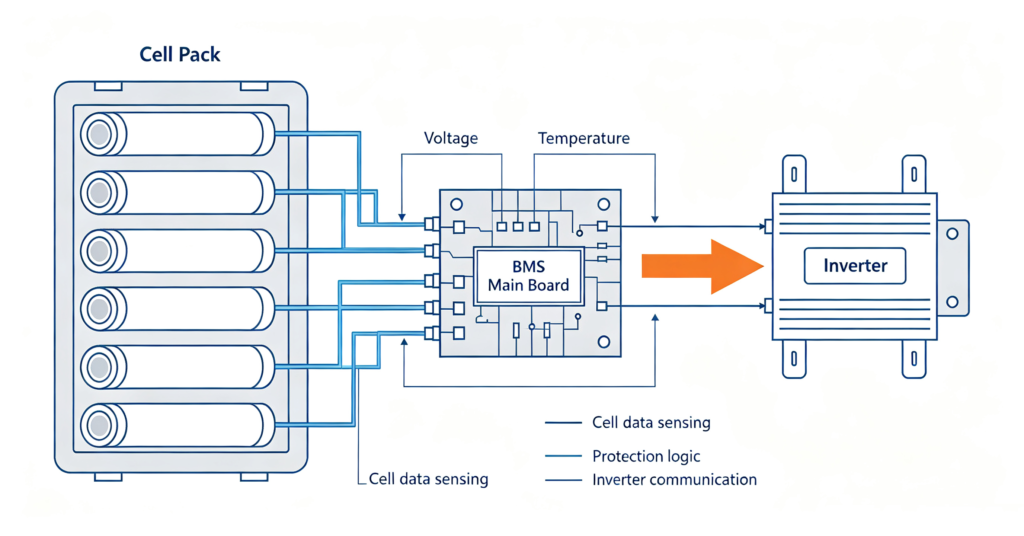
A BMS (Battery Management System) is the control layer of a lithium battery pack. It measures every cell’s voltage and temperature, balances cells so they age evenly, and cuts off charge or discharge if anything goes unsafe — protecting both the pack and whatever it powers.
Think of a lithium battery BMS as the pack’s brain and immune system in one. Cells in a pack drift apart over time; without a BMS, the weakest cell fails first and can take the pack with it. The BMS keeps cells balanced, watches for over-voltage, under-voltage, over-current, and over-temperature, and reports state of charge to the inverter. Choose it by cell count (series), pack voltage, and continuous current — not by price alone.
What a BMS actually does
Four jobs matter most:
- Monitor. Reads per-cell voltage and temperature many times per second.
- Balance. Moves charge from stronger cells to weaker ones so capacity stays usable.
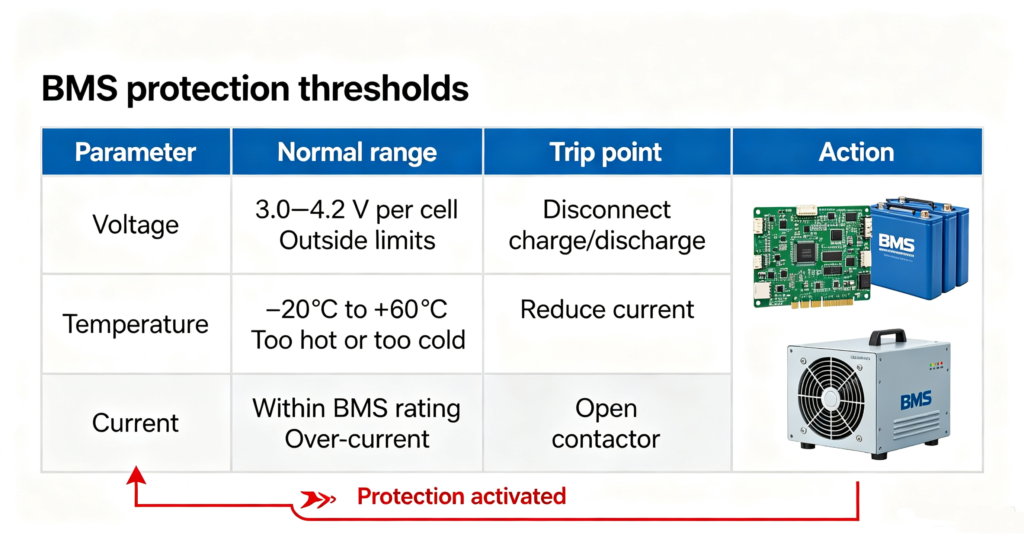
- Protect. Opens the contactor on over/under-voltage, over-current, or over-temperature.
- Communicate. Sends state of charge and faults to the inverter via CAN or RS485.
Core components
| Component | Function | Buyer’s focus |
|---|---|---|
| Sense board / sense wiring | Reads per-string voltage & temperature | Channels = string count; reliable connectors |
| Control board | Computation, protection, balancing decisions | Balancing type (passive / active) |
| Contactor / switch | Cuts charge/discharge on fault | Current rating > peak |
| Communication port | CAN / RS485 to inverter | Protocol must match inverter |
BMS types by voltage class
Low-voltage BMS serves 12V/24V/48V packs (common in residential and DIY); high-voltage BMS serves 100V+ stacks in C&I and utility. The selection logic is the same — match series count, voltage, and current — only the numbers scale. For a 48V LiFePO4 pack, see the LiFePO4 BMS Selection Guide.
How to choose a BMS
- Count series (S). A 16S LiFePO4 string rests near 51.2V; the BMS must match cell count exactly.
- Set voltage. Continuous and peak pack voltage must sit inside BMS limits.
- Set current. Continuous and peak current must exceed the inverter’s max draw, including motor surge.
- Match protocol. CAN or RS485 must match the inverter brand for closed-loop control.
- Pick balancing. Passive is cheaper and fine for most; active suits large banks that cycle hard.
For the “what does BMS mean” definition angle, the BMS meaning guide leads with the acronym and AI-overview block.
Why the BMS is not optional
Lithium cells store a lot of energy in a small space. Without a BMS, one cell drifting out of range can overheat while the pack reports “fine.” The BMS is the difference between a safe battery and a fire risk — which is why cell-level certificates alone do not cover a pack; the BMS and enclosure do.
State of charge accuracy
The BMS calculates state of charge from voltage, current, and coulomb counting. A good lithium battery BMS keeps that number honest so the inverter and the app agree; a poor one drifts, and the user sees half full when the pack is nearly empty. Accuracy matters because the inverter throttles on it – a wrong reading either cuts power early or over-discharges cells. Ask the supplier how the BMS handles coulomb counting and zero-calibration.
Balancing in practice: when it matters
Cells drift as they age and as temperature varies across the pack. Passive balancing slowly trims the strong ones; over a year of daily cycling, that keeps usable capacity from shrinking. Active balancing does it faster and with less loss, which pays in large banks that cycle hard. For a typical home pack, passive is enough; the cost of active rarely returns on a small bank. The LiFePO4 BMS guide frames the trade for 48V packs.
Communication: CAN vs RS485, deeper
CAN carries more data faster and is common in closed-loop systems where the inverter reads cell faults live; RS485 is simpler and widely supported. Either works if the inverter brand matches. The risk is not the wire but the register map – two RS485 devices that speak different maps will not talk. Confirm the map, not just the protocol name, before ordering.
Sizing the BMS to the inverter
A worked example: a 5 kW inverter on a 51.2V pack draws about 98 A continuous and more on motor start. Size the BMS continuous rating above 98 A and peak above the inverter peak – not at average. Undersize and it trips exactly when load is highest. This is the single most common BMS mistake, and the easiest to avoid by reading the inverter nameplate first.
Q. What does a BMS do in a lithium battery?
It monitors each cell’s voltage and temperature, balances cells so they age evenly, and disconnects the pack if voltage, current, or temperature goes unsafe. It also reports state of charge to the inverter.
Q. Can I use a lithium battery without a BMS?
Not safely. A bare cell stack with no BMS can drift, over-discharge, or overheat with no protection. Every leekooenergy pack ships with a matched BMS; DIY builds must add one sized to the cell count and current.
Q. What is the difference between active and passive balancing?
Passive balancing bleeds excess energy from stronger cells as heat — simple and cheap, fine for most packs. Active balancing moves charge between cells — more efficient, used in large banks that cycle hard and cannot afford the loss.
Q. How do I match a BMS to my inverter?
Match the communication protocol (CAN or RS485) and the brand’s register map. Closed-loop control needs the match; open-loop works without it but reports less. Confirm compatibility in writing before ordering.
Q. Is a BMS the same as a battery protector?
A basic protector only cuts off on faults; a full BMS also balances cells and communicates state of charge. For LiFePO4 packs, the balancing and communication functions are what keep capacity and safety over years.
Next step: size the BMS by cell count and current
Write down your cell count (S), pack voltage, and peak current, then match a BMS with headroom. A correct BMS is the cheapest insurance on a lithium pack.
- See the leekooenergy BMS product page (high and low voltage families)
- use #32 choose to check string count × current
- ask the supplier for proof of compatibility with your inverter brand