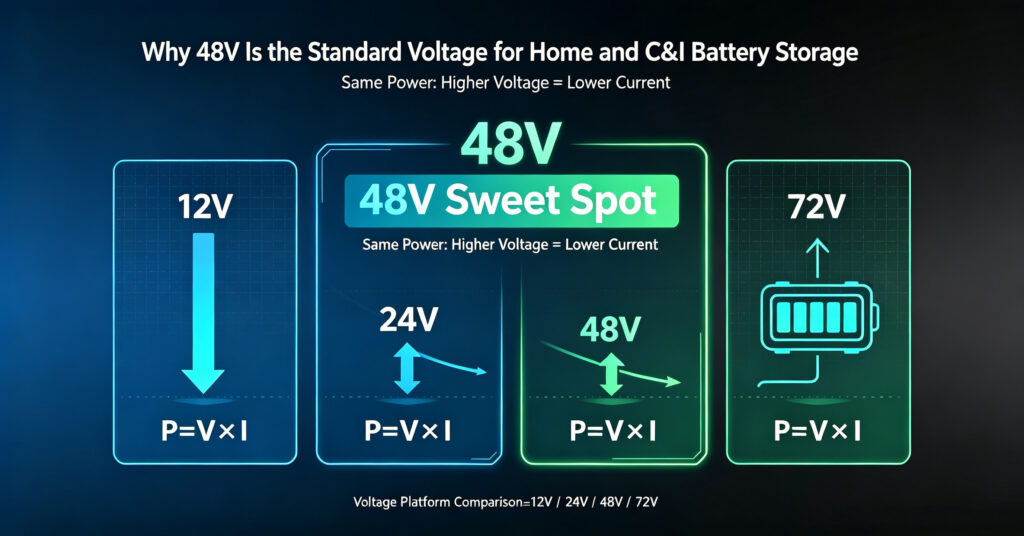
A 48V battery is the default storage voltage because it sits in the sweet spot: high enough that current stays low (thin, cheap cables, less heat loss), but below the ~60V threshold where extra electrical-safety rules kick in. A 16-cell LiFePO4 string rests near 51.2V and is sold as “48V class.” For home and small C&I storage, 48V beats 12V/24V on efficiency and 72V/96V on safety and cost. It is the platform most inverters and BMS speak.
Voltage choice looks like a detail, but it decides cable size, inverter options, and compliance cost. 48V won because it optimizes all three at once.
What “48V” actually means
LiFePO4 cells are ~3.2V nominal. A 16S string is 16 × 3.2V ≈ 51.2V resting and ~58.4V fully charged. The market calls this “48V class” — the nominal label, not the resting voltage. So “48V” and “51.2V” LiFePO4 are the same 16-cell system; count cells, not the marketing number. The 48V vs 51.2V guide resolves that confusion directly.
Why 48V beat 12V and 24V
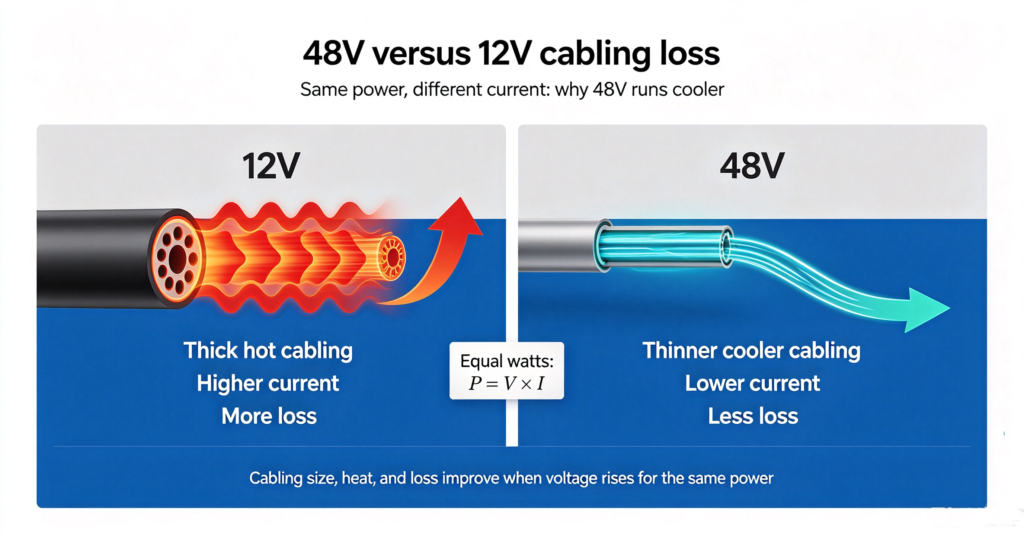
At the same power, current falls as voltage rises. A 5 kW load draws ~400 A at 12V but only ~100 A at 48V — thinner cables, smaller breakers, less heat. Below 48V, cable and loss cost dominate for anything but tiny banks. That is why 12V/24V survive only in RVs and small off-grid, not whole-home storage.
Why 48V beat 72V and 96V
Above ~60V, electrical-safety rules tighten and components cost more; the efficiency gain over 48V is small for home-scale power. Large C&I and utility stacks do go higher, but for residential and small commercial, 48V keeps compliance and BOM cost down while still delivering low current.
48V vs 12V / 24V / 72V at a glance
| Platform | Approx. current | Cabling / loss | Compliance cost | Typical use |
|---|---|---|---|---|
| 12V | ~400 A | Thick, hot | Low | RV / small vehicle |
| 24V | ~200 A | Moderate | Low | Small off-grid |
| 48V | ~100 A | Thin, cool | Moderate | Home / small C&I |
| 72V+ | <70 A | Thin | High | Large C&I / grid-scale |
Spec quick table (48V class)
| Spec | Approx. energy | Fits |
|---|---|---|
| 48V 100Ah | ~5 kWh | Small home / single circuit |
| 48V 200Ah | ~10 kWh | Standard home storage |
| 48V rack build | Tens–hundreds kWh | C&I cabinet |
Compatibility with inverters
Most residential and small C&I hybrid inverters are built for a 48V battery window (roughly 44–58V). Match the inverter’s operating range to the pack’s full-charge voltage, and confirm the BMS protocol. The LiFePO4 BMS guide covers the protocol match.
Sizing note
Capacity (kWh) follows your load and backup hours, not the voltage. 48V just decides how efficiently that capacity moves. Start from the sizing worksheet, then pick a 48V pack that meets it.
Common mistakes
Buyers worry that “48V” and “51.2V” are different batteries (they are the same 16S class), or they size a 12V bank for a whole home and drown in cable cost. Confirm cell count, match the inverter window, and let 48V carry the current efficiently.
48V in residential vs C&I
In homes, 48V carries a wall-mounted pack efficiently with thin cables and simple compliance. In C&I, the same 48V class scales into racks and cabinets where current stays manageable per module. Above ~60V the rules tighten, so most small-to-mid C&I stays at 48V and only large sites go higher. The platform choice follows from scale, not fashion.
Cable sizing worked example
A 48V pack at 5 kW draws about 100 A. At 12V the same load draws about 400 A – four times the cable and breaker. The saving in copper and loss is why 48V won residential storage; the 12V bank that “seems simpler” becomes a cable nightmare at home power. Size the cable to the 48V current, not the old 12V habit.
48V rack vs wall-mounted
Wall-mounted 48V suits homes and small loads; rack or cabinet 48V suits C&I where you stack modules as load grows. Both use the same 16S cells; the difference is enclosure and cooling. Pick the form by space and expansion plan, and confirm the inverter window matches either way.
Future-proofing a 48V system
Choose a 48V inverter and BMS with headroom for the final planned size, so adding modules later is additive, not a rebuild. Confirm the system supports parallel units or an external breaker before committing. Many buyers start at 10 kWh and add a second after a year as real usage shows.
48V and the inverter market
Most residential and small C&I hybrid inverters are built for a 48V battery window, roughly 44 to 58V, because that is the storage sweet spot. Picking 48V means the widest inverter choice and the simplest BMS pairing. Going to 72V or 96V shrinks that choice and raises compliance cost for little gain at home scale. The platform follows the market, which is why 48V won.
Common 48V misconceptions
- “48V and 51.2V are different batteries.” They are the same 16S LiFePO4 class.
- “12V is simpler for home.” At home power it needs huge cables and loses heat.
- “Higher voltage is always better.” Above 60V the safety rules and cost rise for small gain.
Spec deep dive: 100Ah vs 200Ah
A 48V 100Ah pack is about 5 kWh usable; a 200Ah is about 10 kWh. The 200Ah covers a standard home evening and one backup night; the 100Ah suits a single circuit or small cabin. Both use the same 16S cells – the difference is how many parallel groups. Pick by your load and backup hours, then confirm the inverter window.
Buying checklist
Decide kWh from load and backup hours, pick a 48V pack that meets it, and confirm the inverter’s operating window and BMS protocol. Match cell count, not the label. A correct 48V choice is mostly counting cells and reading the inverter nameplate – the rest follows.
Parallel expansion and busbar design
A 48V system rarely stays one battery. To add capacity you parallel identical modules, and the way you tie them together decides whether cells stay balanced. Use a symmetrical busbar or bus cable layout so every module has equal path length and resistance to the inverter; unequal paths let one module carry more current and age faster. Keep paralleled modules the same model, same age, and same firmware, and fuse each branch at the battery so a single fault does not drag the whole string down.
The practical ceiling is set by your busbar rating and the inverter’s max current, not by the modules alone. Size the bus for the full parallel current plus headroom, and document the layout so a later addition keeps the symmetry.
Grounding, isolation, and bonding
48V sits in the “touch-safe but not harmless” band, and a rack of them deserves real grounding discipline. Bond the enclosures to earth, isolate the DC bus from AC where the inverter requires it, and keep the battery room’s bonding continuous so a fault has a low-resistance path to trip protection instead of arcing. Many field nuisance trips and communication glitches trace back to a floating enclosure or a shared neutral done wrong.
For a buyer, ask the supplier for the grounding scheme and the isolation rating between DC and the rest of the system, and match it to your site’s earthing type. This is the kind of detail that separates a clean install from a noisy one.
SOC accuracy and battery monitoring
State of charge on a 48V lithium bank is only as good as the monitor and the BMS model behind it. A quality BMS tracks coulomb count, voltage, and temperature together and self-corrects at full charge; a cheap one drifts, and “20% left” becomes “0% on the next load step.” For a C&I or off-grid user, SOC accuracy is an uptime issue: a wrong reading either strands a load or wastes capacity you were afraid to use.
Confirm the BMS’s SOC method and how often it recalibrates, and pair it with a proper battery monitor if the inverter does not read the BMS directly. Accurate SOC is the difference between trusting the bank and watching the gauge.
Q. Is a 48V battery the same as 51.2V?
For LiFePO4, yes — both describe a 16-cell string (16 × 3.2V ≈ 51.2V resting), sold as “48V class.” Count cells, not the label; the two numbers are the same system at different points.
Q. Why not use 12V for home storage?
At home power levels, 12V needs very thick cables and loses more to heat. 48V cuts current to a quarter, shrinking cable and breaker cost. 12V stays for RVs and small off-grid.
Q. Is 48V safe compared to higher voltages?
48V sits below the ~60V threshold where stricter electrical-safety rules apply, while still keeping current low. That balance is exactly why it became the residential and small C&I standard.
Q. How many kWh is a 48V 200Ah battery?
Roughly 10 kWh usable before depth-of-discharge reserve — a standard wall-mounted home unit. Exact usable capacity depends on the planned depth of discharge in your setup.
Q. Will a 48V battery work with my inverter?
If the inverter is built for a 48V window (about 44–58V) and the BMS protocol matches, yes. Confirm the operating range and protocol with the supplier before ordering.
Next step: back-calculate your 48V config from capacity
Decide kWh from load and backup hours, then pick a 48V pack (100Ah / 200Ah / rack) that meets it and matches your inverter window.
- See the leekooenergy 48V / 51.2V product page (Rack / Wall-mount)
- use #9 Battery Capacity Calculation Table to size kWh
- Read #12 48V vs 51.2V to clarify the naming