A 51.2V 200Ah LiFePO4 ESS for home solar energy storage UPS — and its 300Ah and 600Ah siblings — give a residential buyer a clean capacity ladder inside a single 51.2 V nominal voltage class. The 51.2V 200Ah pack delivers about 10 kWh of usable energy in a slim wall-mount case; the same 16S cell architecture scaled up gives the 51.2V 300Ah at roughly 15 kWh and the 51.2V 600Ah at roughly 30 kWh. All three share the same cell stack, the same BMS handshake and the same modular expansion logic — they differ in capacity, dimensions, weight and price tier. The right one for a given home is set by the evening load, the available wall or floor footprint, and the budget for the next ten years of cycling. The table below compares the three directly; the rest of the guide maps them onto the buyers who usually pick each.
Residential solar storage has consolidated around 51.2 V nominal as the standard low-voltage rack because that voltage lines up with a 16S LiFePO4 cell stack, a mature hybrid inverter class and a wide third-party BMS market. Within that standard, three capacities cover almost every residential installation from a small flat to a large all-electric home. Picking between them is mostly a sizing question — covered in detail in #09 home battery sizing — and this Hub exists to put the three SKU options side by side so a buyer can quote or request a sample without having to dig through three separate spec sheets.
The three SKUs at a glance
| Spec | 51.2V 200Ah (10 kWh) | 51.2V 300Ah (15 kWh) | 51.2V 600Ah (30 kWh) |
|---|---|---|---|
| Nominal energy | ≈10 kWh | ≈15 kWh | ≈30 kWh |
| Usable (90% DoD) | ≈9 kWh | ≈13.5 kWh | ≈27 kWh |
| Cell stack | 16S LiFePO4 prismatic | 16S LiFePO4 prismatic | 16S LiFePO4 prismatic (parallel strings) |
| Form factor | Wall-mount (slim) | Rack-mount (single module) | Stackable / rack-mount (multi-module) |
| Typical dimensions (W×H×D) | ~445 × 600 × 160 mm | ~445 × 700 × 200 mm | ~445 × 1,200 × 220 mm |
| Approx. weight | ~95 kg | ~140 kg | ~280 kg |
| Continuous discharge | 100 A | 150 A | 300 A |
| Cycle life (80% DoD, 25 °C) | ≥6,000 cycles | ≥6,000 cycles | ≥6,000 cycles |
| Operating temp (charge) | 0 °C – 45 °C | 0 °C – 45 °C | 0 °C – 45 °C |
| Communications | CAN / RS485 | CAN / RS485 | CAN / RS485 |
| Certifications | IEC 62619 / UN38.3 / CE | IEC 62619 / UN38.3 / CE | IEC 62619 / UN38.3 / CE |
| Warranty (typical) | 5 years or 6,000 cycles | 5 years or 6,000 cycles | 5 years or 6,000 cycles |
| Best fit | 1–2 bedroom flats, partial backup | 3–4 bedroom homes, full evening backup | Large all-electric homes, EV charging, off-grid |
| Price tier (relative) | Entry | Standard | Premium |
Specifications above are typical for residential-grade LiFePO4 packs in this capacity range. Exact dimensions, weight, discharge current and certifications vary by manufacturer and model — confirm on the product data sheet and request a current test report before purchase.
Who picks the 200Ah / 10 kWh unit
The 51.2V 200Ah wall-mount is the right answer for 1–2 bedroom flats, small homes with modest evening loads, and any installation where wall space is at a premium and floor space is non-existent. At roughly 9 kWh usable it covers an evening of fridge, lighting, Wi-Fi and one round of cooking for a frugal household, with a buffer for one cloudy day. It pairs naturally with single-phase 5–8 kW hybrid inverters and is the most common residential upgrade in markets where net-metering compensation has been reduced. The 200Ah form is also the easiest to retrofit into existing PV systems because its slim wall-mount case fits on a garage wall next to the existing inverter without rewiring the DC side. The full retrofit logic is in #10 lightweight solar batteries.
Who picks the 300Ah / 15 kWh unit
The 51.2V 300Ah rack-mount is the workhorse of the residential line and the SKU most system integrators stock as default. At 13.5 kWh usable it covers a full evening of a 3–4 bedroom home, including cooking, laundry and home-office loads, with headroom for one cloudy day. It pairs with 8–12 kW hybrid inverters and is the format most new-build residential installations have standardised on because the rack case accepts a second module in parallel without rewiring. For a buyer comparing brands at the same capacity tier, the rack-mount format usually wins on expandability, cable management and serviceability — a single 300Ah module can be swapped out by an installer without taking the bank offline.
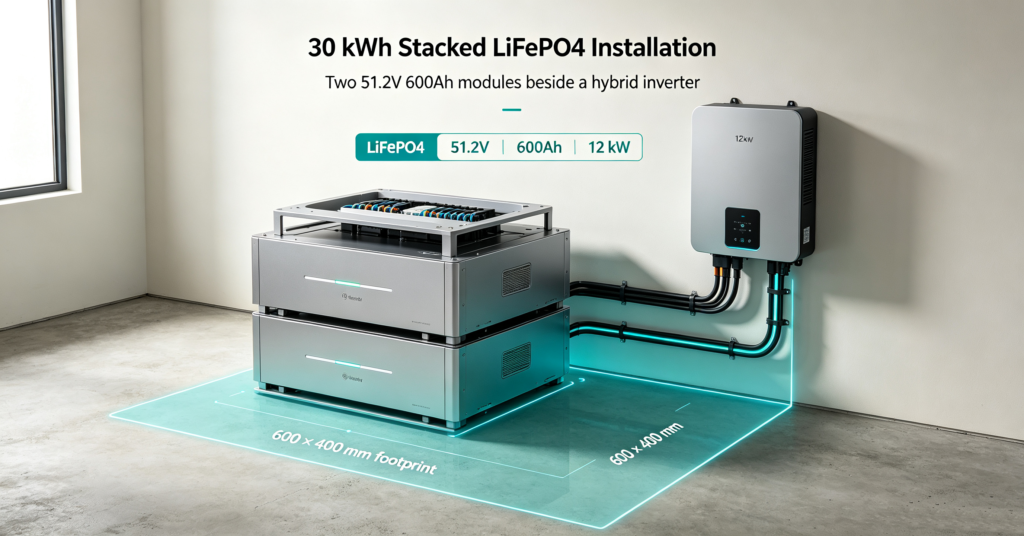
Who picks the 600Ah / 30 kWh unit
The 51.2V 600Ah stackable is the residential line at its largest. At 27 kWh usable it covers a large all-electric home including induction cooking, heat-pump HVAC and overnight EV charging on a single charge cycle, or a multi-day off-grid cabin with appropriate load-shedding. It pairs with 12 kW+ hybrid inverters and the multi-module construction means a single module can be serviced while the rest of the bank remains online. The 600Ah is also the natural bridge between residential and light-commercial — a small shop or a farm pump house that runs the same packs at the same voltage but draws higher continuous current during the day. The off-grid sizing logic for that scale is in #23 off-grid solar system batteries.
How to choose between them in three questions
- What does your evening load look like? Under 9 kWh → 200Ah. Between 9 and 14 kWh → 300Ah. Over 14 kWh, or you want to run induction cooking plus EV charging on the bank → 600Ah. The full sizing math is in #09 home battery sizing.
- Where will the bank physically live? Wall space only and no floor depth → 200Ah wall-mount. A garage shelf or utility-room floor → 300Ah rack. A dedicated plant room or outdoor-rated enclosure → 600Ah stackable.
- Do you expect to expand the bank within five years? Yes → start at 200Ah or 300Ah and add a second module of the same SKU. No → size to current load and buy the SKU that fits it without overspec.
Those three questions put the buyer on the right SKU roughly nine times out of ten. The tenth case is a buyer who is choosing on price per kWh rather than on fit — for that case, the larger packs usually win on a dollar-per-kWh basis but only if the inverter and the wiring can take the higher continuous current. A buyer who chooses the 600Ah to get the price break and then runs it on a 5 kW inverter will be disappointed, because the inverter becomes the bottleneck long before the battery does.
What to ask a supplier before you order
- Cycle life at what DoD and what temperature? A “6,000 cycles” claim is meaningless without the depth-of-discharge and the ambient temperature that anchor it. Look for 80% DoD at 25 °C, and a derating curve for hotter installs.
- What is the actual BMS topology? Single-master, master-slave or distributed. For multi-module banks the distributed topology is the one that survives a single-module failure.
- Which inverter brands have a validated handshake? The CAN / RS485 protocol is standard in name only; the register map is proprietary. Ask for a validated inverter list rather than assuming compatibility.
- What is the warranty claim process and turnaround? A 5-year warranty that takes 90 days to honour is not a 5-year warranty. Ask for the average claim turnaround in writing.
- What is the shipping weight and what certifications does the carrier require? A 280 kg 600Ah module is a forklift-load at the receiving end; UN38.3 plus the carrier’s specific dangerous-goods clearance is what gets it through customs.
For a buyer comparing two suppliers at the same capacity tier, those five questions separate the marketing-grade spec sheet from the engineering-grade one. The full procurement checklist is in #21 evaluating battery manufacturers.
Q. Is a 51.2V 200Ah battery enough to power a house?
For a 1–2 bedroom home with frugal evening loads (fridge, lights, Wi-Fi, one round of cooking) yes — about 9 kWh usable covers an evening with a buffer for one cloudy day. For a 3–4 bedroom all-electric home, no — that home usually wants the 300Ah or 600Ah SKU. The sizing math is in #09 home battery sizing.
Q. Can I parallel a 51.2V 200Ah and a 51.2V 300Ah?
Technically yes on the same BMS, but it is not recommended. Different capacities in parallel force the smaller pack into deeper cycles than it was specced for and shorten its life. For expansion, add another module of the same SKU instead.
Q. What inverter works with a 51.2V LiFePO4 battery?
Any hybrid inverter that supports 48 V nominal low-voltage LiFePO4 — most residential hybrids from the major brands do. Confirm the inverter menu offers an LFP chemistry mode and the right cell-count (16S for 51.2 V nominal); the validated inverter list comes from the battery manufacturer, not the inverter one.
Q. How long does a 51.2V 300Ah battery last?
At one cycle per day, ≥6,000 cycles to 80% of nameplate capacity means roughly 16 years of service before the pack drops to 80% of its original 15 kWh. Most residential banks never reach that — they are usually upgraded or repurposed for grid services within 10–12 years.
Q. What is the price difference between 200Ah, 300Ah and 600Ah?
Price scales sub-linearly with capacity — the 600Ah pack is roughly 2.3–2.6× the price of the 200Ah, not 3×, because the fixed costs (BMS, enclosure, certifications) are amortised over more kWh. Confirm current pricing with a quotation; the table above is for SKU comparison, not for price publication.
Next step: get a quotation sized to your evening load
The table above puts the three SKUs side by side; the next step is a quotation sized to your actual evening load, your wall space and your inverter. Send the load list and the available footprint, and we will return a sized proposal with the cycle-life and certification documents attached.
- Work the capacity math with #09 home battery sizing
- Confirm the voltage class in #12 48V vs 51.2V
- Compare the full residential line in #35 48V lithium batteries explained
- Request a quotation for the 200Ah / 300Ah / 600Ah residential LiFePO4 line