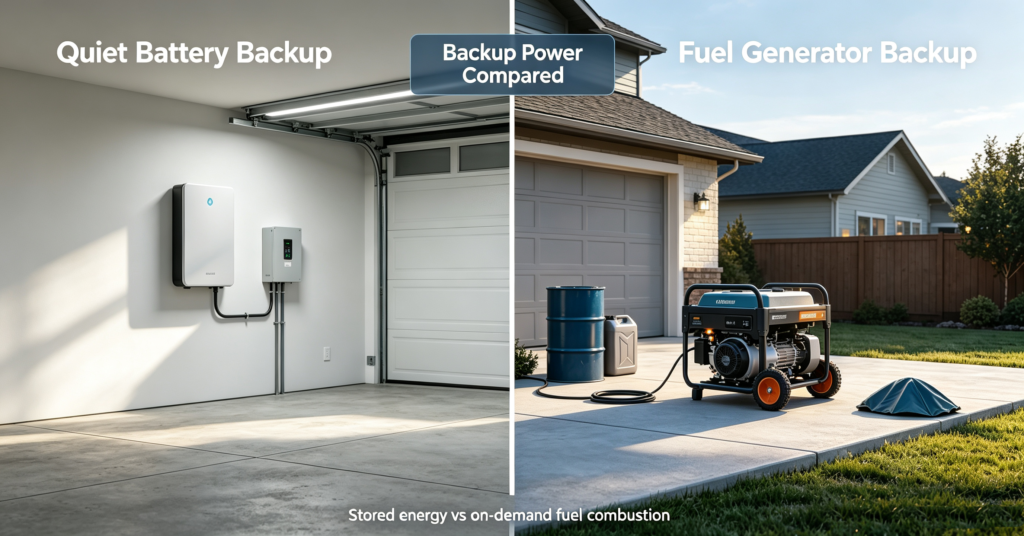
The shortest answer: choose a battery when outages are short, silence and indoor safety matter, and you want zero-fuel daily side benefits like solar self-consumption; choose a generator when outages are long or unpredictable and runtime matters more than anything else — and choose a generator with battery storage when you need both instant, silent response and multi-day endurance. A battery covers hours with no fuel and no noise; a generator covers days with fuel logistics and maintenance; the hybrid covers both. Most households that grid-compare these options are really choosing between a battery and a hybrid, not between a battery and a generator alone.
Backup power is one of the few home decisions where the wrong choice is obvious within the first outage. A battery that runs out during a twelve-hour event, a generator that will not start because the fuel went stale, a system that keeps the fridge but not the well pump — each failure traces back to a decision made before the equipment was bought. This guide compares the two technologies on the criteria that actually show up during an outage, then explains why pairing a generator with battery storage is increasingly the default answer for sites that cannot tolerate either limitation.
What each option actually is
A home backup battery is a stationary lithium battery — today almost always LiFePO4 — connected to the house electrical system through an inverter. When grid power fails, the inverter switches the backed-up circuits to the battery, typically fast enough that computers stay on. The battery discharges silently, produces no exhaust, and can be recharged from the grid or from solar panels. Its limitation is arithmetic: a finite amount of stored energy that depletes at the rate the house consumes it. The capacity question — how much battery a household actually needs — is the sizing method covered in #09 how to size a home battery.
A backup generator is an engine-driven machine — petrol, diesel, LPG or natural gas — that converts fuel into electricity for as long as the fuel lasts. It handles multi-day outages without breaking a sweat, can be sized to run an entire house including heavy motor loads, and in fixed-installation form starts automatically on grid loss. Its limitations are everything an engine implies: noise, exhaust that must stay outdoors, fuel that must be stored and refreshed, oil and filter service, and mechanical wear. Generators also deliver power through a transfer switch, and the switchover time of portable and many standby units is measured in seconds rather than milliseconds.
Comparison table
| Criterion | Home battery | Generator |
|---|---|---|
| Response to outage | Milliseconds — electronics stay on | Seconds to minutes; portable units need manual start |
| Noise | Silent | Engine noise; sound-rated enclosures help |
| Exhaust / indoor safety | None — indoor-safe | Exhaust gas; outdoor installation and clearances mandatory |
| Runtime ceiling | Hours, set by stored energy | Days, set by fuel supply |
| Fuel logistics | None | Purchase, storage, rotation, stale-fuel risk |
| Maintenance | Essentially none; software updates | Oil, filters, spark plugs, periodic load runs |
| Cost structure | Higher upfront, near-zero running cost | Lower entry price; fuel and servicing cost per hour run |
| Service life | Calendar-and-cycle limited; typically a decade-plus | Engine-hour limited; servicing extends life |
| Daily side benefit | Solar self-consumption, tariff shifting | None — sits idle between outages |
| Best for | Short outages, solar households, noise-sensitive sites | Long or unpredictable outages, heavy whole-house loads |
Where the battery wins
The battery’s advantages concentrate in how it behaves between and during outages. Because it is silent and exhaust-free, it lives indoors — on a wall or in a utility room — with no pad, no clearances and no fuel store. Because it switches in milliseconds, it protects computers, network gear and anything else that dislikes a power blip. And because it is a battery, it earns its keep on days with no outage at all: paired with solar it stores afternoon production for evening use, and on time-of-use tariffs it can buy cheap overnight energy. The economics of that daily work are covered in #27 solar self-consumption, and the case for installing a battery without any solar at all is made in #04 home battery backup without solar.
The battery’s weakness is energy density per dollar of capacity. Covering a modest essential-load list for a day is affordable; covering a whole house with cooking, heating and electric vehicles for three days is a battery budget that few households justify on backup value alone. Batteries also age — both by cycling and by calendar — so a backup-only battery spends its life slowly ageing on the wall, which is exactly why the daily side benefits matter to the purchase case.
Where the generator wins
The generator’s advantage is runtime without arithmetic. As long as fuel arrives, it runs — which is why farms, rural properties, medical-adjacent households and regions with multi-day storm outages still standardise on them. Generators also handle large motor loads well: well pumps, compressors, air conditioning start-up surges that can trip a battery inverter sized only for essential circuits. The entry price of portable units is far below any whole-house battery, and a properly serviced standby generator outlives several sets of batteries.
The weaknesses are the mirror image. Fuel is logistics: cans or tanks, refresh cycles, stale fuel after long idle periods, and queues at petrol stations precisely when a storm has arrived. Engines need exercise — a generator that sits unrun for a year is a generator that may not start when needed. Noise and exhaust constrain placement and neighbour relations. And a generator produces nothing of value on the three hundred-plus days a year when the grid behaves.
The hybrid answer: a generator with battery storage
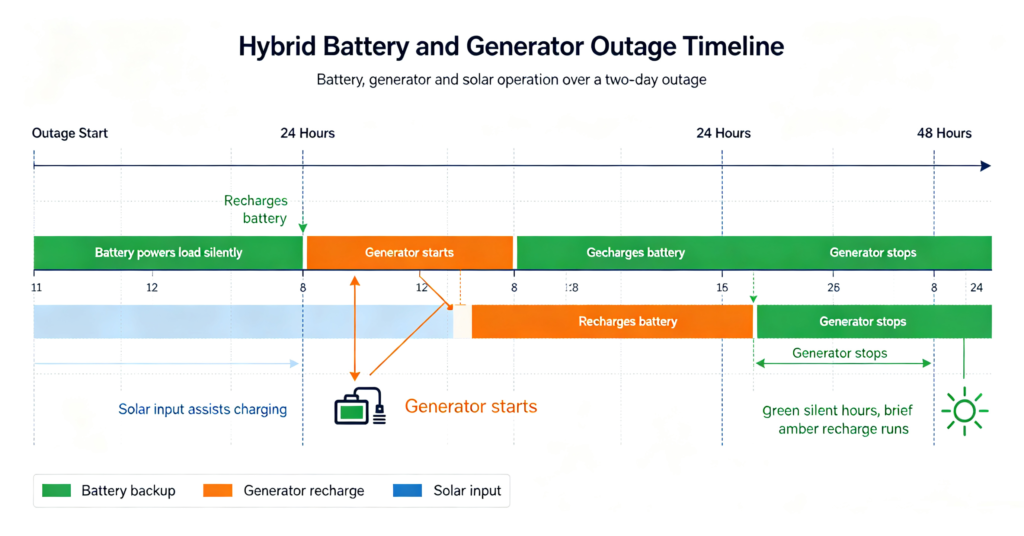
The two technologies fail in opposite directions, which is why pairing them works so well. In a hybrid backup scheme, the battery handles the outage start: instant switchover, silent hours, no fuel burned for a short event that ends after two hours anyway. If the outage persists and the battery approaches its reserve, the generator takes over: it picks up the house load and recharges the battery, then shuts down again once the battery is full — repeating in quiet cycles instead of running continuously. The result is fuel saved, engine hours reduced, noise limited to periodic runs, and the household experiencing a seamless supply throughout.
This duty pattern — short bursts of generation spaced by silent battery hours — also suits solar. A site with photovoltaics charges the battery by day, the generator only tops up during extended bad weather, and the fuel consumption of a generator with battery storage drops to a fraction of a continuously running unit. For off-grid properties the same logic is the whole design basis, which is why the off-grid configuration guide treats the generator as a planned component rather than a fallback; see #23 off-grid solar systems with batteries.
Designing a hybrid has one requirement worth flagging early: the coordination has to be engineered. The inverter must accept the generator as a charge source — with the generator’s output quality, earthing arrangement and control signalling compatible with the battery system. Not every battery inverter works with every generator, and the compatibility question is the same class of problem as battery-inverter matching, which is covered in #17 choosing a storage inverter. Verify the supported generator-charging configuration before buying either unit.
How to decide: a five-question checklist
- How long are your realistic outages? Hours favours a battery; a day or more favours a generator or hybrid. Check your utility’s outage history, not your worst memory.
- Which loads must stay on? A short essential-load list (fridge, network, lighting, medical device) fits a modest battery; whole-house coverage including motors changes the calculus toward generators.
- Can you store and handle fuel responsibly? If fuel logistics are unattractive or prohibited on the site, the battery or hybrid-with-minimal-fuel path is the practical one.
- Do you have solar or plan it? Solar plus battery is the natural pair, and it strengthens the hybrid case further by reducing generator run-hours.
- What does your daily energy tariff look like? If time-of-use pricing exists, a battery earns between outages and the backup function rides on hardware that already pays for itself.
Q.Can a battery replace a generator entirely?
For short outages, yes — a correctly sized battery silently covers essential loads through events measured in hours. For multi-day outages or whole-house motor loads, a battery alone becomes expensive per hour of coverage, which is why long-endurance sites either keep a generator or move to a hybrid of battery plus generator.
Q.How long will a home battery last during an outage?
It depends entirely on what is connected. An essential-load panel with refrigeration, lighting, networking and device charging draws far less than whole-house air conditioning or electric heating, so the same battery can last from several hours to a day or more. Sizing the backed-up load list before buying the battery is the step that decides this; the method is in the sizing guide linked above.
Q.Is a generator with battery storage more expensive than either alone?
The upfront cost of the hybrid is higher than either single solution, but the running economics can be better than a generator alone: fuel is burned only during periodic recharge runs rather than continuously, and the battery provides the daily solar or tariff benefits that a standalone generator never can. Compare on total cost over the expected outage profile, not on the invoice alone.
Q.Do I need permits for a battery or a generator?
Both usually involve some approval, but of different kinds. Battery installations are typically governed by electrical codes and, for lithium systems, by mounting, ventilation and fire-code provisions. Generators add fuel storage, exhaust clearance and noise rules, and fixed standby units need their own permits. Requirements vary by jurisdiction, so confirm with the local authority and installer before ordering either.
Q.Which is more reliable after years of sitting idle?
A lithium battery has no engine to seize and typically starts its protection electronics every time, though it ages on the calendar whether used or not. A generator needs scheduled exercise runs and fuel maintenance to remain trustworthy. Whichever you choose, the reliability difference is largely a maintenance-habit difference, and a monitored battery plus an exercised generator is the most dependable combination.
Next step: turn the choice into a load list
Whichever direction you lean, the next step is the same: write down the loads that must stay on, their power draw and how long they must run. That single list prices every option.
- Size the loads with #09 how to size a home battery
- Check the no-solar battery case in #04 backup without solar
- See outage behaviour in #26 solar battery backup for outages
- Plan the off-grid version with #23 off-grid solar systems
- Ask leekooenergy for battery and hybrid backup configurations matched to your load list